'Mexico made its biggest leap in peacefulness in a decade in 2025, yet more Mexicans feel unsafe than they did the year before', writes Kaylee Janysek, IEP Research Assistant
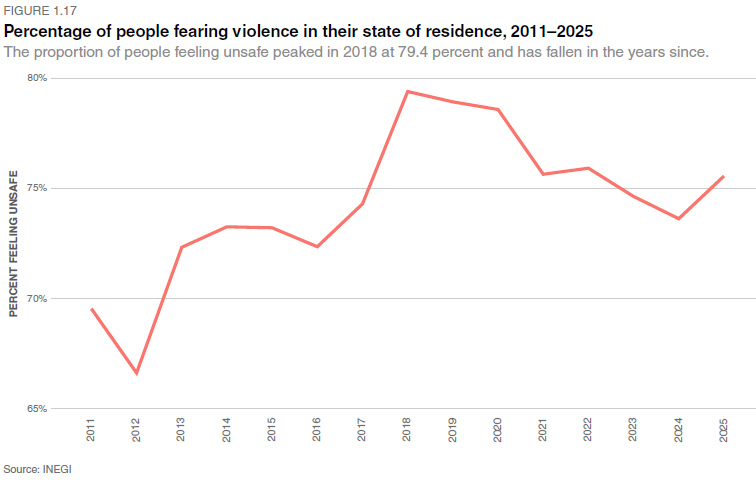
In 2025, Mexico recorded its largest improvement in peacefulness in at least a decade. However, as we show in the latest edition of the Mexico Peace Index (MPI), last year the country’s fear of violence indicator worsened for the first time in seven years, with perceptions of insecurity rising by two percentage points.
The share of citizens who consider their state unsafe climbed from 73.6 to 75.6 per cent, the first increase since the rate peaked in 2018 at 79.4 per cent.
Fear of violence is not shaped purely by the latest crime statistics or even personal exposure. It is influenced by memory, media, institutional trust, and proximity to high-profile events. In Mexico, that dynamic is especially acute. The MPI’s fear of violence indicator therefore captures something that crime statistics alone cannot: the accumulated psychological burden of living in a society where violence is widespread.
IEP’s work distinguishes between two forms of peace: Positive Peace and negative peace. Positive Peace refers to the things that a society should possess to build and sustain stability, justice and prosperity, comprising certain attitudes, institutions, and social structures. Negative peace, by contrast, refers to what a society should be free from – namely, violence and the fear of violence. This latter form of peace is what guides the Global Peace Index (GPI), as well as the Mexico Peace Index.
Based on this definition of peace, it is not enough to limit outward manifestations of violence; citizens also need to feel free from the threat of violence. Of course, the relationship between statistics on violence and perceptions of safety is a multifaceted one. Global survey data has revealed, for example, that across an array of domains with the potential to cause a person harm, including road accidents, severe weather, food and water risks, and workplace hazards, violence elicits the most disproportionate levels of worry relative to actual experience. IEP’s Safety Perceptions Index, which is based on survey data of citizens across more than 120 countries, finds that on average, people are six times more likely to worry about violent crime than to have experienced it first hand in the previous two years.
Last year, 24 of Mexico’s 32 states recorded increases in their fear of violence levels. The single most dramatic case is Sinaloa, where fear levels surged by more than 25 percentage points, from 54.9 to 80.5 per cent, following the eruption of an intra-cartel succession war in the state.
In Mexico, extreme levels of violence are often concentrated in certain states and even certain areas within states. But while violence concentrates geographically, fear does not. It can travel much further and faster than violence itself, especially in the age of social media. This is part of the reason survey data shows that Mexicans tend to feel safest in their immediate surroundings, with perceptions of unsafety increasing as the geographic scale expands. About four in ten regard their neighbourhood as unsafe, about six in ten regard their municipality as unsafe, and more than seven in ten regard their state as unsafe. As people assess places further from their immediate surroundings, perceptions of insecurity become increasingly shaped by national media coverage and high-profile incidents.
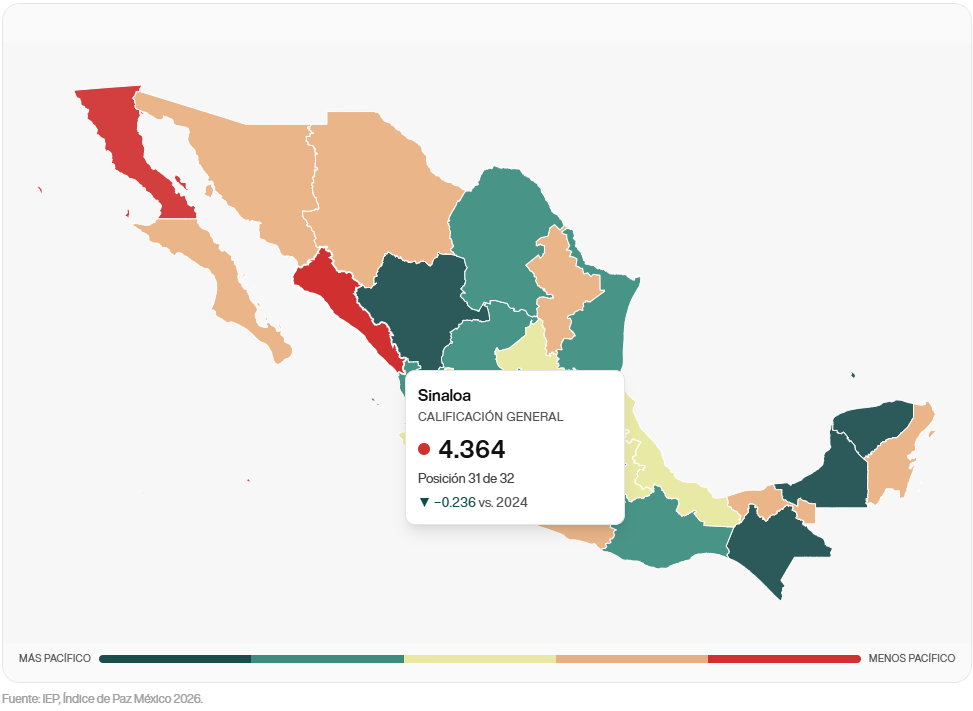
Even Yucatán, by far the most peaceful state in Mexico, saw fear rise by nine percentage points in a single year despite recording a decline in actual violence. However, fear is not irrational. In many cases, it is the most rational response available to people who have watched institutions fail them. Mexico’s deepest problem is not its homicide rate; it is the institutional infrastructure supposed to prevent homicide and respond to it when it occurs.
Only a fraction of reported crimes result in a criminal investigation, and fewer still lead to a conviction. When victims learn that reporting a crime is unlikely to produce justice, they stop reporting. When citizens see that cartels restructure rather than collapse, they stop trusting the statistics. The MPI finds that the country allocates just 0.5 per cent of its GDP to law enforcement and the justice system, well below the averages for both the OECD and Latin America.
Building peace in Mexico requires reducing violence as well as enhancing public confidence and perceptions of safety. These are complementary but distinct tasks. Reducing homicides requires disrupting criminal networks. Restoring perceptions of safety requires consistent institutional presence, visible reductions in the street-level crime people actually encounter, and the work of rebuilding trust in institutions that have historically fallen short. Actions like these can help convert statistical improvements into improved perceptions of security.
The state of Zacatecas illustrates the depth of the challenge. In 2025, the state recorded the country’s largest improvement in peacefulness for the third year in a row, with homicides nearly halving last year. However, these improvements come on the heels of several years of extreme levels of violence, particularly from 2020 to 2022. As a result, in 2025, 87.3 per cent of residents still considered their state unsafe, one of the highest rates in the country. The persistence of fear despite substantial reductions in outward violence highlights the long-term social and institutional effects of insecurity.
While Mexico is becoming safer by several objective measures, perceptions of safety often change more slowly than the conditions that shape them. Closing that gap will be essential to building lasting peace.
View Mexico Peace Index 2026 data, maps and download the report: https://indicedepazmexico.org/

Peace in Mexico improved by 5.1 per cent in 2025, the largest single-year gain ever, while the number of recorded homicides fell by approximately...
Explore how cartel fragmentation, the Sinaloa Cartel conflict and shifting CJNG dynamics are shaping violence, security and prospects for peace in...
Identificación y medición de los factores que impulsan la paz
Identifying and measuring the factors that drive peace