Explore how cartel fragmentation, the Sinaloa Cartel conflict and shifting CJNG dynamics are shaping violence, security and prospects for peace in Mexico following recent gains in the Mexico Peace Index.
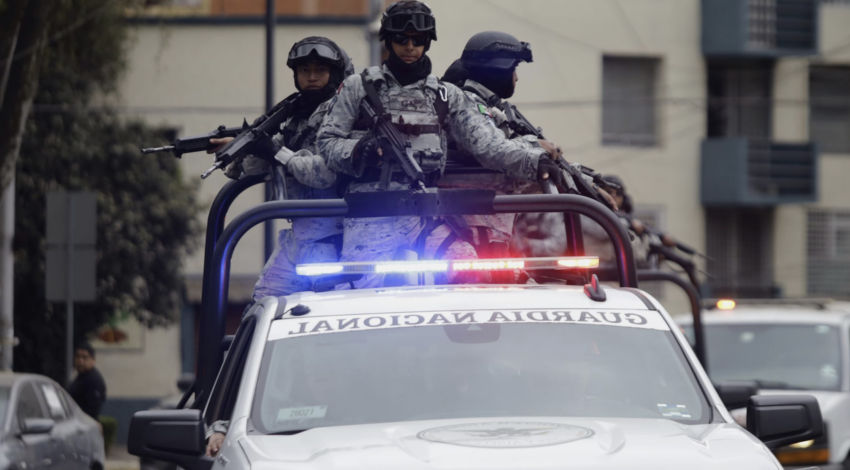
Last year, peacefulness improved by 5.1 per cent, the largest single-year gain in the history of the Mexico Peace Index. But this progress comes at a moment of acute uncertainty in the country. Recent events have disrupted an equilibrium that had appeared to have emerged among Mexico’s dominant criminal organisations, presenting both an opportunity and a risk for the country’s peace trajectory.
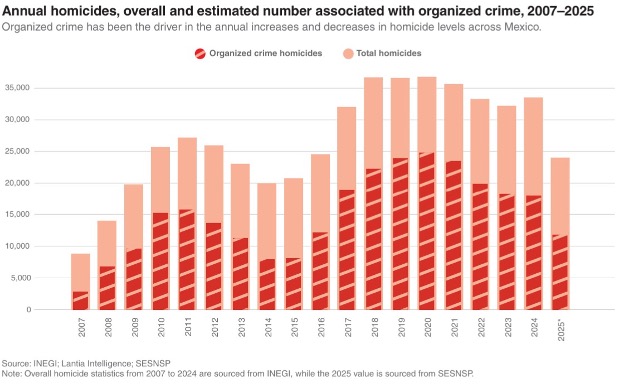
Understanding shifts in cartel dynamics is essential for analysing the trajectory of violence in Mexico. Over the past decade, violence has remained closely linked to the activities of organised criminal groups. Drawing on figures from Lantia Intelligence, the annual number of killings estimated to be associated with organised crime increased more than fourfold between 2007 and 2025, while all other homicides doubled – underscoring the growing centrality of cartel activity in shaping Mexico’s security landscape. This dynamic is reflected in the following figure.
Because violence is so closely connected to cartel activity, it remains unevenly distributed across Mexico. In 2025, Colima, a strategic entry point for precursor chemicals used to synthesise fentanyl, recorded a homicide rate of over 74 deaths per 100,000 people, the highest in the country, even though this marked a significant decline from the 101 deaths per 100,000 recorded in 2024. In contrast, Yucatán, which has far less cartel activity and ranks as the most peaceful state in the country, recorded a rate of just 1.8 deaths per 100,000 people last year.
Mexico’s organised criminal landscape is composed of dozens of groups. Recent studies estimate that these groups employ between 160,000 and 185,000 people in total, making them one of the country’s largest sources of employment. However, these organisations are not monolithic structures but multifaceted networks of individuals, cells, factions, and local allies, participating in cartel activities for different motivations and periods of time, making them highly dynamic and susceptible to infighting and fragmentation.
The persistently high levels of conflict among organised crime groups can be traced back to the fragmentation of cartels following the launch of the war on drugs in 2006, which relied heavily on a kingpin strategy aimed at weakening criminal organisations by removing their leaders. Throughout the 2010s, this contributed to the emergence of Los Caballeros Templarios as an offshoot of La Familia Michoacana, the independence of Los Zetas from the Gulf Cartel, the breaking of the CJNG with the Sinaloa Cartel, and the subsequent split of the Santa Rosa de Lima Cartel from the CJNG. With a larger number of competing groups, the country experienced a surge in disputes over territory and power, leading to more turf wars and casualties across Mexico.
By the early 2020s, however, Mexico’s criminal landscape appeared to be entering a period of partial reconsolidation, with the CJNG and the Sinaloa Cartel emerging as the two clearly dominant actors. According to records from the Uppsala Conflict Data Program (UCDP), deaths from cartel conflict peaked in 2021 at around 15,000 – the majority associated with either the CJNG, the Sinaloa Cartel, or both – before falling below 11,000 by 2024. Since 2015, the rivalry between these two groups has been associated with some 30,000 confirmed deaths, accounting for nearly 29 per cent of all cartel conflict deaths in the UCDP records, making it by far the most lethal criminal conflict in Mexico over the past decade. The apparent de-escalation of their rivalry was a significant contributor to improvements in national peace scores from 2020 onwards.
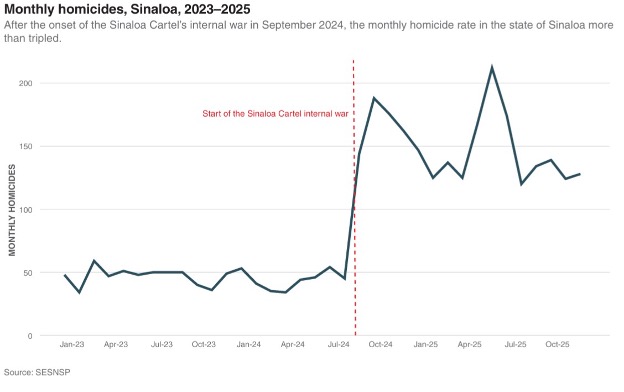
That fragile equilibrium was disrupted in 2024 by the outbreak of open warfare within the Sinaloa Cartel itself, between the Chapitos, affiliated with the sons of the imprisoned Joaquín ‘El Chapo’ Guzmán, and the Mayiza faction, affiliated with his former partner Ismael ‘El Mayo’ Zambada. The trigger was the 25 July arrest of Zambada at a US airport, reportedly following a betrayal by Joaquín Guzmán López, a leading Chapitos figure who also surrendered to US authorities on the same day. On 9 September 2024, less than two months later, armed clashes erupted across Culiacán, the cartel’s historic stronghold, with gunmen establishing roadblocks, inspecting civilians’ phones for contacts linked to rival factions, and engaging in kidnappings and executions. These actions instilled widespread fear among residents, leading to deserted streets and shuttered businesses.
The conflict produced a sharp and sustained increase in killings across the state, as shown in the following figure. Bodies were frequently discovered in vehicles, coolers, or abandoned in public areas, a reflection of the brutal, symbolic violence used by rival groups to intimidate opponents and local populations. In 2025, this conflict drove Sinaloa to record one of the sharpest deteriorations in the history of the MPI, even as much of the rest of the country improved. Beyond the human toll, the violence carried a significant economic cost: one local economist estimated losses equivalent to two to three per cent of the state’s GDP.
Amid this prolonged violence, cartel dynamics continued to evolve. Throughout 2025, law enforcement pressure appears to have contributed to weakening the Chapitos faction, with arrests of key operators disrupting elements of its structure. By year’s end, only two of its leaders remained at large. By May 2025, reports and mounting evidence suggested a potential alliance between the Chapitos and the CJNG. Such a partnership could increase each group’s territorial reach and access to resources, though if the Chapitos have genuinely suffered significant losses, it could also shift the balance of power decisively in favour of the CJNG. Either way, it represents a striking development given that the Sinaloa–CJNG rivalry had been one of the principal drivers of cartel violence for much of the past decade.
These evolving dynamics were unfolding when a second major disruption occurred earlier this year. On 22 February, a military operation in Jalisco resulted in the death of Nemesio ‘El Mencho’ Oseguera Cervantes, the long-time leader of the CJNG. El Mencho’s grip over the organisation was unusually centralised, and his death risks triggering a fresh surge of violence.
Guadalajara was promptly plunged into chaos as the cartel retaliated, with violence spreading to cities and beach resorts across Mexico as gunmen set fire to stores and banks. Narco-blockades and roadblocks were reported across 19 Mexican states, including Baja California, Guanajuato, Michoacán, and Tamaulipas, and at least 25 National Guard personnel were killed in Jalisco. A March report estimated that retail sales fell by 6.5 per cent in the immediate aftermath due to blockades and mobility disruptions across the country.
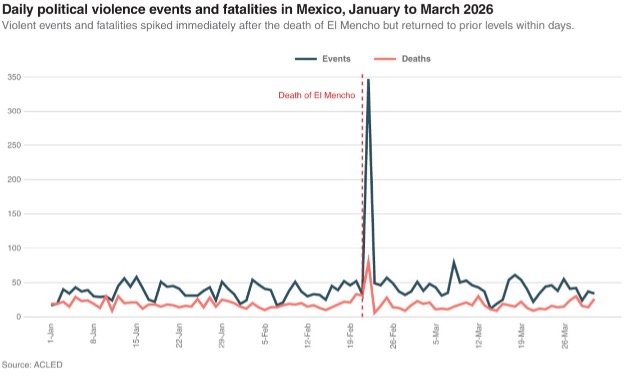
According to ACLED data, political violence events spiked more than tenfold on the day of El Mencho’s death. However, by the following day, they had returned to prior levels and the situation began to normalise, as shown in the following figure.
Given the size and geographic reach of the CJNG, El Mencho’s death raises the possibility of internal fragmentation and succession struggles within the organisation. Reports as of March 2026 suggest the cartel may have settled on Juan Carlos Valencia González, El Mencho’s California-born stepson, as his successor, with some officials and analysts describing him as commanding considerable internal legitimacy and as the figure best placed to ensure continuity.
If this transition holds, it reduces the risk of a succession war. If, however, his authority is contested, or the reported Chapitos–CJNG alliance, reportedly brokered under El Mencho’s supervision, fractures alongside it, Mexico could see a resurgence of the very turf wars that drove the dramatic deterioration in peacefulness of the late 2010s.
The weakening of Mexico’s two dominant cartels therefore presents a genuine opportunity and a serious risk for the prospects for improved peacefulness in Mexico. The country’s recent history is a caution: it was precisely the fragmentation of dominant criminal organisations after 2006 that triggered the prolonged deterioration that followed. Whether the current disruptions lead toward further consolidation of peace gains or toward a new cycle of violent fragmentation will be one of the defining questions for Mexico’s security landscape in the years ahead.