In 2026, Mexico prison population past a record 260,000. While yielding short-term safety, it fails to fix structural judicial backlogs and the roots of organized crime.
In this year’s Mexico Peace Index, we examine the sharp rise in incarcerations over the course of 2025 and the factors that drove it, as well as what this surge means for the durability of Mexico’s recent peace gains.
Last year, the country had its most substantial improvement in peacefulness in at least a decade. The homicide rate fell by 22.7 per cent in 2025, representing nearly 7,000 fewer deaths compared to the previous year, the largest single-year decline on record.
These gains appear to have been at least partly supported by a more intensive enforcement posture under the administration of President Claudia Sheinbaum, which contributed to a sharp rise in arrests and detentions. Yet the scale of that rise raises a broader question: enforcement-driven suppression of violence can support real short-term gains, but it does not in itself address the structural conditions that give rise to organised crime and insecurity, and its costs, both economic and institutional, are significant.
Mexico’s prison population surged in 2025, rising by nearly 21,000 people to reach more than 256,000 by December – the highest year-end figure on record. The rise has since continued into 2026, with official records showing more than 260,000 people incarcerated by the end of February across Mexico’s 276 local and federal prisons. As shown in the figure below, the increase began in earnest shortly after the beginning of Sheinbaum’s presidency.
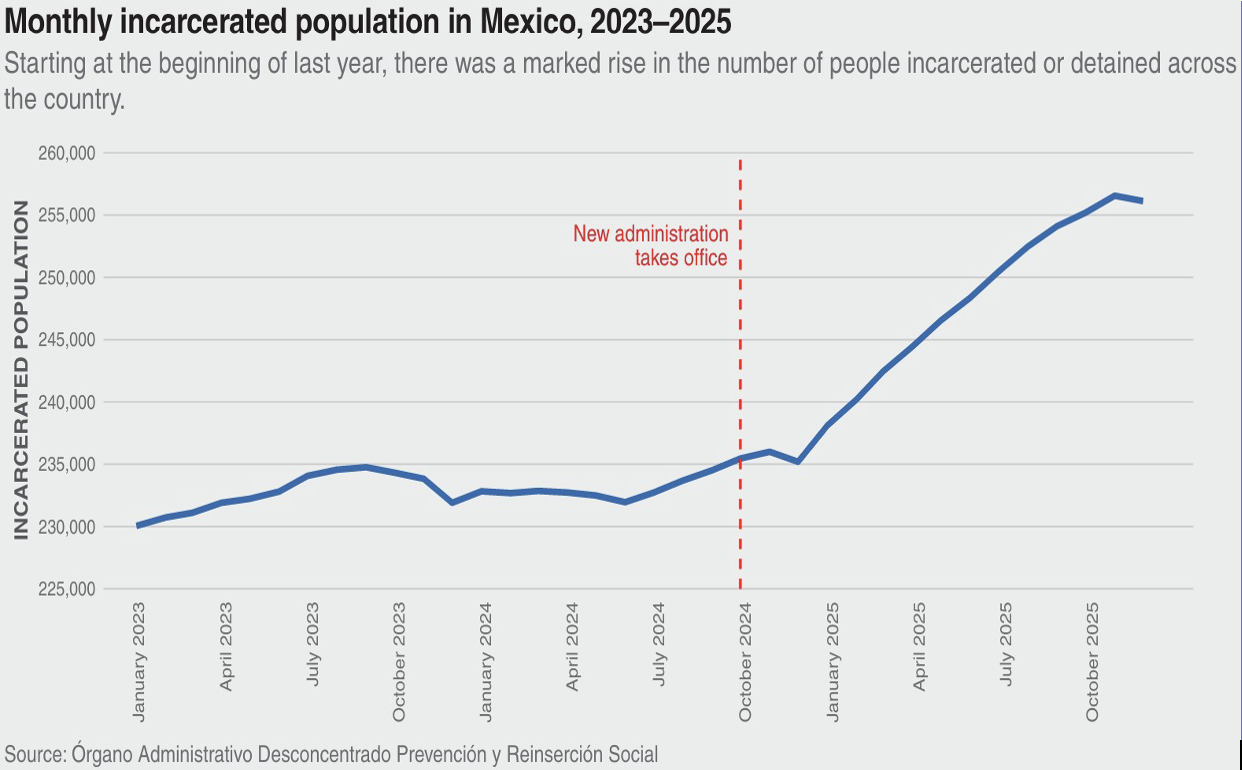
The increase coincided with a broader recalibration of security policy following the transition in federal leadership. President Sheinbaum’s security strategy, presented in October 2024, placed renewed emphasis on strengthening the National Guard, expanding intelligence gathering, improving investigative capacity, and coordinating federal institutions more closely. The stated aim was to reduce murders, kidnappings, and extortion while avoiding a formal return to the militarised approach of previous administrations. In practice, this translated into a notable increase in arrests and detentions over the course of the year.
A key figure in this shift has been Omar García Harfuch, appointed as Security Minister after previously serving as Mexico City’s police chief, where he was credited with helping to reduce homicides in the capital. His appointment signalled Sheinbaum’s intention to place policing, intelligence, and investigative capacity at the centre of her national strategy. This more operational approach, accompanied by efforts to give the Security Ministry greater control over investigation and intelligence, appears to have allowed the federal government to identify targets more quickly and coordinate arrests more effectively across agencies. As one analysis noted, much of the security apparatus now runs through Harfuch.
The increase in detentions also unfolded amid growing external pressure from the United States. The Trump administration pushed Mexico to move faster against individuals suspected of cartel links – including politicians – and to accelerate action against high-priority cross-border targets, under threat of expanded tariffs on Mexican exports. This pressure added a diplomatic dimension to Mexico’s domestic security strategy, particularly in border states.
One of the most visible manifestations of this shift was the launch of Operación Frontera Norte on 5 February 2025, days after President Trump threatened a 25 per cent tariff on Mexican imports and shortly following a bilateral agreement to temporarily suspend those measures. The operation targeted organised crime in Mexico’s northern border states, with a focus on drug trafficking, arms smuggling, and criminal networks. The results were rapid: within the first two days, authorities reported 111 detentions, and by late December 2025, the Cabinet of Security reported that the operation had led to the detention of 10,379 people, alongside the seizure of thousands of firearms.
Institutional dynamics within the justice system may have reinforced these trends. Following Mexico’s 2024 judicial reform, which introduced the direct election of judges beginning in 2025, prison admissions substantially exceeded releases over the course of the year. It has been suggested that the electoral process may have favoured candidates perceived as less likely to authorise releases, while also increasing ongoing political influence on decisions around pretrial detention and sentencing. Human rights organisations have warned that the reform could weaken judicial independence and undermine due process safeguards, though the precise contribution of this factor to the overall increase in incarcerations remains difficult to isolate.
The sharp rise carries significant economic implications. Current cost estimates based on the Mexico Peace Index methodology suggest that the indirect cost of incarceration – measured as lost labour income valued at the minimum wage – amounts to approximately 13 billion pesos annually. This figure reflects incarceration levels at the start of 2025 and does not fully capture the financial impact of the surge observed over the rest of the year. Preliminary analysis suggests that housing an additional 21,000 inmates would result in at least one billion pesos in additional lost economic output annually through forgone labour alone, and this does not include the direct costs of processing and incarcerating offenders within the judicial system and domestic security apparatus.
The scale of Mexico’s incarcerated population places it in notable international company. According to the World Prison Brief, Mexico now has the ninth largest prison population in the world in absolute terms. On a per capita basis it ranks 82nd globally, with approximately 192 inmates per 100,000 people, though this is still well above the global average of roughly 140 per 100,000. The system is also running beyond capacity, with an occupancy rate of 115 per cent across its 276 facilities, pointing to growing pressure on infrastructure and resources.
The relationship between rising incarcerations and improving peace metrics raises an important question about sustainability. IEP’s understanding of peace encompasses not only the absence of violence but the strength of the institutions and norms that underpin it. Suppression of violence through enforcement can support short-term gains, but it does not in itself address the structural conditions that give rise to organised crime and insecurity.
Mexico’s justice system remains a critical constraint in this regard. The country has an average of just two judges and magistrates per 100,000 people – one-seventh of the global average – contributing to significant case backlogs, high levels of impunity, and large numbers of unsentenced detainees, who already account for 42.4 per cent of the prison population. Whether Mexico can consolidate recent improvements in peacefulness will depend not only on the effectiveness of enforcement, but on the capacity of its judicial and institutional architecture to process, adjudicate, and ultimately reduce the underlying drivers of violence.

Peace in Mexico improved by 5.1 per cent in 2025, the largest single-year gain ever, while the number of recorded homicides fell by approximately...
Explore how cartel fragmentation, the Sinaloa Cartel conflict and shifting CJNG dynamics are shaping violence, security and prospects for peace in...
Identificación y medición de los factores que impulsan la paz
Identifying and measuring the factors that drive peace