As U.S. drug consumption patterns shift, Mexico's criminal economy faces a massive overhaul.

For decades, violence associated with Mexican cartels has been driven largely by demand from the United States drug market, while efforts to address the crisis have focused primarily on enforcement and disrupting supply. However, as overdose deaths and cross-border drug flows decline amid generational shifts in demand for drugs, the criminal economy underpinning violence in Mexico may also be entering a period of significant transformation.
In this year’s edition of the Mexico Peace Index, we examine the shifting dynamics of Mexican criminal organisations, which have contributed to extreme levels of violence across the country. For decades, these groups have derived much of their power and profit from the US drug market, and the scale of that market has shaped everything from cartel structure to trafficking routes to the political economy of entire Mexican states.
Competition for control of smuggling routes into the United States has been one of the primary drivers of organised violence in Mexico. Such territorial disputes between criminal groups are, at their root, disputes over access to US consumers. These groups have built transnational supply chains spanning multiple continents in response to that demand.
But the nature of what these organisations supply has also shifted over time in response to changes in consumption patterns in the United States. For example, demand for marijuana illegally trafficked from Mexico declined sharply as the drug became legalised or decriminalised across much of the United States. At the same time, synthetic opioids became increasingly dominant. Fentanyl, cheaper to manufacture and exponentially more potent than heroin, rapidly emerged as the central product of the illicit opioid market because US demand made it enormously profitable.
The dominant policy conversation surrounding this crisis has focused primarily on supply and enforcement: border security, cartel disruption, precursor chemical controls, and interdiction efforts. However, recent trends suggest that the dynamics underpinning the drug trade may be changing in ways that enforcement-focused frameworks did not anticipate.
Figures from US Customs and Border Protection suggest substantial declines in cross-border flows for several major drug categories over the past several years. According to official statistics, the number of fentanyl seizures at the Mexico–US border peaked in 2021 and has since fallen considerably, as shown in the following figure.
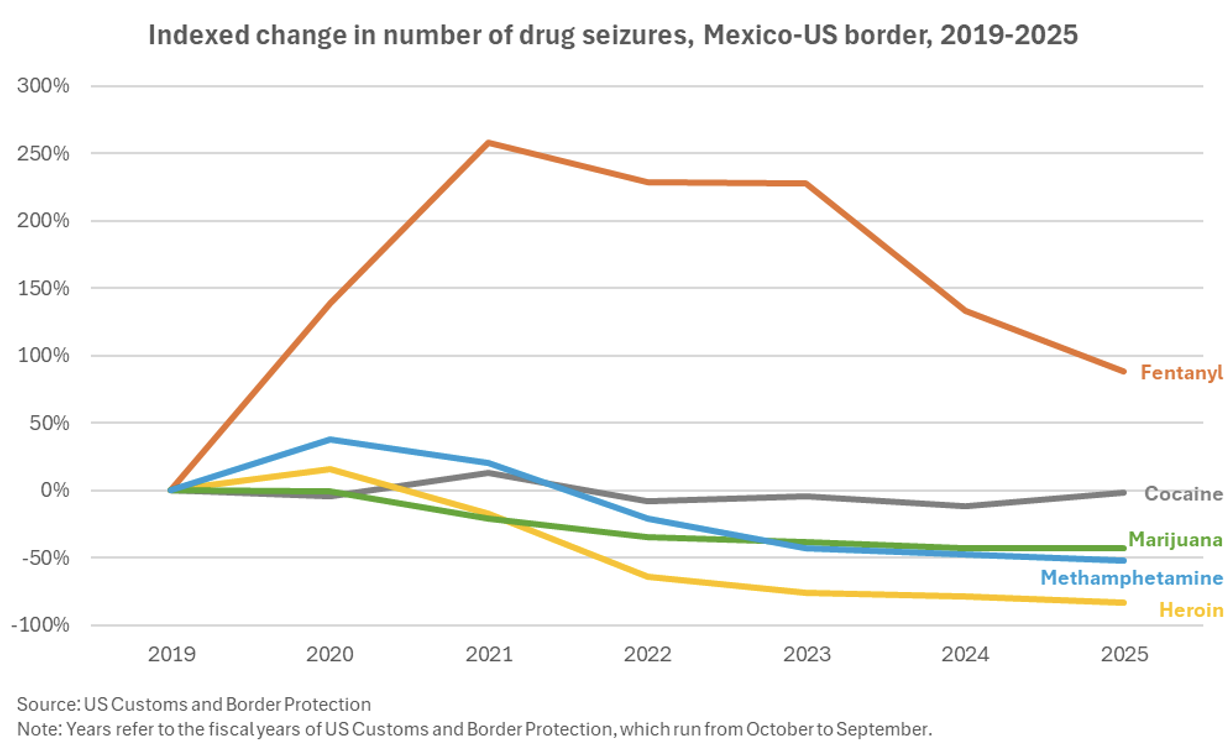
Comparable declines are also evident in seizure volumes. The amount of fentanyl seized at the border peaked at approximately 12,100 kilograms in 2023, but by fiscal year 2025 it had fallen to just 5,200 kilograms. January 2026 interceptions were also 24 per cent lower than the same month the previous year.
At the same time, overdose deaths in the United States have fallen sharply after years of sustained increases. Drug overdoses increased approximately 520 per cent between 1999 and 2023. However, as shown in the figure below, provisional data from the US Centers for Disease Control indicates that overdose deaths fell from an all-time high of roughly 110,000 in 2023 to an estimated 68,000 in 2025, representing the longest sustained decline in decades.
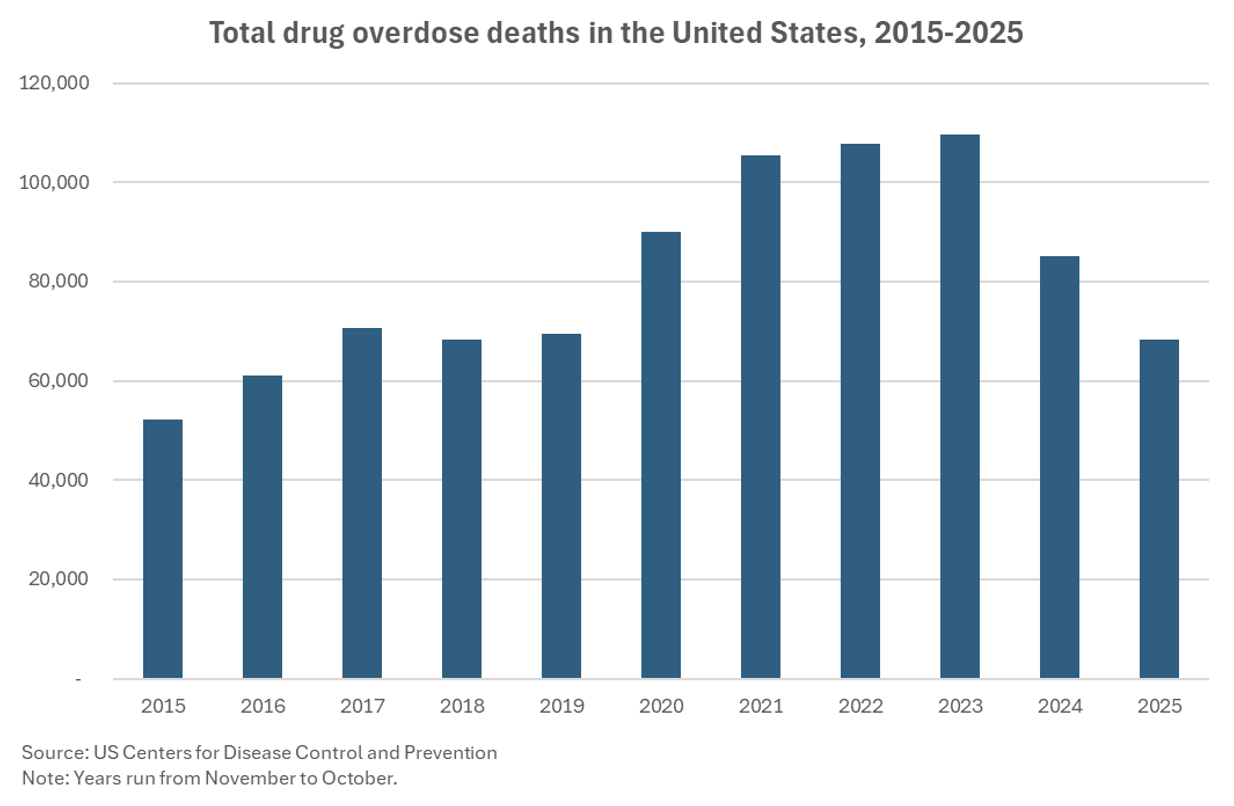
The decline in overdoses appears unlikely to be explained by enforcement alone. Experts point to a combination of factors, including expanded treatment access, increased availability of naloxone, and opioid settlement funding. Yet one of the most significant developments may be behavioural: fewer Americans appear to be initiating drug use in the first place.
For the fifth consecutive year, the NIH-funded Monitoring the Future survey found that the historic decline in adolescent substance use that began during the COVID-19 pandemic has persisted. In 2025, 91 per cent of eighth graders, 82 per cent of tenth graders and 66 per cent of 12th graders reported abstaining from marijuana, alcohol, and nicotine in the previous 30 days. The anticipated post-pandemic rebound in youth substance use never materialised.
The most striking shift is among young adults aged 20 to 29. Addiction researchers have documented approximately a 47 per cent reduction in fatal overdose risk among this cohort. Years of fentanyl devastation – involving a drug that is highly potent, difficult to detect, and impossible to dose reliably by sight – appear to have fundamentally altered perceptions of risk for many younger Americans. Prescription opioid dispensing has also declined substantially, narrowing one of the major pathways into addiction.
These changing patterns of demand have important implications for organised crime in Mexico. Criminal organisations adapt quickly to changing markets. The decline in marijuana trafficking following legalisation in the United States demonstrated how rapidly cartel business models can shift when demand changes.
Current seizure data suggests that this process of adaptation is ongoing. While fentanyl seizures have declined sharply, the volume of cocaine seized at the border rose by 35 per cent from 2024 to 2025. The emergence of carfentanil – a synthetic opioid roughly 100 times more potent than fentanyl – also highlights the capacity of traffickers to modify products in response to changing market conditions. In 2025, carfentanil appeared in roughly 1,400 DEA laboratory reports, compared to just 54 in 2022.
Reduced US demand does not necessarily imply a corresponding reduction in organised violence in Mexico. In some cases, shrinking markets can intensify competition among criminal groups, particularly if cartels fragment or diversify into alternative revenue streams. As the Mexico Peace Index shows, criminal organisations in Mexico are increasingly expanding into domestic criminal markets as well.
While Mexico has traditionally been viewed primarily as a producer or transit point for drugs destined for the United States, its internal drug market has grown substantially in recent years. The trend in retail drug crimes reflects the increasing reliance of traffickers on sales to local consumers. The Mexico Peace Index finds that the rate of retail drug crime – the local sale of drugs – rose by over 10 per cent last year and has tripled since 2016.
National survey data from Mexico points to similar trends in consumption. Between 2016 and 2025, the prevalence of illegal drug use among the Mexican public increased from 9.9 per cent to 13.1 per cent. Marijuana remains by far the most widely used illegal drug, with lifetime usage rising from 8.6 per cent to 12 per cent over the same period. These increases were driven primarily by adults rather than adolescents.
Interestingly, younger Mexicans appear to be moving in a somewhat different direction. Among adolescents, illegal drug use declined from 6.2 per cent in 2016 to 4.1 per cent in 2025, while the average age of first illegal drug use increased from 17.5 to 19 years old. Although Mexico’s domestic drug market continues to expand overall, these figures suggest that generational attitudes toward drugs may also be changing in Mexico, much as they appear to be in the United States.
The implications of these shifts extend beyond public health. For decades, organised violence in Mexico has been deeply shaped by demand from US drug consumers. If those demand patterns are now changing, criminal organisations are likely to continue adapting in response, reshaping trafficking networks, criminal markets, and patterns of violence across the country.
The policy lesson is therefore broader than border enforcement alone. Supply-side interventions remain important, but long-term reductions in violence may depend equally on the broader social, economic, and institutional conditions that shape the demand for drugs.

Peace in Mexico improved by 5.1 per cent in 2025, the largest single-year gain ever, while the number of recorded homicides fell by approximately...
Explore how cartel fragmentation, the Sinaloa Cartel conflict and shifting CJNG dynamics are shaping violence, security and prospects for peace in...
Identificación y medición de los factores que impulsan la paz
Identifying and measuring the factors that drive peace