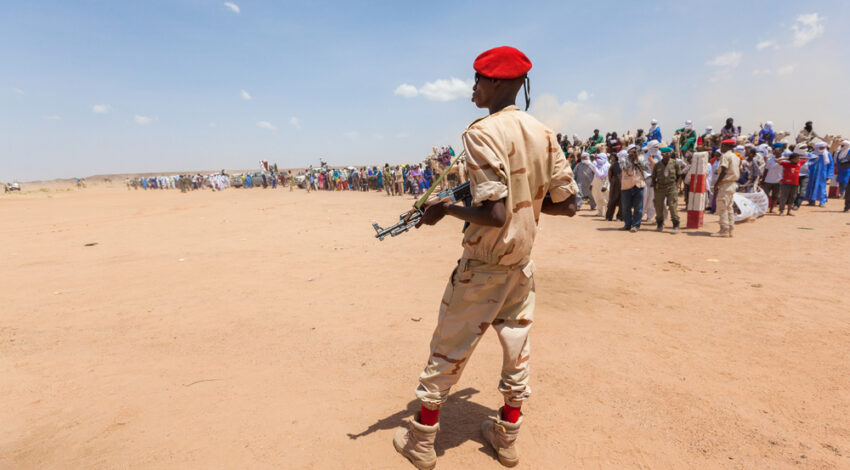
Between 2020 and 2023, a series of coups in Mali, Burkina Faso and Niger prompted a worsening of an already poor security situation. New military leaders took office with a mandate to reassert sovereignty, remove foreign influence, and improve security. While this vision proved popular, the impact on the security situation has been far less positive.
Violence in the Sahel has resulted in tens of thousands of deaths, largely attributed to Jama’at Nusrat al-Islam wal-Muslimin (JNIM), a coalition of jihadist groups affiliated with al-Qaeda. Islamic State Sahel Province (ISSP) has also contributed to the violence. ISSP is generally more violent in its areas of operation, particularly in the border regions between Burkina Faso, Mali and Niger, while JNIM has developed a broader footprint, including expanding influence into coastal West Africa.
The withdrawal of French forces and the removal of the United Nations mission in Mali have played a significant role in the deterioration of security. While these external actors were not able to halt the spread of jihadist violence, their presence acted as a buffer that helped secure major cities and limit the expansion of militant groups. Their departure removed this constraint, allowing jihadists to expand their territorial control across Mali and Burkina Faso and gain ground in Niger.
The arrival of Russian Wagner forces has not improved the situation. Their approach has been characterised by haphazard tactics and widespread human rights abuses, often targeting civilian populations without clear evidence of jihadist presence. Civilian deaths attributed to national security forces and their partners have risen sharply, further undermining trust between communities and the state.
In Burkina Faso, the expansion of volunteer defence forces has compounded these challenges. Recruitment into these forces has been significant, but exclusion of certain communities, particularly the Peuhl, has intensified social divisions. State security forces have also been implicated in large scale abuses, including mass executions of civilians. These approaches have proved ineffective in countering jihadist violence and have instead contributed to recruitment by reinforcing grievances among affected populations.
The underlying conditions in the Sahel continue to support the expansion of militant groups. Governments have struggled to provide basic services, economic opportunities, or infrastructure, particularly outside major urban centres. For many individuals, joining a jihadist group offers both income and protection. There is limited evidence that ideological commitment is the primary driver of recruitment. Instead, economic necessity and security concerns play a more significant role.
The consequences of these dynamics are evident in the scale and spread of violence. Jihadist groups have expanded their territorial reach and increased the frequency and intensity of attacks. In Mali, JNIM has demonstrated its operational strength through coordinated attacks on military targets, including high profile assaults in the capital. At the same time, groups have extended their influence into new regions, reflecting both their growing capacity and the weakness of state responses.
JNIM has increasingly focused on economic targets as part of its strategy. By attacking key transport and trade hubs and blockading access to fuel and essential goods, the group has sought to undermine state authority and destabilise governments. These tactics aim to weaken governments from within, creating conditions for political upheaval without requiring direct control of major urban centres.
Despite these pressures, governments have so far remained in place, although often weakened. Military forces across the Sahel face challenges including low morale, fragmented command structures, and ongoing instability. Reports of coup attempts and military reshuffles further limit the ability of these forces to implement effective strategies.
The expansion of jihadist violence in the Sahel is increasingly affecting coastal West Africa. Groups such as JNIM are extending their operations southwards, seeking access to ports and new sources of revenue. Attacks along borders with countries such as Senegal and Nigeria illustrate this shift, as does the increase in violence in countries like Benin.
In Benin, there has been a significant rise in attacks linked to Sahel based groups, despite efforts to strengthen border security. Benin too witnessed a considerable rise in assaults by JNIM in 2025, with 70 percent more deaths between January and December 2025 than in the first 11 months of 2024. It has deployed 3,000 soldiers along its border with Burkina Faso and Niger to try to reduce the scope of incursions, but it is unlikely this alone will halt the jihadists who are extremely adept at exploiting porous border areas.11 If the state weakens further in Cotonou – following a coup attempt in late 2025 – it is likely that the group will push further south and start to establish an even greater foothold in that country. Political instability further increases vulnerability, creating opportunities for expansion.
Côte d’Ivoire and Ghana for their parts have been spared some of this expansion of jihadist violence. Côte d’Ivoire witnessed a series of assaults in 2020 – 2021 but has since brought the violence under control, with no confirmed attacks since then. Meanwhile despite considerable communal tensions in the border areas, Ghana has also largely managed to keep jihadist assaults at bay. Both countries have combined security measures with broader strategies focused on development, infrastructure, and decentralisation. These approaches have helped to reduce recruitment by addressing some of the underlying drivers of extremism. However, both countries face growing pressure, including refugee flows and rising tensions in border regions.
The dynamics observed in the Sahel provide important lessons for coastal states. Jihadist groups have consistently exploited local grievances and communal tensions, particularly between herder and farming communities. By aligning themselves with marginalised groups and offering protection, they are able to build support and expand their influence. State responses that target communities indiscriminately or rely on poorly trained militias risk reinforcing these dynamics and driving further recruitment.
Crucially, coastal countries can learn much from what has not worked in the Sahel. Jihadist groups have always capitalised on local grievances and communal tensions to recruit and to carve a space for themselves in the local and political discourse. Governments in coastal countries can do more to try to resolve these communal divisions and bring communities closer together to reduce the potential for jihadist exploitation.
Security is also not the only answer.
Effective responses require a more targeted and balanced approach. Military action must be precise and accountable, avoiding the widespread use of force that can exacerbate tensions. At the same time, efforts to strengthen governance, create economic opportunities, and improve infrastructure are critical. Where communities have access to livelihoods and basic services, they are less likely to support or join militant groups.
The situation in the Sahel illustrates how quickly instability can spread when underlying conditions are not addressed. Jihadist groups have demonstrated a capacity to adapt, expand, and exploit weaknesses in both governance and security.
Understanding that this is not solely a security problem would go a long way to resolving the crisis that has spread so exponentially in recent years across the Sahel and is now edging its way closer to the ports of coastal West Africa.
This excerpt is taken from ‘Jihadists in the Sahel: What is Behind Expansion and What is the Threat to Coastal West Africa?‘ by Jessica Moody, Research Consultant, Political Risk and Peacebuilding in West and Central Africa, originally published in the Global Terrorism Index 2026 report.
— Download the Global Terrorism Index 2026 Press Release
— Request a Media Interview
— View the Global Terrorism Index 2026 interactive map


Youth radicalisation has become a defining feature of the contemporary terrorism landscape, emerging alongside a broader shift in the nature and...
Assessment of the current state of the Iran conflict through the lens of terrorism and the...