Northern Ireland's peace has held for nearly three decades. IEP Research Assistant Lana Messinger examines why public trust in the institutions meant to sustain it has declined.
Northern Ireland’s underlying peace has held for close to three decades. Public trust in the institutions meant to sustain it has not.
The new Northern Ireland Peace Index (NIPI) finds that confidence in the criminal justice system fell from 72.5% of people surveyed in 2019 to 60% in 2025, even as sectarian violence has fallen sharply.
Produced by the Institute for Economics & Peace (IEP), the NIPI is the first composite measure of negative and Positive Peace in Northern Ireland. It covers the period from 2019 to 2025, at the national level and across the 11 Local Government Districts, with comparison points against the rest of the United Kingdom (UK) and its jurisdictions.
The NIPI is unique in that it is IEP’s first national peace index based on a post-conflict setting. Northern Ireland’s conflict, known as the Troubles, ran from the late 1960s up until the establishment of the 1998 Belfast/Good Friday Agreement.
The tensions developed out of longstanding sectarian divisions mainly between Catholic nationalists, who generally favoured Irish unity, and Protestant unionists, who supported remaining in the United Kingdom, alongside grievances over political representation, discrimination and economic inequality.
Violence involved republican paramilitaries such as the Provisional IRA, loyalist paramilitaries such as the Ulster Volunteer Force and the Ulster Defence Association and British security forces. According to the Conflict and Politics in Northern Ireland Archive‘s security statistics, 3,289 people were killed in conflict-related violence in Northern Ireland between 1969 and 1998, while 42,304 people were injured between 1968 and 1998.
The decades since the 1998 Agreement have seen peace largely holding in Northern Ireland. However, as the Index report notes, the comparative literature positions Northern Ireland as an important and productive case of a peace and social development process, rather than a model to be emulated.
The NIPI assesses Northern Ireland’s social landscape in terms of both outward manifestations of violence, also known as ‘negative peace’, as well as Positive Peace, which refers to the attitudes, institutions and structures that create and sustain peaceful societies. Positive Peace highlights the importance of resilience and responsiveness while enabling grievances to be resolved without force.
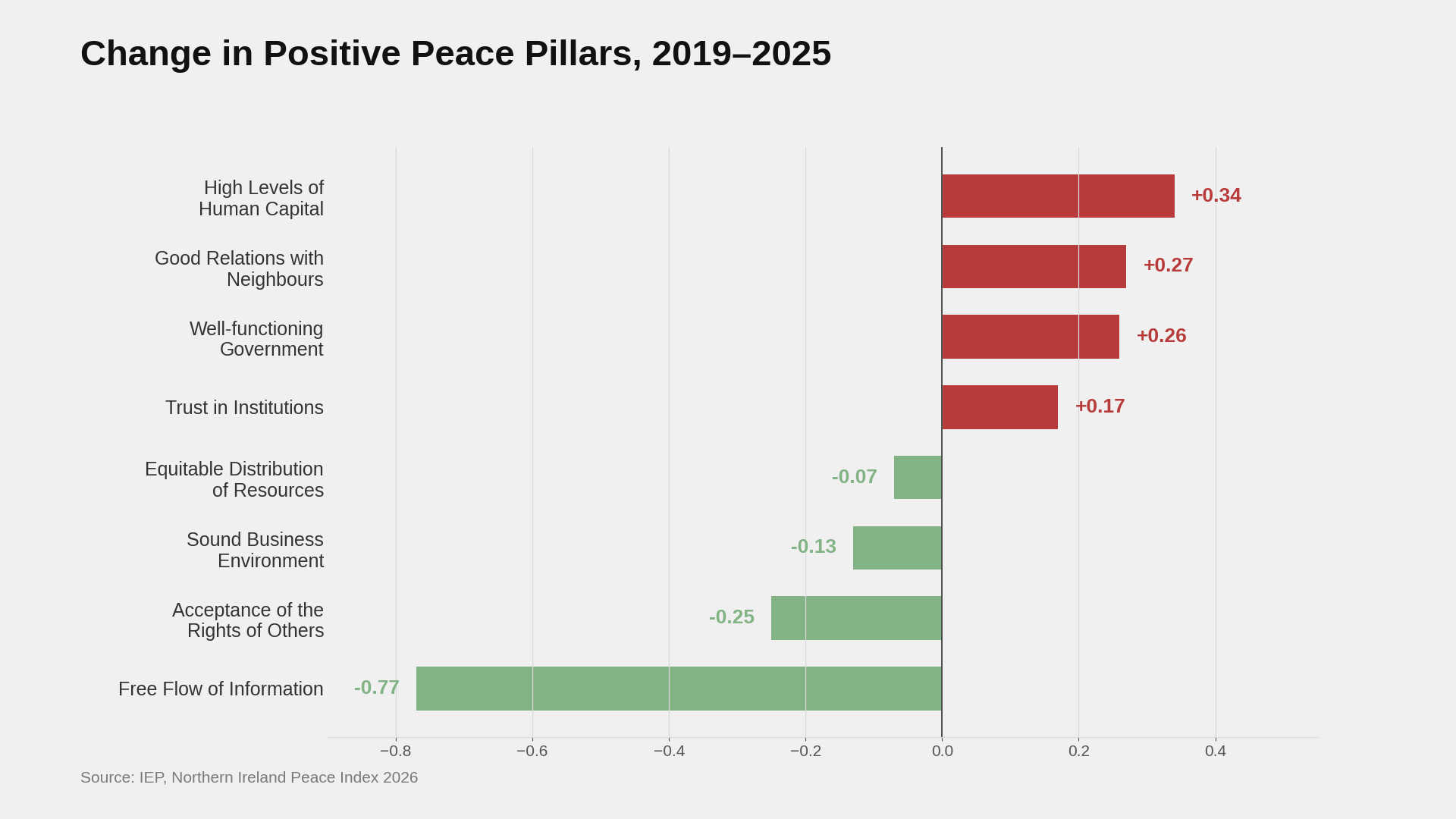
Four out of the eight Pillars of Positive Peace improved over the period, led by Acceptance of the Rights of Others and Equitable Distribution of Resources, in addition to Free Flow of Information and Sound Business Environment. Four deteriorated: Well-Functioning Government, Trust in Institutions, High Levels of Human Capital and Good Relations with Neighbours. Trust in Institutions deteriorated by 6.5% and confidence in the justice system fell from 72.5% of people surveyed in 2019 to 60% in 2025.
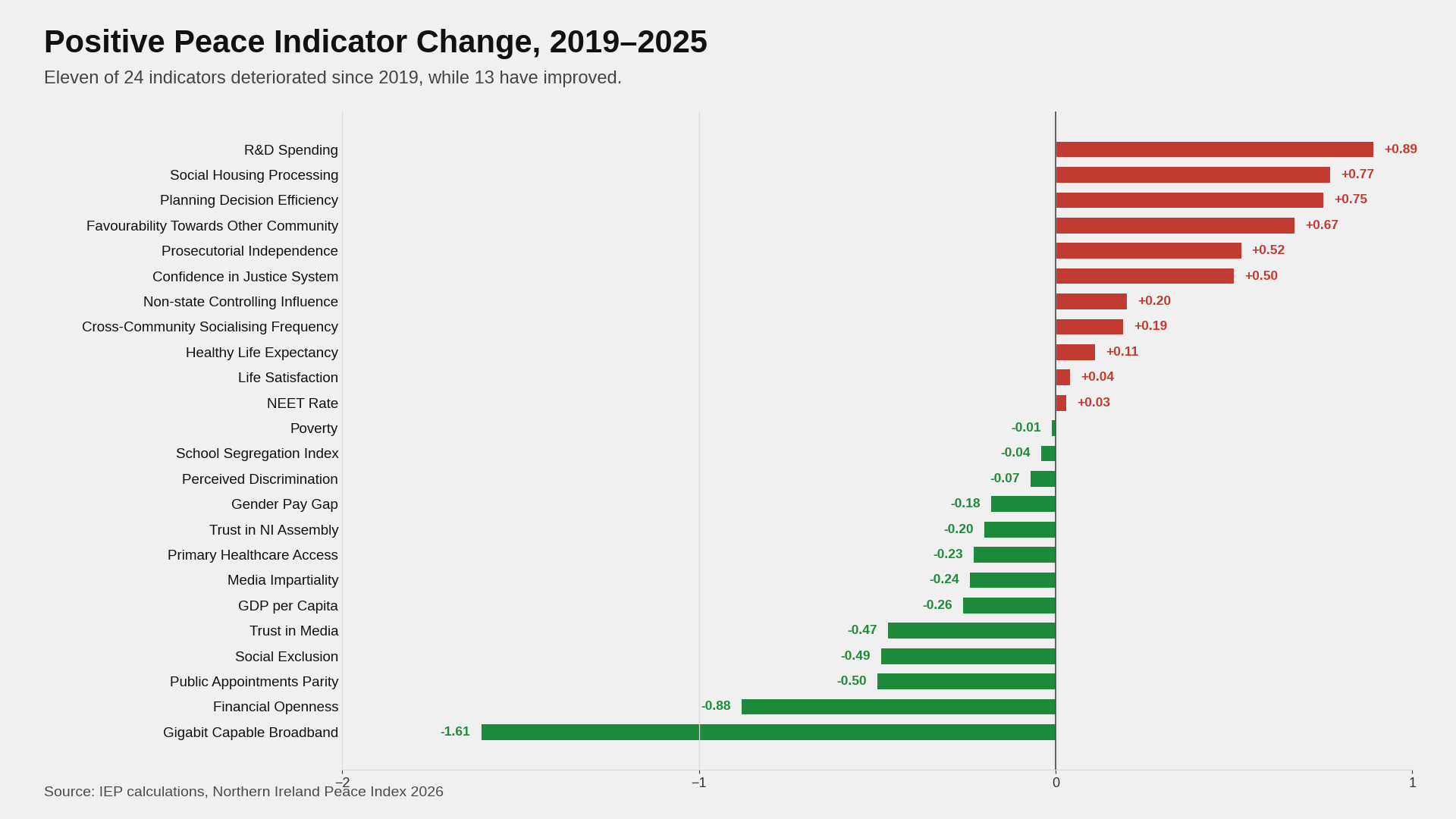
Prosecutorial independence and non-state controlling influence both deteriorated as well. Understanding this decline necessitates looking at the institutions created to sustain Northern’s Ireland’s post-conflict settlement, and the history they were designed to address.
The 1998 Agreement created institutions to address the questions that the settlement itself could not resolve: policing, dealing with the past and contested cultural identity.
As Northern Ireland shifted from ending political violence to sustaining peace, the performance and legitimacy of these institutions became increasingly important. The question was no longer whether the institutions existed, but whether they could govern effectively, deliver justice and retain public confidence equally across all sections of the population.
The tension between institutional stability and institutional confidence is particularly visible in devolved government. Since the 1998 Agreement, Northern Ireland has experienced six periods in which there was no working devolved government, amounting to around 10 years in total. The cause is rooted into the settlement itself: in ending sustained political violence, the 1998 Agreement created a system in which representation is anchored in communal designation rather than cross-community engagement.
The Index’s results further indicate the Agreement’s layered complexity in seeking to combine consociation, federacy through intergovernmental treaty and self-determination mechanisms, all while situated against a legacy of conflict.
Confidence in the overall fairness of the criminal justice system has consistently progressed ahead of confidence in its effectiveness. In 2019 and 2020, the two figures were 57% and 50% respectively. The gap is a useful number: people are more willing to accept that the system is fair in principle than that it works in practice.
Notably, the Police Service of Northern Ireland (PSNI) remains one of the highest users of stop and search powers in the UK, while producing comparatively poor outcomes, particularly for the youth populations.
Time is one reason. In 2019/20, Crown Court Cases in Northern Ireland took a median of 565 with longstanding evidence indicating that cases took around twice as long to resolve as comparable cases in England and Wales. By 2024/25, median processing times had risen to 542 days for charge cases and 1,211 days for summons cases. These figures measure the period from the offence being reported or detected by the police to its final court disposal.
Delays have also remained acute for sexual offences. In 2019/20, cases in which the main offence was a sexual offence took a median of 698 days to complete. Despite recent improvements, sexual-offence cases remained substantially slower than the 189-day median across all criminal cases in 2024/25.
Attrition is high, and delay has been identified as one factor in complaint withdrawal. The 2019 Gillen Review reported that around 40% of those entering the process did not proceed, supported by PSNI research finding a 41% withdrawal rate among rape incidents reported between January and July 2017.
Concerns about how the justice system operates today sit alongside an older and particularly sensitive challenge: how institutions can address unresolved violence from the Troubles.
Victims’ groups and the prominent Northern Ireland parties have kept legacy policing at the centre of the argument over trust in criminal justice, and over the PSNI’s investigation of conflict-related deaths. It has been reported that the police in Northern Ireland have a legacy caseload of over 900 cases involving approximately 1,200 deaths, the majority unresolved. On existing resources, completing human rights complaint investigations into the caseload alone would take an estimated 20 years.
Legacy processes and subsequent justice mechanisms that are independent, transparent and human rights compliant, paired with genuine stakeholder engagement and visible accountability would address the deterioration in trust, and in the justice system. Greater transparency in public appointments, prosecutorial decision-making and council planning would narrow the gap between how institutions work and how the public sees them.
Positive Peace tends to build slowly. Northern Ireland’s peace has held since 1998, but the institutions designed to sustain it are losing public confidence. Together, delays in contemporary justice, contested legacy processes and repeated political dysfunction help explain how institutional trust can deteriorate even while levels of political violence remain historically low.
The NIPI therefore emphasises a central challenge for Northern Ireland: sustaining peace requires not only the absence of violence, but institutions that people believe can govern effectively and equally, delivering equitable justice and addressing the past.
It refers to the gap between Northern Ireland's underlying peace, which has held for close to three decades, and public trust in the institutions meant to sustain it, which has not. Confidence in the criminal justice system fell from 72.5% of people surveyed in 2019 to 60% in 2025, even as sectarian violence has fallen sharply.
Confidence in the criminal justice system fell from 72.5% of people surveyed in 2019 to 60% in 2025. Trust in Institutions, one of the eight Pillars of Positive Peace, deteriorated by 6.5% over the same period.
Since the 1998 Agreement, Northern Ireland has experienced six periods with no working devolved government, amounting to around 10 years in total. The cause is rooted in the settlement itself, which anchored representation in communal designation rather than cross-community engagement.
Police in Northern Ireland have a legacy caseload of over 900 cases involving approximately 1,200 deaths, the majority unresolved. On existing resources, completing human rights complaint investigations into the caseload alone would take an estimated 20 years.
Legacy processes and justice mechanisms that are independent, transparent and human rights compliant, paired with genuine stakeholder engagement and visible accountability, would address the deterioration in trust. Greater transparency in public appointments, prosecutorial decision-making and council planning would also narrow the gap between how institutions work and how the public sees them.

Northern Ireland has recorded its lowest levels of violence and fear of violence since 2019, improving 10.7% from the 2019 baseline. However, the...

Northern Ireland's violence is falling on nearly every measure, except one. Hazel Armstrong, Research Assistant at the Institute for Economics and...
Identifying and measuring the factors that drive peace
Analysing the factors that sustain peace.