Northern Ireland has recorded its lowest levels of violence and fear of violence since 2019, improving 10.7% from the 2019 baseline. However, the structural foundations that sustain peace, measured by Positive Peace, have not strengthened at the same pace.
The Northern Ireland Peace Index (NIPI), published jointly by Queen’s University Belfast and the Institute for Economics & Peace (IEP), is the first attempt to measure peace in Northern Ireland empirically, using the same statistical approach IEP applies around the world. The Index tracks two distinct but related dimensions of peace between 2019 and 2025, at both the Northern Ireland level and across its 11 Local Government Districts (LGDs), and benchmarks the results against the rest of the United Kingdom (UK) and the Republic of Ireland (RoI).
Those two dimensions are negative peace and Positive Peace. Negative peace is defined as the absence of violence and the fear of violence. Positive Peace is defined as the attitudes, institutions and structures that create and sustain peaceful societies. The distinction matters because an area can register a low level of violence while still lacking the underlying conditions, such as trust in institutions or shared community spaces, that make that calm durable over the long term.
Northern Ireland has made significant progress since the 1998 Agreement (commonly known as the Good Friday Agreement or the Belfast Agreement). The core promise of that settlement, an end to sustained political violence, has largely been achieved. The deeper structural foundations that make this relative absence of violence durable are, by nature, slower to build and remain a work in progress. The Index is designed to measure both halves of that story rather than treating the end of large-scale violence as the end of the analysis.
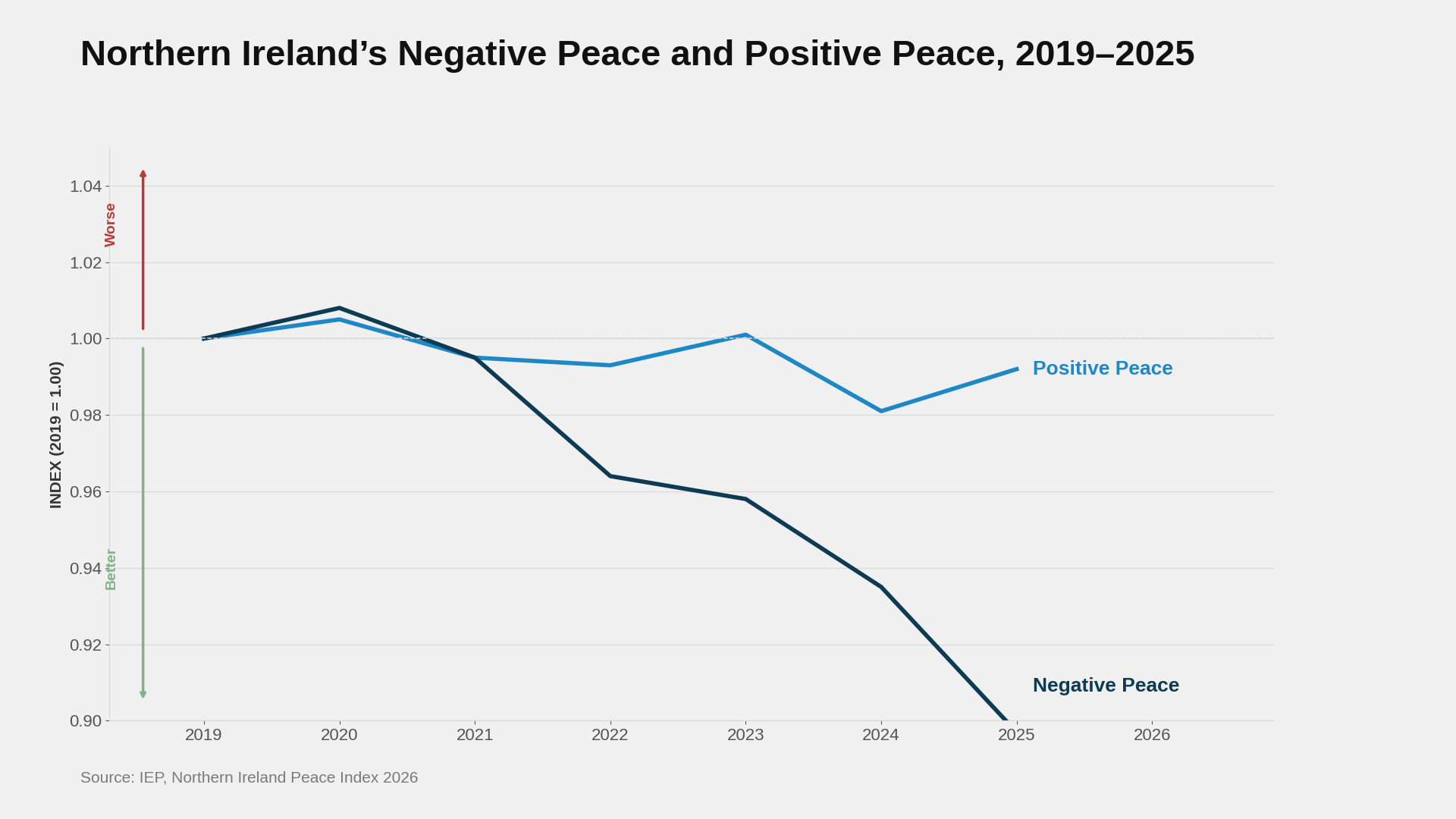
The central finding of the report is a gap between the two measures. Using IEP’s one-to-five scale, on which one represents the most peaceful outcome, negative peace in Northern Ireland improved 10.7% between 2019 and 2025, with the steepest gains coming in the most recent two years, 2023 to 2025. Positive Peace improved by just 1.2% over the same period.
In other words, the relative absence of violence is consolidating faster than the attitudes, institutions and structures meant to sustain it. Some of the structural conditions underpinning peace in Northern Ireland are strengthening, while others are weakening. The report frames the central question this way: whether those structural conditions can keep pace with the peace they are meant to support.
Explore findings: Northern Ireland Peace Index (Interactive site)
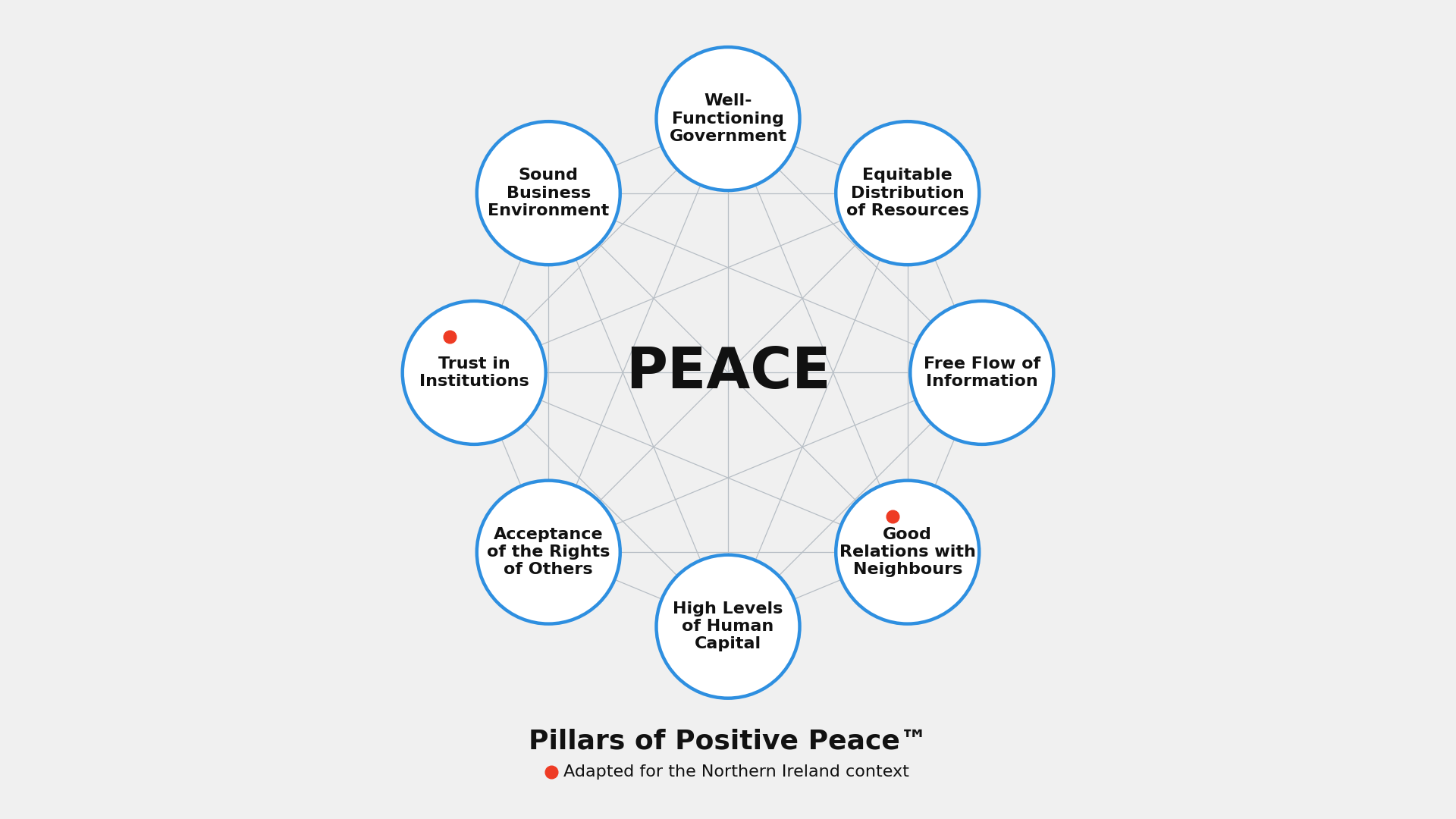
Positive Peace in Northern Ireland is organised into eight pillars, adapted from IEP’s global framework: Well-functioning Government, Equitable Distribution of Resources, Free Flow of Information, Good Relations with Neighbours, High Levels of Human Capital, Acceptance of the Rights of Others, Trust in Institutions and Sound Business Environment.
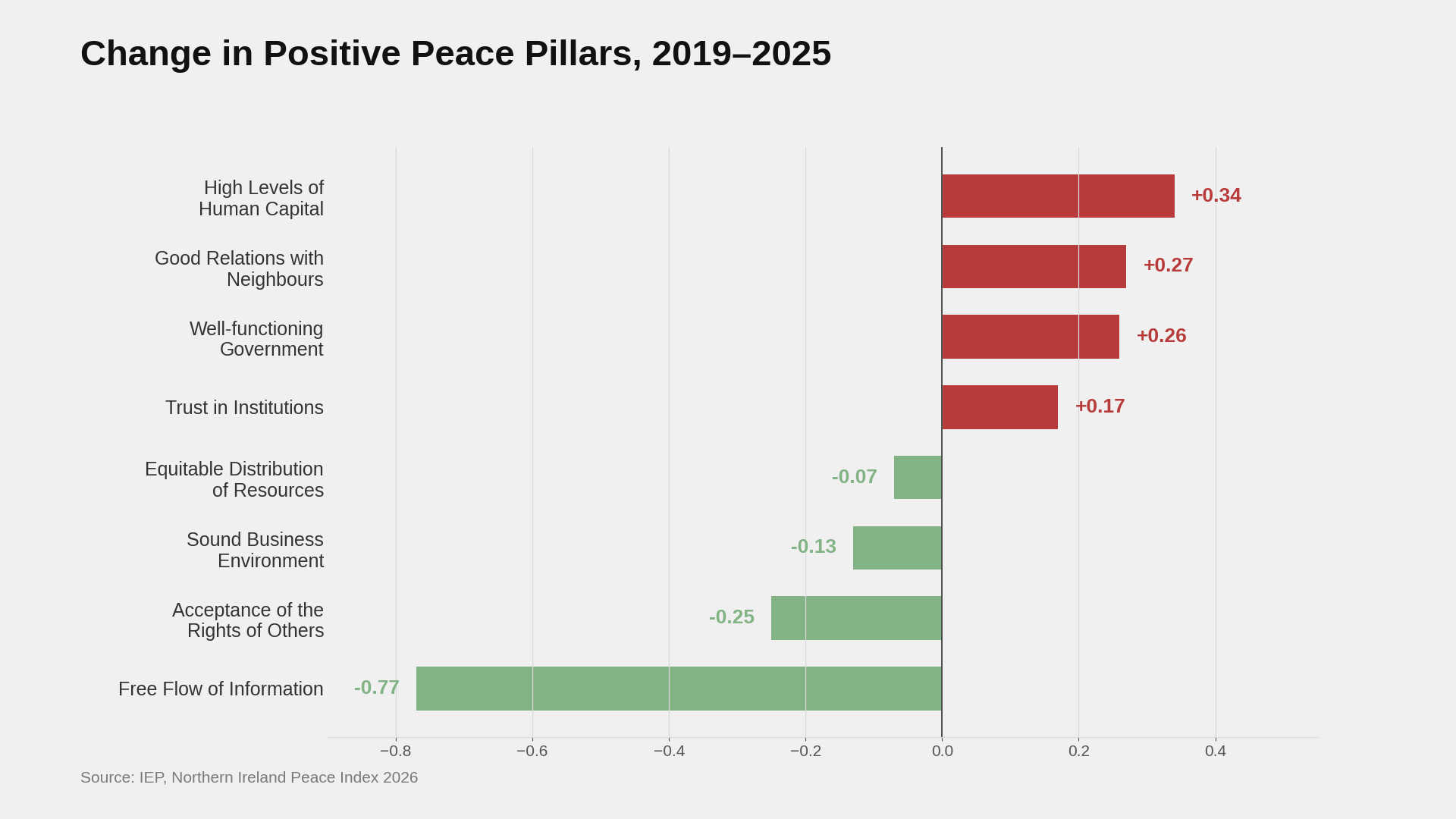
Since 2019, four of these pillars have improved: Free Flow of Information, Acceptance of the Rights of Others, Sound Business Environment and Equitable Distribution of Resources. Four have deteriorated: High Levels of Human Capital, Well-functioning Government, Good Relations with Neighbours and Trust in Institutions.
Progress has been strongest where capital investment and formal policy can move an outcome directly. It has been weakest on the institutional, human-capital and community-relations dimensions that bear most directly on the long-term consolidation of peace. Behind this headline picture, individual indicators moved by large margins in both directions. Confidence in the justice system deteriorated by almost 24% over the period, planning decision efficiency by 41%, favourability towards the other community by 40%, and research and development spending by 34%. Gigabit capable broadband improved by almost 57%, public appointments parity by 33%, and the gender pay gap by 13%.
On the indicators that allow a direct comparison with the rest of the UK since 2019, Northern Ireland matches or exceeds the British average on the social, equity and material outcomes that capture how people experience everyday peace. It falls behind on the economic-dynamism indicators that determine long-term productive capacity, namely research investment, foreign-capital intensity and output per capita.
Against the Republic of Ireland , the picture partly reverses. On the smaller set of like-for-like indicators available, Northern Ireland trails the Republic of Ireland on most measures, and the youth-transition and gender pay gap outcomes on which it leads within the UK become shortfalls when measured against the Republic of Ireland instead.
At the level of the 11 Local Government Districts, a strong Positive Peace position does not guarantee a strong negative peace position, and the two measures do not track each other. Belfast records above-average performance on several of the structural foundations of peace, yet it also concentrates the highest share of recorded violence among all council areas. Derry and Strabane shows the opposite pattern: it lags on several Positive Peace indicators, yet it has recorded some of the largest improvements on violence-related measures over the same period.
This is because each council area’s social composition shapes negative peace and Positive Peace through different channels, so a district’s standing on one measure is not a reliable guide to its standing on the other. The areas where peace is least consolidated are consistently those marked by persistent deprivation and entrenched low trust in institutions.
The report is careful to note that the relationship between the two measures is not one-directional. Falling violence may build the structural conditions of Positive Peace as much as those conditions sustain the fall in violence; the Index measures the presence of these conditions, not the direction of cause. The path from structural improvement to durable peace runs through generations of social and political change, not annual policy cycles.
Drawing on the Index results, the report sets out four long-term priorities. These describe a direction of travel rather than near-term targets, and are as follows: first, strengthen public confidence in the institutions people rely on; second, support a stronger domestic economic and research base, so that gains in skills and infrastructure are retained locally; third, create more shared spaces and services that bring communities together in everyday life; and fourth, widen access to opportunity for all, especially where deprivation and division coincide.
Taken together, the findings suggest that Northern Ireland’s peace, nearly three decades after the 1998 Agreement, rests on a firmer foundation against violence than it did in 2019, but on a foundation of institutions, trust and community relations that has moved only marginally in that time.
Full Report: Northern Ireland Peace Index
It is the first Index to apply the Institute for Economics & Peace's negative peace and Positive Peace framework to Northern Ireland, produced jointly by Queen's University Belfast and IEP. It measures peace at the Northern Ireland level and across the 11 Local Government Districts between 2019 and 2025.
Negative peace is defined as the absence of violence and the fear of violence. Positive Peace is defined as the attitudes, institutions and structures that create and sustain peaceful societies over the long term.
Negative peace improved 10.7% between 2019 and 2025, with the steepest gains in the final two years. Positive Peace improved by only 1.2% over the same period, indicating that the underlying structural conditions for peace are consolidating more slowly than the reduction in violence.
Not necessarily. Belfast records above-average Positive Peace performance but also the highest concentration of recorded violence among the 11 council areas, while Derry and Strabane lags on several Positive Peace indicators yet has recorded some of the largest improvements in violence-related measures.
Northern Ireland matches or exceeds the rest of the UK on social, equity and material outcomes but trails on economic-dynamism indicators such as research investment and output per capita. Against the Republic of Ireland, Northern Ireland trails on most of the directly comparable indicators.

Dr Andrew Thomson and Professor Dominic Bryan of Queen's University Belfast set out the case for using the Positive Peace framework to measure and...

IEP has identified eight key factors, or Pillars, that comprise Positive Peace.
Identifying and measuring the factors that drive peace
Analysing the factors that sustain peace.