Northern Ireland's violence is falling on nearly every measure, except one. Hazel Armstrong, Research Assistant at the Institute for Economics and Peace, examines the patterns in worry about crime across Northern Ireland's 11 districts as hate crime rises.

Today, Northern Ireland finds itself on a trajectory of improvement, building away from the region’s once distinctive violence and reaching its most peaceful conditions since 2019. Negative peace, defined as the absence of violence or the fear of violence, improved by 10.7% between 2019 and 2025, across multiple metrics. Negative peace in Northern Ireland continues to be characterised by tensions about social cohesion, but historical sectarian conflict shows signs of giving way to tensions associated with immigration.
These dynamics are presented in the Northern Ireland Peace Index, a report developed by the Institute for Economics and Peace (IEP) and Queen’s University Belfast. Released earlier this week, the Index assesses the challenges of peace and violence in the region’s 11 districts through six measures of negative peace and eight Pillars of Positive Peace.
Conflict and peace in Northern Ireland have historically been shaped by ethnonationalist divisions centred around the country’s status as part of the United Kingdom (UK). These disputes led to the eruption of violence in the 1960s, sparking the period known as the Troubles. The emergence of paramilitary groups and the deployment of British troops escalated violence further, killing over 3,500 before the 1998 ‘Good Friday’ Agreement. The legislation created a devolved government in Northern Ireland, establishing cooperation between Northern Ireland, Ireland and the UK as well as the power of Irish reunification through referendum. While the Troubles have ended, sporadic paramilitary incidents, community tensions and the legacy of violence persist in Northern Ireland today, only becoming more complex with the proliferation of discourse surrounding immigration.
In no metric do these contexts converge more than worry about crime, which describes the percentage of adults reporting a high level of concern about crime. The indicator decreased by 30% since 2019, improving in 10 of 11 districts, but jumped sharply between 2023 and 2024, disrupting one of the strongest negative peace trajectories. The strength of this decrease correlates with those of paramilitary activity and homicide, each improving by over 40% since 2019, highlighting the significance that sectarian violence holds in local culture and mindsets, ultimately overshadowing the substantial growth in hate crime in the same period. In terms of its trajectory over time, correlation to other indicators and variation between districts, worry about crime reflects the complex current conditions of crime and safety in Northern Ireland, caught between the lasting memory of the Troubles and increasingly violent anti-immigrant sentiment.

The paramilitary activity indicator fell 44.7% between 2019 and 2025, with improvements in all but two districts. Despite reflecting some of the most important advancement in the context of violence in Northern Ireland, this dimension remains a strong driver of worry about crime as many demographics and institutions remain focused on sectarian conflict even almost 30 years after the 1998 Agreement.
Growing contestation about immigration is largely embodied in the public disorder indicator due to the prevalence of violent anti-immigration demonstrations. It is also reflected in the hate crime indicator, as racially motivated incidents have overtaken sectarian ones in recent years, more than doubling them in 2025. Both indicators increased in six districts since 2019, the most widespread deteriorations in the Index, and hate crime was the only one to increase throughout the region. Fear related to immigrants themselves is harder to quantify in the Index, but is nonetheless prevalent, often fuelled by online misinformation and causing such violence.
In certain districts, the impact of anti-immigrant violence manifests quite clearly in perceptions of crime. Intensified public disorder and hate crime in Antrim and Newtownabbey made it the district with the least improvement in worry about crime and the only one to worsen in overall negative peace. Anti-immigrant sentiment has recently manifested there in attacks on asylum seekers’ protections and xenophobic graffiti that, while non-violent, reflect local agitation and enable future brutality, creating a vicious circle. Similarly, Lisburn and Castlereagh’s increased public disorder and lack of paramilitary activity coincide with a 24% growth in worry about crime just since 2024, underscoring how quickly this new context is taking shape.

The conditions shaping fear in other districts is varied, often more clearly impacted by the legacy of the Troubles. Mid and East Antrim was defined by challenges solely in worry about crime while Fermanagh and Omagh held the indicator’s worst score alongside rises in immigrant-targeted violence. Both districts are characterised by older populations and strong connections to paramilitary presence as well newer contexts of violence, such as anti-immigrant riots in Ballymena in the summer of 2025. With Ards and North Down’s deteriorations in violence of various contexts and worse than average concern, these districts illuminate the intersection of past and present violence in contemporary sentiment.
Structural conditions such as an urban environment and an intense history of violence create unique thresholds for concern in some areas. Belfast City is the prime example of this as it holds the highest rates of violence overall alongside the second lowest worry about crime score. In August 2024 and June 2026, Belfast was the site of intense riots that targeted immigrants, destroying local businesses and places of worship, yet residents’ concern remained minor. Similarly, Derry and Strabane faced widespread rises in violence but improved in worry about crime, making it the districts’ only indicator better than the regional average. Causeway Coast and Glens and Mid Ulster, the other districts that make up County Derry, one of the most significant locations of the Troubles, saw similar trends in increasing crime, with recent challenges relating to anti-immigrant gangs and xenophobic public murals, while the former held the lowest worry about crime score and the latter experienced its largest decrease. The specific experiences and historic challenges faced in these communities allow for extensive crime without parallel fear.
Armagh, Banbridge and Craigavon and Newry, Mourne and Down stand at more neutral positions but represent the importance of continued monitoring as they adapt to wider trends.

The Index is rooted significantly in IEP’s concept of Positive Peace, which contends that the attitudes, institutions and structures that create and sustain peaceful societies are just as crucial as the absence of violence. However, as violence in Northern Ireland continues to emerge from tensions regarding social cohesion, the Good Relations with Neighbours Pillar of Positive Peace remains constrained, persisting as the region’s worst performing Pillar. Internally, the manifestations of immigration-centred tensions outweigh improvements to sectarianism: measures of school segregation have improved between 2019 and 2025, but indicators relating to cross-community engagement and favourability have notably deteriorated. Because the Pillars of Positive Peace are deeply connected and interdependent, constraints on one hinder the advancement of the entire society.

Worry about crime in Northern Ireland’s districts underscores the transitional phase the region finds itself in today, tethered to the memory of paramilitary and sectarian violence of the 20th century while anti-immigrant violence takes precedence in the everyday. The conflicts are two sides of the same coin, and they highlight the necessity of improving community relations and combatting biased perceptions of others to simultaneously adapt to new challenges and address those that are more culturally embedded, ultimately building more sustainable peace in the unique context of Northern Ireland.
It describes the percentage of adults reporting a high level of concern about crime. The indicator decreased by 30% since 2019, improving in 10 of 11 districts, but jumped sharply between 2023 and 2024.
Historical sectarian conflict shows signs of giving way to tensions associated with immigration. Paramilitary activity and homicide each improved by over 40% since 2019, while hate crime was the only indicator to increase across the entire region.
No. Belfast City holds the highest rate of violence overall alongside the second-lowest worry about crime score, while Derry and Strabane faced widespread rises in violence but still improved on worry about crime.
As of the 2026 Northern Ireland Peace Index, Antrim and Newtownabbey saw the least improvement, driven by intensified public disorder and hate crime linked to anti-immigrant sentiment. It was also the only district to worsen in overall negative peace.
Positive Peace holds that lasting peace depends on the attitudes, institutions and structures that sustain it, not just the absence of violence. Northern Ireland's Good Relations with Neighbours Pillar, the region's worst-performing Pillar, shows why this matters: even as violence falls, deteriorating cross-community engagement and favourability suggest the underlying conditions for durable peace aren't keeping pace, leaving room for new tensions like anti-immigrant sentiment to take root.
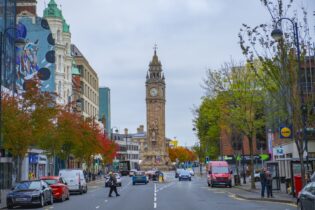
Northern Ireland has recorded its lowest levels of violence and fear of violence since 2019, improving 10.7% from the 2019 baseline. However, the...

Dr Andrew Thomson and Professor Dominic Bryan of Queen's University Belfast set out the case for using the Positive Peace framework to measure and...
Identifying and measuring the factors that drive peace
Analysing the factors that sustain peace.