In the industrial race behind an increasingly automated battlefield, China is well ahead of the US, while investment in AI applications built for peace is well behind.
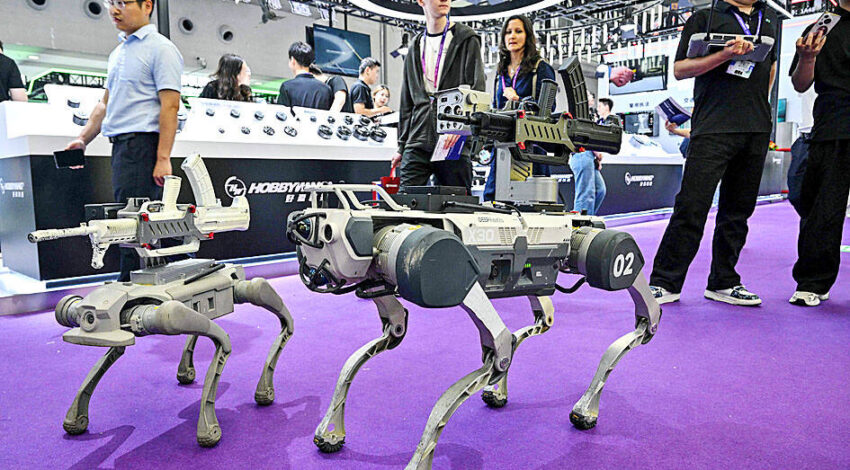
If most of the fighting in a future conventional war is carried out by unmanned systems, military power is redefined as the capacity to combine AI with robotics, and manufacture the result in large numbers.
That is the argument made by Andreas Urbanski, who has worked in AI partnerships at Google Cloud and in military hardware production at Airbus Defence and Space.
On his account, as a guest contributor to the Royal United Services Institute (RUSI), that capacity currently belongs mainly to China.
Urbanski points to demographic pressure as one driver. China’s population is projected to shrink by 250 million people by 2050, and its workforce by at least a quarter. Russia has recorded approximately 1.4 million dead and wounded in its war against Ukraine, and Germany struggles to recruit enough volunteers to reach its North Atlantic Treaty Organisation (NATO) target of 260,000 soldiers. For the governments of China, Russia, and Germany alike, he argues, machines that can fight are becoming a demographic necessity.
China’s industrial position reinforces the point. In 2024, Chinese factories installed 295,000 industrial robots, against 32,200 in the United States and 26,982 in Germany. In humanoid robotics, Chinese firms took close to 90 per cent of the world market in 2025; two manufacturers, Unitree and AgiBot, each sold more than 5,000 robots, while every American manufacturer combined sold fewer than 500.
Most military robots will not fight directly, Urbanski notes. They will scout, clear mines, and carry supplies. But the systems that do fight, autonomous quadrupeds, aircraft, and boats, draw on the same manufacturing base, down to shared batteries, sensors, and actuators.
Underlying this is a harder bottleneck. China produces 90 to 98 per cent of the permanent magnets used in drone motors and actuators, and has tightened export controls on rare earth minerals since 2025. More than 80,000 components across approximately 1,900 US weapons systems depend on minerals that China controls.
The contest extends to software as well as hardware. Stanford University’s AI Index found that the performance gap between Chinese and American frontier AI models has essentially closed, achieved with less than five per cent of the private AI investment made in the United States.
Leading Chinese models are open-weight and up to 50 times cheaper to run than their American counterparts; Alibaba’s Qwen family of models has passed a billion downloads. Open-weight models are not subject to export controls, are not confined to facilities controlled by a single government, and can be adapted by state and non-state actors for specific military uses, a combination that raises the risk of the technology spreading beyond the states that developed it.
China does not hold every advantage. Stanford’s researchers found that AI-powered robots still fail nine in 10 everyday tasks, the United States retains a lead in autonomy software through companies such as Waymo and Tesla, and the People’s Liberation Army (PLA) has not fought a war since 1979.
China is training robots for combat in dedicated centres, however, and Russia’s drone war against Ukraine has generated a large body of battlefield data that Chinese systems, and the components inside them, may help convert into practical experience.
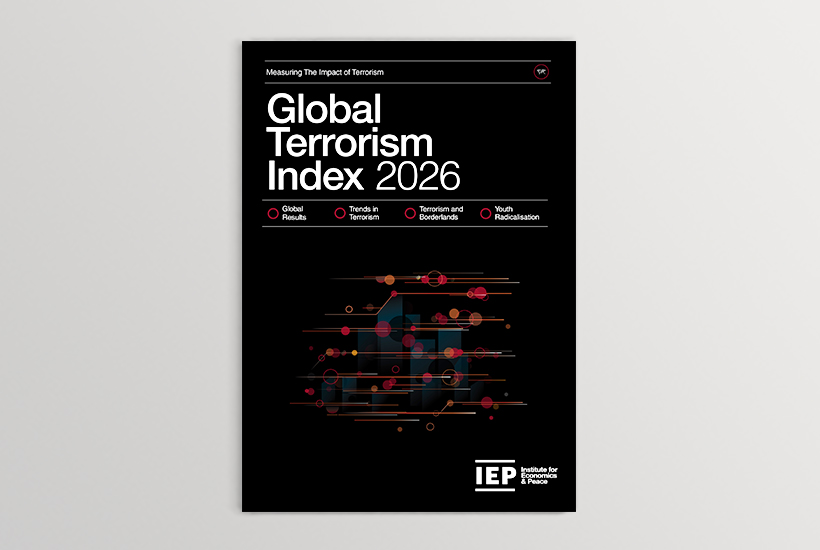
These developments are against a backdrop of global peacefulness deteriorating for a 12th consecutive year in 2026, according to the Institute for Economics & Peace’s Global Peace Index (GPI) 2026. The report recorded 61 active state-based conflicts, the highest number since the end of the Second World War, and found that 99 countries, the largest number in 20 years, became less peaceful over the past 12 months.
Global violence now costs an estimated US$21.8 trillion a year, and conflict deaths reached more than 181,000 in 2025, six times the level recorded in 2008.
Behind these figures lies a change in how wars are fought. Drone strike events worldwide rose from 364 in 2018 to more than 42,000 in 2025, and in several recent conflicts artificial intelligence (AI) has compressed the time needed to review and authorise a strike from about a day to approximately 20 seconds. For the first time, IEP researchers note, machines are making life-and-death combat decisions faster than a human being can meaningfully review them.
In Gaza, Israel used two AI systems, known as Lavender and Habsora (‘The Gospel’), to help identify targets for air strikes. Lavender flagged approximately 37,000 potential targets, most of them classified as ‘military-aged males’ suspected of militant affiliation. Human analysts reportedly spent only 20 seconds reviewing each recommendation before authorising a strike, functioning mainly as an approval step rather than an independent check.
In Iran, the US and Israel tested the Maven Smart System (MSS), a Pentagon program that uses computer vision to analyse satellite imagery and identify targets. By May 2025, the value of Pentagon contracts with the company Palantir for this work had reached approximately US$1.3 billion, an increase of 165 per cent in 12 months. During Operation Epic Fury, US Central Command compressed a process that once took hours or days into seconds, conducting 900 strikes in the first 12 hours.
In Ukraine, drone production reached nearly five million units in 2025. Ukrainian systems such as Saker Scout drones can identify 64 categories of military equipment and continue an attack autonomously after losing contact with GPS or radio signals. Russia has fielded fully autonomous combat drones and V2U loitering munitions fitted with Nvidia Jetson Orin chips that identify targets without a human operator.
The GPI 2026 sets out three levels of risk from this shift. At the tactical level, drone swarms can coordinate attacks and reassign roles without human instruction; one demonstration involved a single operator controlling more than 200 autonomous drones. At the strategic level, frontier AI systems can fuse intelligence at a scale that exceeds human analytical capacity, and AI developers have themselves warned that the same systems could assist in the development of nuclear, biological, radiological, and chemical weapons. At the existential level, a 2026 King’s College London study of 21 simulated nuclear crises found that 95 per cent involved nuclear signalling and tactical nuclear use, and 76 per cent involved strategic nuclear threats.
Governments have begun to respond. The United Nations (UN) established a 40-member Independent International Scientific Panel on AI in August 2025, together with a Global Dialogue on AI Governance. A UN resolution on lethal autonomous weapons, put to a vote in November 2025, received 156 votes in favour. Russia, Israel, and the United States voted against it, and China abstained.
The GPI 2026 also documents a less visible use of the same technology. Applications described as ‘AI for Peace’ support mediation, the documentation of atrocities, language access, and the anticipation of conflict, though they operate at three to four orders of magnitude below the investment scale of frontier military AI. The UN’s Innovation Cell has deployed such tools in Libya, Yemen, Iraq, Lebanon, Haiti, and Bolivia. The Remesh platform can process hundreds of community submissions at once, and the Polis deliberation platform achieved an 80 per cent rate of government action on issues debated through it in Taiwan between 2015 and 2018.
Military AI capability is developing faster than the rules meant to govern it, and the industrial base behind it, in minerals, manufacturing, and increasingly in AI models themselves, is concentrated in fewer hands than at any point since the end of the Cold War. Investment in AI applications built for peace has not kept pace with either trend.
Military power is being redefined as the capacity to combine AI with robotics and manufacture the result at scale, according to Andreas Urbanski of RUSI. Demographic pressure is a key driver: China's population is projected to shrink by 250 million by 2050, pushing governments toward machines that can fight as recruitment pools shrink.
Yes, by manufacturing scale. China installed 295,000 industrial robots in 2024 versus 32,200 in the US, and Chinese firms held close to 90% of the global humanoid robotics market in 2025.
China produces 90 to 98% of the permanent magnets used in drone motors and actuators, and has tightened export controls since 2025. Over 80,000 components across roughly 1,900 US weapons systems depend on minerals China controls.
The US retains a lead in autonomy software through companies like Waymo and Tesla, and AI-powered robots still fail nine in ten everyday tasks, according to Stanford researchers.
Global peacefulness has deteriorated for a 12th consecutive year, with drone strike events rising from 364 in 2018 to over 42,000 in 2025. The UN established a scientific panel on AI in 2025, and a November 2025 resolution on lethal autonomous weapons received 156 votes in favour.

Massive infrastructure investments in artificial intelligence are changing the nature of power in the 21st century and reshaping global alliances.

Global peacefulness deteriorated for the 12th consecutive year, with the number of active, state-based conflicts reaching 61. This is the highest...

Identifying and measuring the factors that drive peace