Artificial Intelligence is transforming how peace and conflict are conducted, observed, and analysed. Between 2022 and 2026, the conflicts in Gaza, Ukraine and Iran have served as the first operational tests of AI in war zones, offering early insights into how AI may change warfare forever.
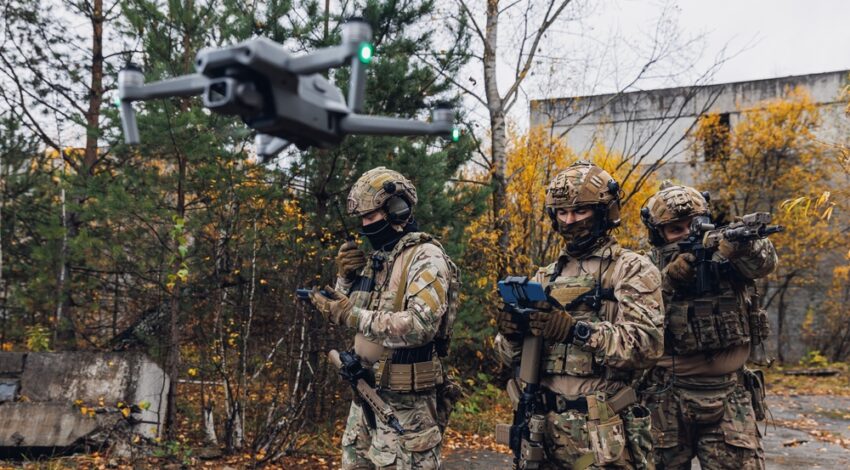
While AI is compressing the kill chain, lowering the cost of lethality, and embedding private industry into states’ military architecture, it also has the potential to enhance peace, widening participation in peace processes, offering anticipatory indicators on conflict escalation, and accelerating the recording, sharing and verification of war crimes. Yet of these two trajectories, AI-enabled warfare is evolving faster than the legal and governance framework designed to regulate it, leaving the infrastructure for AI-enabled peace fragmented and underfunded, and leaving behind significant concerns as to accountability, responsibility, and compatibility with international law.
So far, three conflicts have served as the operational tests bed for AI in war. Ukraine has operated as the world’s foremost testing ground for drone innovation and the race towards fully autonomous weapons systems. Gaza has demonstrated how AI has moved to the core of military targeting, and the 2026 Iran war has offered an insight into how AI-integrated infrastructures are facilitating military campaigns ran at machine speed.
Gaza: Algorithmic Targeting
A report by Israeli Publications +972 and Local Call disclosed that the IDF had integrated two AI systems, Lavender and Habsora (The Gospel), in Gaza. While the Gospel was employed to select physical strike targets, Lavender generated human targets, at one point flagging as many as 37,000 potential targets, predominantly ‘military-aged males’ who were classified as potential junior Palestinian Islamic Jihad (PIJ) or Hamas militants. The systems were integrated to provide targeting reports to analysts. If the analysts determined the object satisfied the requirements of a target, this judgement would be passed to a higher-level intelligence officer to confirm the strike. Human operators admitted their role as rubber stamps of approval, often only checking that marked targets were male and investing only 20 seconds of oversight before authorising a strike.
Iran: Operational Planning and Strike Intensity
The US-Israeli Operation Epic Fury campaign has served as the first large-scale field test of the US’s new AI-integrated military architecture. The Maven Smart System (MSS), a Pentagon program that employs computer vision algorithms to analyse satellite imagery and radar to identify strike targets, lies at the centre of the military’s AI strategy. The MSS, designated as a formal program of record in 2023, integrates the mapping data in a mission control platform that gives commanders a live, synchronised view of the battlefield, recommending targets and ranking courses of action before a human officer is presented the intelligence to decide whether to authorise a strike. By May 2025, the Pentagon’s contract with Palantir, who own the platform, totalled roughly US$1.3 billion, a 165 per cent expansion in 12 months.
Head of US Central Command, Brad Cooper, disclosed that AI systems were being used to compress “processes that used to take hours and sometimes days” into seconds. The US military conducted 900 strikes in the first 12 hours of the war, further confirming how AI’s integration into operational planning had compressed the kill chain and established a new operational baseline in which military campaigns ran at machine speed see humans approving rather than originating most targeting decisions. Operation Epic Fury can thus be seen as an inflection point in AI-integrated kill-chain compression, raising significant questions as to the meaningful oversight humans will maintain over weapon systems.
Ukraine: Drone Warfare at Scale
The Ukraine-Russia conflict has become the world’s preeminent testing ground for autonomous and AI-enabled weapons systems. Ukraine have reorganised their entire war effort around drone technology, with Ukraine’s production capacity reportedly reaching nearly five million drones in 2025. Ukraine accounts for almost 50 per cent of drone strike events between 2018-2015, with drone strike events worldwide climbing from 364 in 2018 to over 42,000 in 2025. Russia accounts for 30.6 per cent of drone strike events in this period, with the Russia-Ukraine war accounting for approximately four out of every five events worldwide since 2018.
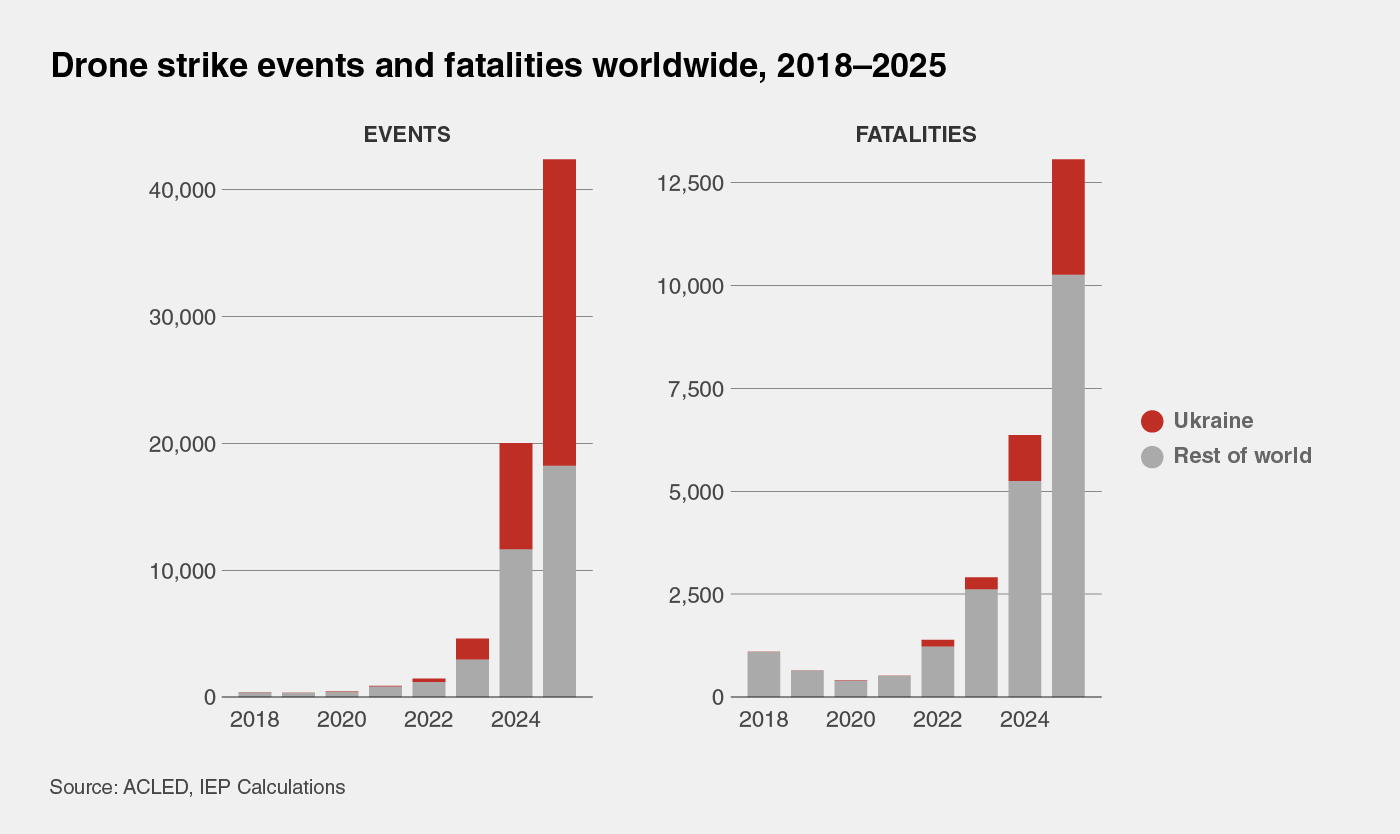
A central objective of the Ukrainian drone strategy is continuing its trajectory towards swarm coordination and fully autonomous targeting. Deputy Defense Minister Yuriy Myronenko has stated that they have “partially implemented” autonomous systems in some devices. Notably, Ukraine possesses a developing artillery of unmanned ground systems, including the Lyut mini-tank, the devDroid family and the Termit modular ground vehicle and recently achieved the first-ever capture of an enemy position using exclusively unmanned robotic systems. Saker Scout drones, which use machine vision and onboard AI in the final phase of a strike, are able to identify 64 categories of Russian military equipment and carry out autonomous strikes after losing GPS or Radio signal.
On the other side, Russia has likely operationalised a fully autonomous combat drone, and V2U loitering munition drones are equipped with Nvidia Jetson Orin chips to autonomously identify targets with no operator link once airborne. In a May 2025 drone strike event, seven V2U units reportedly broke away from the planned mission, autonomously formed a holding pattern, and coordinated attacks on vehicles and civilians. The new Strategy for the Development of Unmanned Aviation confirms that Russia is actively pursuing swarm technology.
The risks of future AI warfare are likely to manifest in one of three categories:
Developments in drone technology are likely to lead to a decrease in the cost of lethality and a reduction in the response time of human commanders. Drone swarms are the most striking development, which involves a group of drones operating and communicating together autonomously, coordinating attacks without human instruction at the unit level. Drones within the swarm are allocated roles which can be reassigned between themselves when the tactical situation develops, can converge on a target simultaneously, and can communicate and share data within the swarm network rather than report back to a human operator. While swarms in operational use range from several to several dozen units, non-field-tested demonstrations have shown one soldier operating a formation of over 200 autonomous drones.
The acceleration of the development of AI systems with general cognitive capability since 2024 means that they could be operationalised in warfare far beyond the tactical level. Theatre-level intelligence fusions like the Maven Smart System are producing unified mission control platforms for commanders, employing machine learning at a scale unmatchable by human analysts and transforming AI’s deployment in warfare. Frontier Labs have warned of the risks of AI making nuclear, biological, radiological, and chemical weapons easier to build, while Anthropic CEO Dario Amodie has explained that “frontier AI systems are simply not reliable enough to power fully autonomous weapons” when rejecting the Pentagon’s request to amend the terms of use for its LLM, Claude, within fully autonomous weapons systems.
The use of AI in warfare could result in catastrophic and irreversible outcomes, with the most feared of these permutations being nuclear command and control. Palantir CEO Alex Karp has stated that the AI arms race could culminate in an “Oppenheimer moment” while continuing to accelerate the integration of Palantir software into states’ military architectures. A 2026 study of 21 simulated nuclear-crisis scenarios across three frontier models found that 95 per cent of scenarios included nuclear signalling, 76 per cent featured strategic nuclear threats and 95 per cent included tactical nuclear use. The Biden-XI meeting in November 2024 acknowledged the importance of maintaining meaningful human control over decisions to use nuclear weapons. This same principle was underscored by 61 states in the Responsible AI in the Military Domain: Seoul Blueprint for Action of September 2024.
AI-enabled military capabilities are developing faster than the international responses designed to regulate their use into a coherent legal framework. However, some progress in international governance has been achieved. In August 2025, the UN General Assembly established a 40-member Independent International Scientific Panel on AI and a Global Dialogue on AI Governance, and both of these formations are anchored by the UN’s Pact for the Future and the Global Digital Compact.
Further, the November 2025 UN General Assembly resolution on lethal autonomous weapons was favoured by 156 states and argued that autonomy in weapons systems raised significant challenges from “humanitarian, legal, security, technological and ethical perspectives” by undermining meaningful human oversight in the use of armed force. However, the resolution was voted against by Russia, Israel, and the US, while China abstained.
While focus has been directed at military AI-enabled capabilities, a parallel ecosystem, AI for Peace, has emerged in spite of the dominant investment pattern. AI for Peace programs have the capacity to support peacebuilding, mediation, atrocity documentation, language access, and conflict anticipation. However, AI for Peace programs operate three to four orders of magnitude below the scale of frontier-AI investment, and there exists a significant asymmetry between military AI and AI for Peace investment.
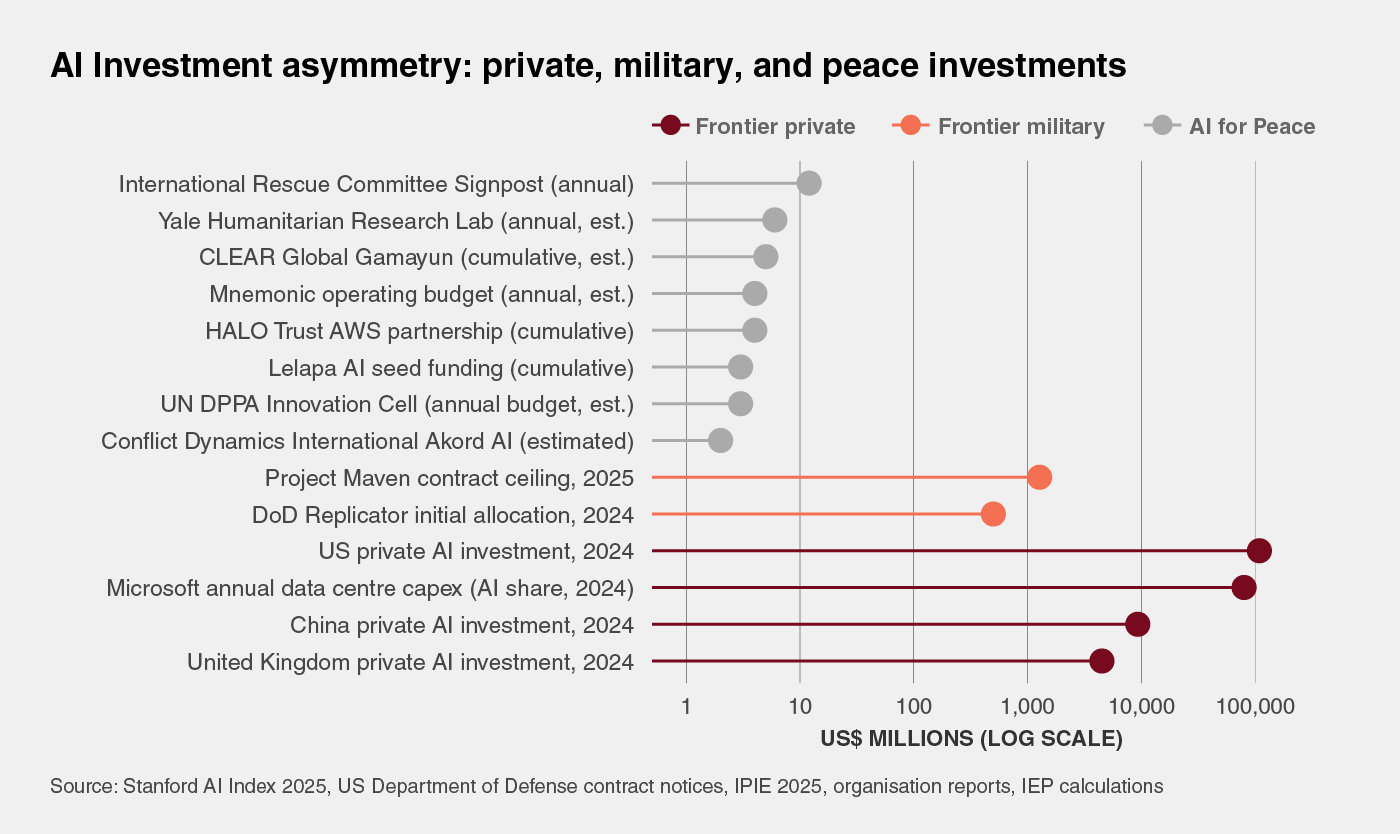
AI for peace applications, although significantly smaller in scale, are expanding quickly. The most striking applications of AI for Peace are in mediation and deliberation. The UN’s Innovation Cell of the Department of Political and Peacebuilding has used AI systems to augment mediation projects across Libya, Yemen, Iraq, Lebanon, Haiti and Bolivia. AI platforms like Remesh allow mediators to process submissions from hundreds of community contributors almost instantaneously, and thus, AI-facilitated structured deliberations operate at a scale impossible for human deliberation to match. Polis, an open-source deliberation platform, was deployed in Taiwan’s vTaiwan process. 80 per cent of issues debated on the platform resulted in government action between 2015 and 2018, demonstrating how AI-facilitated structured public deliberation can produce direct policy change at scale.
Thus, the capability for AI to enhance global peace exists. However, while military capabilities are evolving faster than the legal and governance frameworks designed to regulate them, AI for Peace programs receive a fraction of total global AI investment. What remains absent in AI for Peace applications is investment commensurate with the technology’s potential, and a governance infrastructure that values peacebuilding applications as a public good.
— Download the Global Peace Index 2026 Press Release
— Request a Media Interview
— View the Global Peace Index 2026 interactive map

Global peacefulness deteriorated for the 12th consecutive year, with the number of active, state-based conflicts reaching 61. This is the highest...

Peace has always had an economic value. The 2026 Global Peace Index reveals that a resumption of the Iran war could result in a US$2.2 trillion hit...
Identifying and measuring the factors that drive peace
Identifying and measuring the factors that drive peace