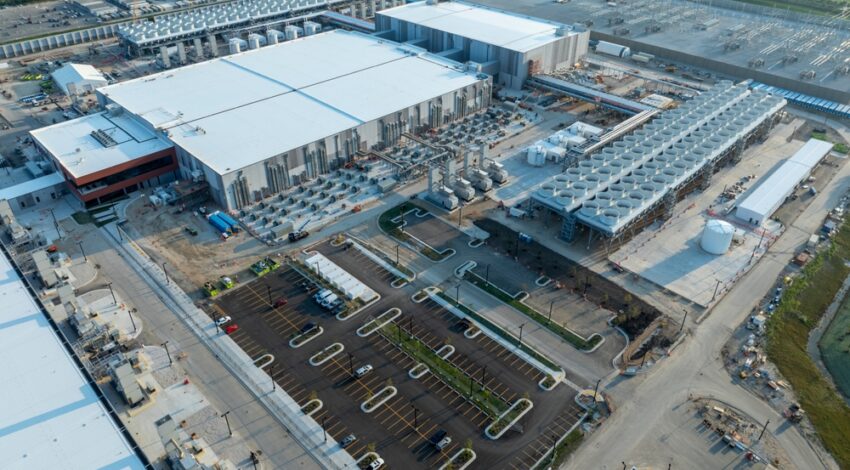
Massive infrastructure investments in artificial intelligence are changing the nature of power in the 21st century and reshaping global alliances.
Every era of great power competition has revolved around a particular critical resource.
In the 19th century, steel production determined industrial might. Throughout the 20th century, oil access shaped military power and economic dominance. Now, in the 21st century, artificial intelligence is increasingly viewed by major powers as a strategic resource that could shape future power dynamics.
The current scale suggests a fundamental shift in strategic thinking: Europe announced over $23 billion investment in AI infrastructure, Saudi Arabia over $114 billion, and the United States between $1.14-2.28 trillion. These enormous numbers exceed the typical technology spending. Historically, such a fund allocation was used for power competition, suggesting that the major powers now see AI as not merely as a technology sector, but a fundamental part of national power, economic influence and even cultural identity.
Yet this competition differs from previous ones. Understanding how and why reveals much about the changing nature of power in the 21st century.
The significance of the AI race became clear in 2017 when China published its AI development plan, setting a goal to achieve global leadership in artificial intelligence by 2030. This is how the term “AI Cold War” has gained widespread use among the policymakers to describe a technological competition between major powers, primarily the US and China. This competition extends across four technology domains: artificial intelligence, semiconductor chips, quantum computing, and biotechnology. Together, these “accelerator technologies” have the potential to enable rapid advances across economic, military, and social domains. Yet, there is an ongoing debate about its accuracy and whether this framing reflects genuine strategic competition or whether the framing itself helped create the competition.
When drawing parallels to the 20th century Cold War, where newly independent nations were pressured to align themselves with either the US or the Soviet Union, today, developing countries face similar constraints as they choose between the technological ecosystems of those of the US or China. Both powers are luring nations through funding, technology transfers, and capacity-building programs, but also each nation presents its AI capabilities as superior models. Yet there are four differences that distinguish this race from its predecessor.
First, the strategic resource has shifted from nuclear weapons to advanced silicon chips. Second, the way the Cold War was financed has changed. The first Cold War was primarily financed by the government through public programs. While today’s AI competition relies heavily, if not only, on private investment since the most advanced AI systems come from private companies such as NVIDIA, Meta, OpenAI, Anthropic, Google, etc. Yet the governments can intervene and regulate private companies by taking equity stakes, sharing revenue from strategic exports, and using regulatory power to shape future development. The result is neither purely market-driven nor government-directed, but a hybrid model that varies from country to country.
Third, transparency has reversed. Cold War developments were held in secret, behind the closed doors. Today AI development happens publicly: research papers with detailed capabilities are being published, and new models are released in open access to anyone in the world. However, this leads to a paradox where everyone can see what everyone else is doing, however competitive advantages continue to be strictly protected through chip export controls, talent acquisition, and strategic partnerships. Since the biggest AI chip companies are produced in the US by the most-well known company NVIDIA, US policy has sought to restrict China’s access to these chips, aiming to slow Beijing’s progress. Some analysts argue, however, that the restrictions might inspire China to come up with innovative solutions and could make them stronger.
Finally, what we see now is new alliances being formed not based on political ideologies but on technological compatibility.
Both China and the US have different approaches in the governance and deployment of AI, shaped by their different economic environments.
As AI transitions from experimental demonstrations to real-world deployment, the central challenge shifts from technical feasibility to economic sustainability, particularly the cost of delivering reliable and useful outputs. The question of who bears these costs leads US and Chinese firms toward distinct monetisation strategies. For instance, Chinese AI startups tend to target enterprise and government customers, while US startups build around abundance raising huge capital, buy time and push the boundaries. Further, because Chinese startups adapt to different conditions, as their infrastructure for cutting-edge research is more limited, their growth must come from efficiency, strategic focus, and careful market selection.
There is also a big capital gap as the AI startups in the US attract more capital than those in China. In 2024 alone, US companies received nearly $109.1 billion in private investment, while Chinese firms received only about $9.3 billion, a figure that includes government-backed funding alongside private capital. Another difference in the approach is that AI companies in the US receive revenue from selling the access to their AI models to businesses and individuals. Anyone can buy ChatGPT Plus for $20 per month, while Chinese firms, such as DeepSeek, Baidu, and ByteDance’s Doubao provide access for free and this is because its consumer AI operates on a different model. For companies like Baidu and ByteDance, AI is primarily a tool to attract and retain massive user bases, with profits generated indirectly through ads, enterprise services, such as API calls from businesses, and platform integration like cloud service bundling, rather than through direct user subscriptions.
Besides the huge capital gap, there is also a massive spending gap. The US firms spent about $368.52 billion on software in 2024, while China only $61.8 billion. This is because historically, Chinese firms spend far less on software as AI cannot be easily sold as a standalone product. Instead, it has to be represented as a full-service solution for concrete business outcomes and aims to be sold to big organisations rather than individual users.
Finally, the deployment of AI in the industrial sector in both countries varies significantly. In manufacturing, 67% of Chinese industrial firms have deployed AI in production, compared with 34% of analogous US firms. This speed of deployment by Chinese firms is linked to their revenue depending on delivering outcomes rather than access, and this is something China is very good at.
Overall, the US might lead in terms of model performance, while China might be ahead in terms of widespread adoption. It all depends on how the progress is defined – when it comes to model performance, the US might be ahead; however, if progress means broader economic adoption, China may have the edge, as its restriction-based strategies are gaining traction more quickly in certain areas.
The challenge becomes clear when examining the components of AI capability.
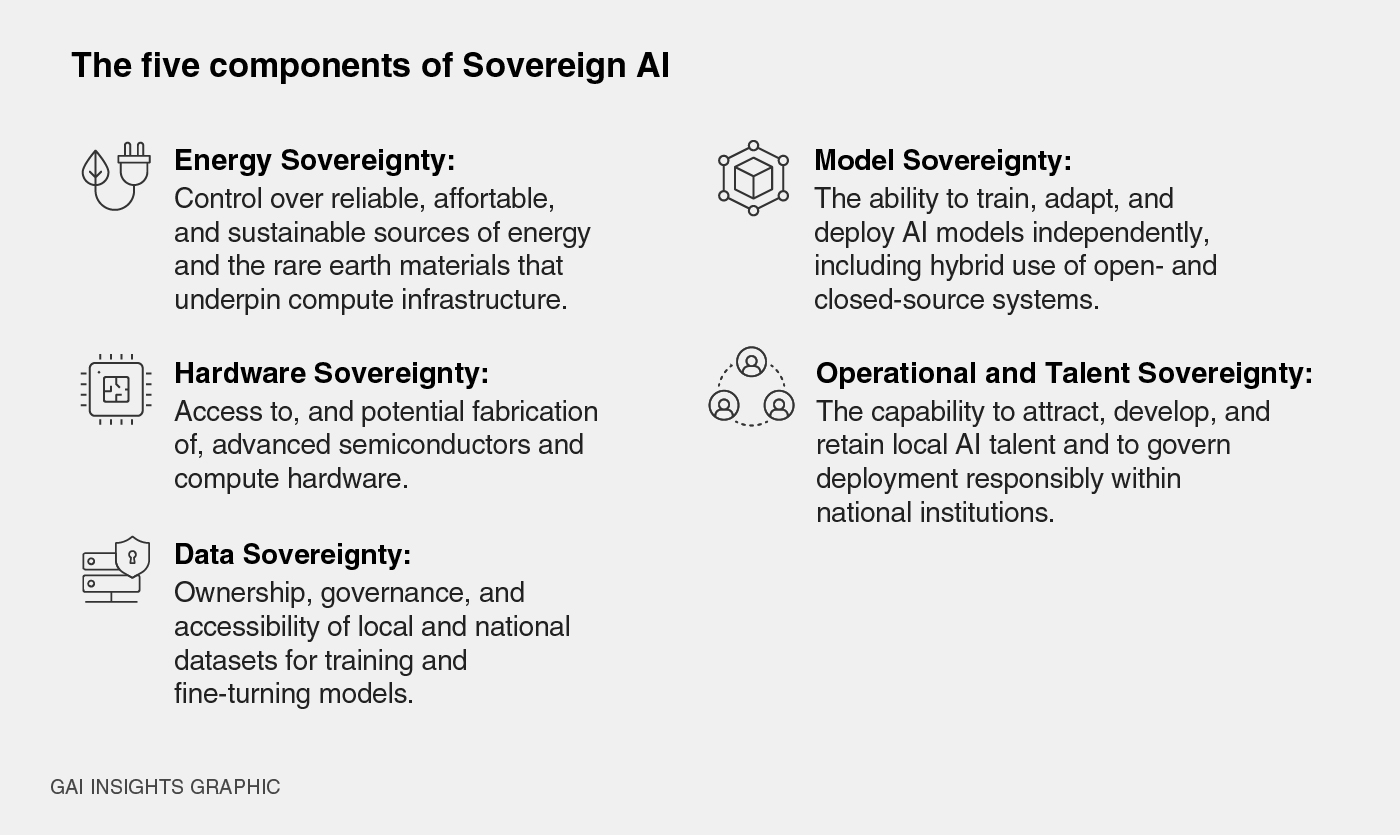
Forbes analysis identifies five essential layers: energy, hardware, data, models, and talent. In theory, every nation would like to have control over its AI future. However, in practice, no country, not even the US or China, has achieved a complete independence across all these five layers. Some nations have advanced models but lack semiconductor manufacturing capability. Others have manufacturing capacity but face talent shortages. Some have talent but lack the venture capital necessary for innovation and scaling.
The analysis suggests that the US and China maintain leadership positions because they are strong across all five layers, not because either has achieved complete self-sufficiency. This interdependence creates both vulnerability and opportunity as nations must choose where to invest their limited resources, which partnerships to pursue, and which dependencies to accept. However, according to some experts, even smaller countries can find their niches if they align their infrastructure and partnerships effectively. For example, Saudi Arabia can turn its cheap energy into a competitive advantage by establishing large data centers.
Looking ahead, observers offer different assessments of how AI competition will evolve in the future. Some analysts suggest that AI is creating what they call a new “world order” where the leading nation in AI may construct the new emerging international order. Some experts claim that the AI race in 2026 will still likely remain defined by a multipolar order, with the US and China as its leaders. Another analysis notes that the winner could gain not just economic advantages but determine technological standards, military capabilities, establish control over supply chains and influence the future of job markets.
Moreover, some analysts argue that whichever nation sets the ethical standards for AI development could become known as “the moral compass for the digital age” and could influence what should be considered as “normal,” “true,” what is hate speech, political extremism, or “harmful.” Some experts argue that it could become a new form of soft power because it may enable that country to spread its cultural values and ethics more easily and faster. At the same time, countries that are unable to develop the same technologies might face a risk of falling behind the major powers and as a result the global inequality might increase.
On a final note, caught between these two major powers, an increasing number of countries are opting for hybrid strategies rather than aligning completely with one side or the other. France, the United Arab Emirates, and Singapore are examples of this “third way.” These countries purchase computing power and tools from the global leaders while developing their own AI models and data sets. They selectively enter into partnerships for specific competencies and try to preserve their autonomy in decision-making.
Moreover, the rise of regional technology centres in developing countries such as India, Kenya, and Brazil suggests that a new “Non-Aligned Movement” in AI development might be possible. These countries are building their own AI platforms that are customised to their own local needs and values, at the same time they are selectively working with the US and China. However, there are also some disagreements regarding whether true AI sovereignty is achievable or whether interdependence is inevitable.
This bifurcation into competing technological ecosystems echoes a broader shift that IEP’s 2026 Global Peace Index describes as the “Great Fragmentation”, or a gradual retreat from the multilateral, interdependent order of recent decades toward hardening blocs. Whether AI ultimately deepens this fragmentation or opens new avenues for cooperation may prove just as consequential for global peace as who leads the underlying technology race.
Artificial Intelligence is transforming how peace and conflict are conducted, observed, and analysed. Between 2022 and 2026, the conflicts in Gaza,...

While advancing a “maximum lethality” doctrine in its war with Iran, the US is simultaneously testing a large-scale AI-driven military...
Identifying and measuring the factors that drive peace
Identifying and measuring the factors that drive peace