Most countries with large peace deficits in 2009 saw internal peace deteriorate over the following 15 years.
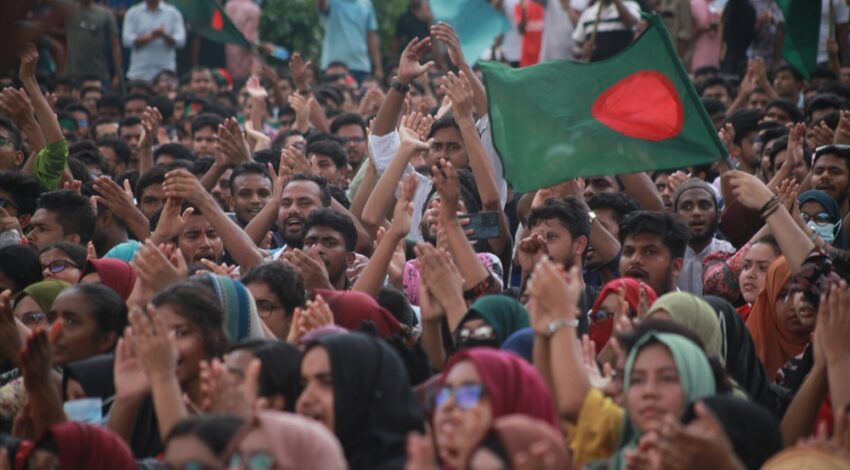
Countries whose peacefulness outruns their institutional strength are more likely to see violence rise, according to the Positive Peace Report 2026, released by the Institute for Economics & Peace (IEP).
Of the 30 countries with the largest deficits in 2009, 25 deteriorated in internal peace by 2024. All 16 countries with the largest deficits deteriorated. The five largest falls in the internal peace rankings over the period were Burkina Faso (101 places), Libya and Syria (72 places each), Nicaragua (58) and Panama (56). Most came from countries that carried large or near-large deficits in 2009.
Burkina Faso shows the dynamic in its sharpest form. In 2009 it ranked 129th on the Positive Peace Index (PPI) but 52nd for internal peace, a deficit of 77 places. The fragility surfaced after the fall of the Compaoré government in 2014, the spread of insurgent violence linked to extremist groups across the Sahel and military coups in 2022.
Its internal peace score deteriorated by 71.3% by 2024. Libya, with a 2009 deficit of 42 places, followed a similar path through the Arab Spring revolution and civil war, recording a 42.9% deterioration.
The size of the falls also differed. Among countries with deficits of at least 20 places that deteriorated, the average decline in internal peace was 15%, compared with 12% for other deteriorating countries.
The report uses two comparisons to show how small differences in Positive Peace can set countries on very different paths. IEP describes these as tipping points.
Between 2009 and 2024, 83.3% of countries with large Positive Peace deficits recorded a deterioration in internal peace, compared with 54% of all countries.
IEP defines a Positive Peace deficit as a country whose internal peace rank on the Global Peace Index (GPI) is at least 20 places ahead of its rank on the PPI. In plain terms, the country is more peaceful than its institutions, economy and social cohesion would predict. When peacefulness sits ahead of resilience, the system is more exposed to shocks.
The inverse is a Positive Peace surplus, where structural resilience sits ahead of peacefulness. Countries with surpluses tend to translate that resilience into peace gains over time. Of those that did, the average improvement in internal peace was 10.2%, against a global average deterioration of 3.2%.
Egypt and Syria occupied comparable positions in 2009. Both were classified as authoritarian regimes, but Egypt scored materially better on Well-Functioning Government, Low Levels of Corruption and Sound Business Environment. After the Arab Spring, Syria descended into large-scale civil war and became entrenched in what IEP calls the Conflict Trap. Egypt experienced significant upheaval but avoided a comparable collapse.
Georgia and Venezuela diverged in the other direction. In 2009 Venezuela ranked 143rd for internal peace and Georgia 147th, but Georgia had the stronger foundations, ranking 70th on the PPI against Venezuela’s 96th.
By 2024 Georgia ranked 70th for internal peace and Venezuela 145th. Georgia’s politics have since been marked by polarisation and concerns about democratic backsliding, and its PPI rank improved by 21 places to 49th.
Venezuela, where checks and balances eroded, recorded the largest Positive Peace decline of any country in the Index over the decade to 2024.
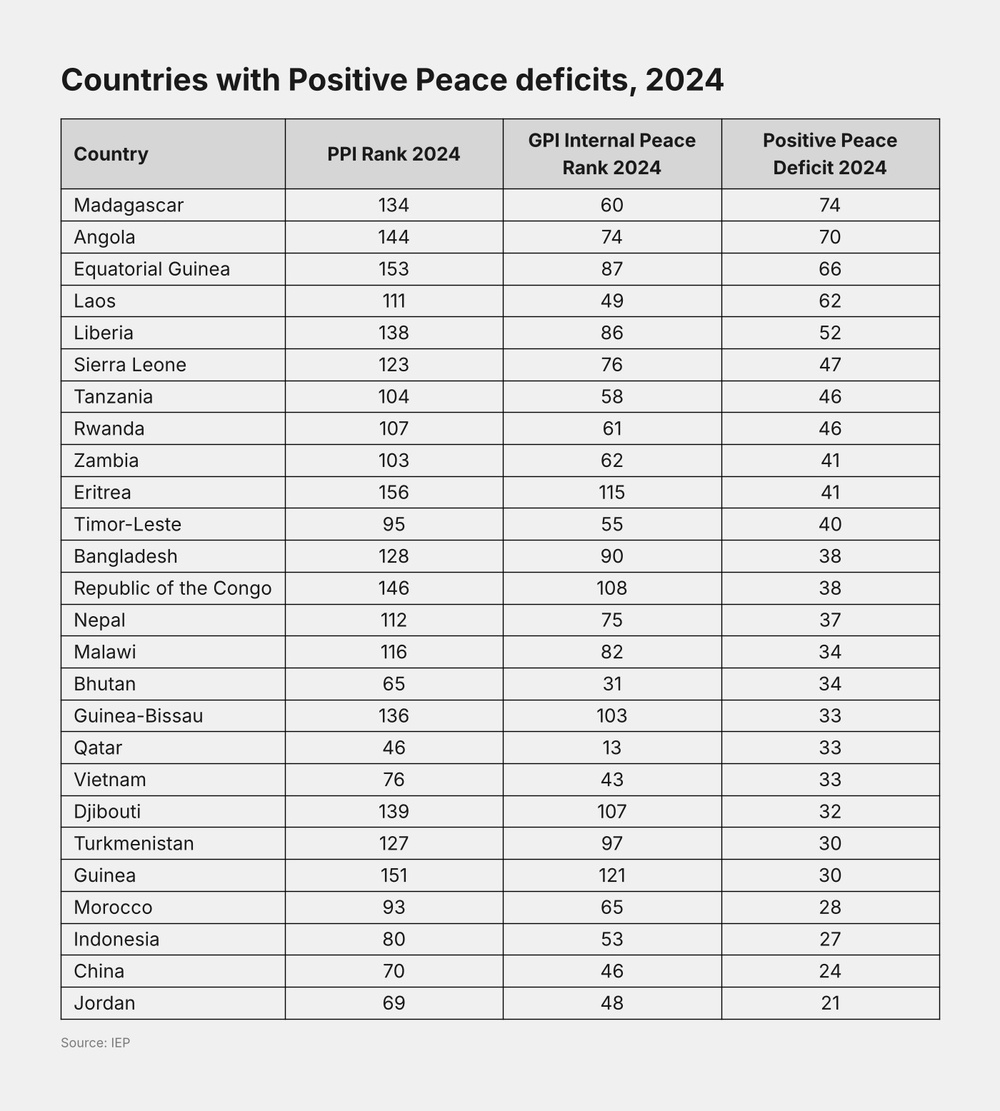
Madagascar (74 places), Angola (70), Equatorial Guinea (66), Laos (62) and Liberia (52) head the list of the 26 countries with deficits of 20 places or more in 2024.
The report singles out Eritrea. It combines a 41-place deficit with a long-running deterioration in its foundations: its PPI score fell by 8.5% from 2009 to 2024, with seven of the eight Pillars deteriorating. Equatorial Guinea, Turkmenistan, Laos, Madagascar, the Republic of the Congo, Angola and Djibouti have also recorded modest to large deteriorations in Positive Peace over the same period.
The framework describes patterns of risk, not mechanical predictions. Bhutan, Madagascar and Timor-Leste all held substantial deficits in 2009 and recorded improvements in internal peace by 2024.
IEP attributes this to small populations, strong community ties, geographic isolation or post-conflict fatigue, even where the economic and institutional base remains limited.
Timor-Leste and Indonesia illustrate the point from another angle. Both appear on the 2024 list, despite sustained improvements in government effectiveness and corruption control since 2009.
In Timor-Leste, the share of young people not in employment, education or training deteriorated by more than 40%. In Indonesia, internal peace deteriorated as social inclusion weakened.
For these countries, the report says long-term resilience depends on building the institutions and service delivery that reduce the incentives for corruption, organised crime and political instability.
IEP uses the Positive Peace deficit as a structural risk indicator. In 2024, 26 countries had deficits of 20 places or more, led by Madagascar (74 places), Angola (70), Equatorial Guinea (66), Laos (62) and Liberia (52). The report singles out Eritrea, which combines a 41-place deficit with Positive Peace foundations that have been deteriorating for years
A Positive Peace deficit is a country whose internal peace rank on the Global Peace Index (GPI) is at least 20 places ahead of its rank on the Positive Peace Index (PPI). In plain terms, the country is more peaceful than its institutions, economy and social cohesion would predict, which leaves it more exposed to shocks.
Countries with large deficits were more likely to see internal peace deteriorate: 83.3% did between 2009 and 2024, against 54% of all countries. Of the 30 countries with the largest deficits in 2009, 25 deteriorated, and all 16 with the largest deficits did.
No. Bhutan, Madagascar and Timor-Leste all held large deficits in 2009 and recorded improvements in internal peace by 2024. IEP attributes this to small populations, strong community ties, geographic isolation or post-conflict fatigue, and describes the deficit as a structural risk indicator that complements country-specific analysis, not a deterministic forecast.
A tipping point is a threshold beyond which small differences between countries lead to sharply different outcomes. IEP says small differences in Positive Peace can set countries on very different paths, because countries respond very differently to the same shock depending on their histories, institutions and social norms. In mid-peace countries, small changes can precede rapid deteriorations if they pass a tipping point. The report illustrates this with Egypt and Syria, and with Georgia and Venezuela: pairs that started close together in 2009 and ended up in very different places.
Both were classified as authoritarian regimes and occupied comparable positions in 2009. Egypt scored materially better on Well-Functioning Government, Low Levels of Corruption and Sound Business Environment. IEP found these modest differences proved critical to each country's capacity to absorb the shocks of the Arab Spring.
By 2024 Georgia ranked 70th for internal peace and Venezuela 145th, having ranked 147th and 143rd in 2009. Georgia started with stronger Positive Peace foundations, ranking 70th on the Positive Peace Index against Venezuela's 96th, even though Venezuela was marginally more peaceful. Georgia experienced a peaceful transfer of power in 2012, while power in Venezuela became increasingly concentrated and checks and balances eroded.
Over the 2009 to 2024 period, no country in the Sustainable Peace region, where both Positive Peace and internal peace are high, experienced a large deterioration in internal peace, despite shocks. By contrast, countries in the Conflict Trap tend to find it difficult to exit without external assistance.
A surplus is the inverse of a deficit: a country's structural resilience sits ahead of its peacefulness. From 2009 to 2024, 58% of surplus countries recorded improvements in internal peace, rising to 75% outside the Americas, where organised crime and political instability produced widespread deteriorations.
For mid-range countries, IEP identifies Well-Functioning Government and Low Levels of Corruption as structural bottlenecks. Only three countries, China, Indonesia and Timor-Leste, recorded sustained improvement in both between 2009 and 2024. Mid-range countries that improved on both Pillars recorded the largest average gains in Positive Peace and internal peace.

The Positive Peace Report 2026 finds that the concept and metric of Positive Peace offers an empirically based path to renewal for democracies...
Two decades of Global Peace Index data tell a story that goes beyond deterioration. They describe a world that has learned to live with a growing...
Identifying and measuring the factors that drive peace
Identifying and measuring the factors that drive peace