The Positive Peace Report 2026 finds that the concept and metric of Positive Peace offers an empirically based path to renewal for democracies grappling with falling productivity, social fragmentation, and declining government legitimacy.

Positive Peace is a transformational concept for societal revitalisation, according to the Positive Peace Report 2026, released by the Institute for Economics & Peace (IEP).
Empirically developed from analysis of more than 20,000 datasets, the framework places peace at the centre of national development. It is associated not only with more peaceful societies but with higher per capita income growth, stronger performance on measures of wellbeing and happiness, better environmental outcomes and improved development outcomes more broadly.
Many democracies, particularly in high-income Western economies, are contending with low or falling productivity, social fragmentation, declining legitimacy in government and reduced international influence. The report states that for high-income countries facing these pressures, Positive Peace ‘provides a blueprint for revitalising these societies.’ IEP argues that addressing these pressures requires an approach grounded in evidence and simple enough to be widely understood and applied. Positive Peace, the report argues, holds the promise of that transformational change.
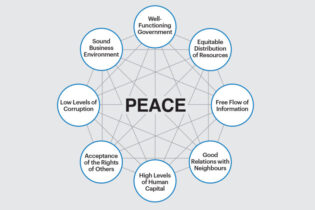
The report’s two decades of data illustrates why the case is being made now. Countries such as The Netherlands, Germany, Sweden, Spain and France have markedly deteriorated in key areas including government effectiveness rule of law, control of corruption and regulatory quality, while simultaneously having marked improvement in many measures of inequality, group grievances and gender. The report finds that social advancement relies on a balanced system where improvements are made across eight different thematic areas.
In the United States, Positive Peace deteriorated by 8.8%, the second-largest decline after Venezuela of any country in the Index, driven by a 54.6% deterioration in the factionalised elites indicator, the largest such decline recorded on that indicator by any country. High-income democracies, the report finds, are not immune to the erosion of the institutional foundations that Positive Peace measures.
The report finds Positive Peace is a strong predictor of economic and social performance, the outcomes at the centre of its renewal case for Western democracies. Real GDP grew at twice the rate in countries that improved in Positive Peace compared with those that deteriorated between 2015 and 2024, while foreign direct investment grew at 9.3% a year in improving countries against 3.5% in deteriorating countries. Positive Peace also correlates closely with environmental performance, health outcomes and subjective wellbeing.
That erosion sits inside a wider global pattern. Positive Peace improved by 1.7% over the decade to 2024, but the gain was driven almost entirely by a single indicator: the telecom infrastructure index, which improved by 36.8%. Excluding it, the Positive Peace Index (PPI) would have deteriorated by 0.1%, with 84 of the 163 countries in the Index recording declines compared with 79 that improved.
The largest global deterioration of any of the eight Pillars was in Well-Functioning Government, down 3%, driven by declines in government openness and transparency, rule of law and government effectiveness. The steepest decline of any single indicator was freedom of the press, down 22.1%, with declines in 141 of 163 countries, accelerating to more than five times its pre-pandemic pace after 2020.
Positive Peace is also a good measure of societal resilience. During COVID-19 countries with higher Positive Peace were less affected and recovered more than three times quicker.
China and India each improved by around 6% over the same period, although India’s freedom of the press fell by 45.4%. Russia deteriorated by 5.2%, with the deterioration concentrated in the period following its invasion of Ukraine in 2022. Across five leading global powers assessed in the report, all rank substantially higher on the PPI than on IEP’s Global Peace Index (GPI), indicating stronger socio-economic foundations than current levels of peacefulness would suggest.
Among mid-peace countries, which face the greatest risk of sliding backward, Well-Functioning Government and Low Levels of Corruption stand out as structural bottlenecks. Countries in this group that improved on these two Pillars recorded the largest average gains both in Positive Peace overall and in internal peace, while those that deteriorated on the same Pillars saw substantially poorer outcomes.
It means using the eight measurable Pillars of Positive Peace, covering areas like government effectiveness, economic openness and social cohesion, as a practical framework for addressing the falling productivity, social fragmentation and declining government legitimacy many democracies are facing. Because the framework is empirically developed and simple enough to apply, IEP argues it offers a concrete starting point rather than just a diagnosis.
No. In the United States, Positive Peace deteriorated by 8.8%, the second-largest decline after Venezuela of any country in the Index, driven by a 54.6% deterioration in the factionalised elites indicator, the largest such decline recorded on that indicator by any country. High-income democracies are not immune to the erosion of the institutional foundations that Positive Peace measures.
Positive Peace improved by 1.7% over the decade to 2024, but the gain was driven almost entirely by a single indicator, the telecom infrastructure index, which improved by 36.8%. Excluding it, the Positive Peace Index would have deteriorated by 0.1%, with 84 of the 163 countries in the Index recording declines compared with 79 that improved.
Real GDP grew at twice the rate in countries that improved in Positive Peace compared with those that deteriorated between 2015 and 2024, while foreign direct investment grew at 9.3% a year in improving countries against 3.5% in deteriorating countries. Positive Peace also correlates closely with environmental performance, health outcomes and subjective wellbeing.
Among mid-peace countries, which face the greatest risk of sliding backward, Well-Functioning Government and Low Levels of Corruption stand out as structural bottlenecks. Countries in this group that improved on these two Pillars recorded the largest average gains both in Positive Peace overall and in internal peace.

The Positive Peace Report 2026 finds freedom of the press fell faster than any other indicator over the past decade, accelerating sharply after...
Harnessing the essence of Positive Peace is more than just envisioning a world without conflict; it’s about actively shaping our future through...
Identifying and measuring the factors that drive peace
Identifying and measuring the factors that drive peace