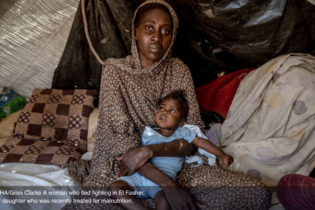
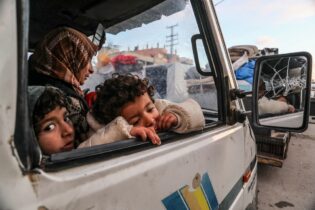
Drone strikes are now causing most civilian conflict deaths in Sudan, as a technology refined in Ukraine and Gaza is now prolonging one of the world's deadliest wars.
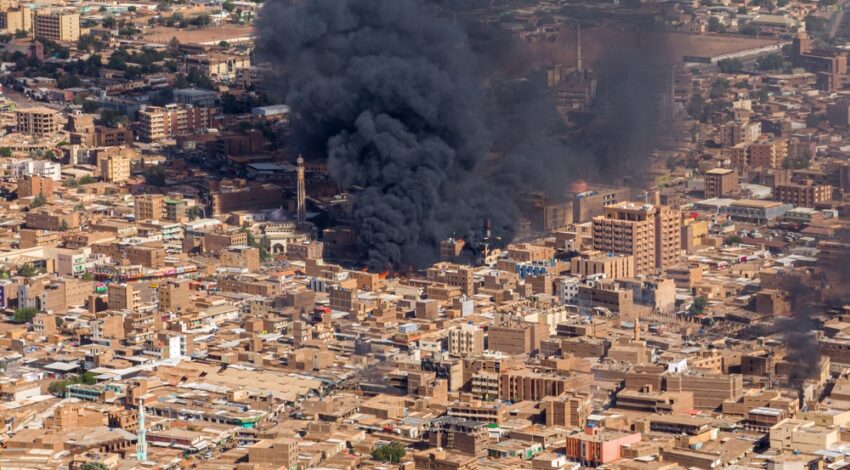
Unmanned aerial vehicles have become the leading cause of civilian deaths in Sudan’s civil war. Drone strikes killed at least 306 people and injured hundreds more in the first three weeks of October 2026, according to the United Nations (UN) Office of the High Commissioner for Human Rights.
Strikes hit homes, markets, hospitals, displacement sites, power stations and water sources across Kordofan, Darfur, Blue Nile and Khartoum. The deadliest single incident in that period occurred on 18 October in Dibab, West Kordofan. At least 139 people were killed when a transport truck was hit in a repeat strike. Nine days earlier, a strike on displaced people working at a gold mining site in Abu Shendi, Blue Nile, killed at least 31 people, most of them women and children.
The October figures follow a longer trend. Between January and April 2026, drone strikes killed at least 880 civilians, more than 80% of all conflict-related civilian deaths recorded in Sudan. The most frequently struck targets were markets, residential areas and military assets and sites. The UN recorded at least 28 drone attacks on markets and at least 12 on health facilities that caused civilian casualties over the same period.
Both the Sudanese Armed Forces (SAF) and the Rapid Support Forces (RSF) use drones, and the UN has attributed civilian deaths to both sides.
The Global Peace Index (GPI) 2026 identifies drones as the defining weapon of modern warfare. Recorded drone attacks rose by around 11,500% between 2018 and 2025. Over the same period, 565 armed groups, including criminal cartels, carried out at least one drone strike, and the number of states with a recorded drone strike rose by more than 200%.
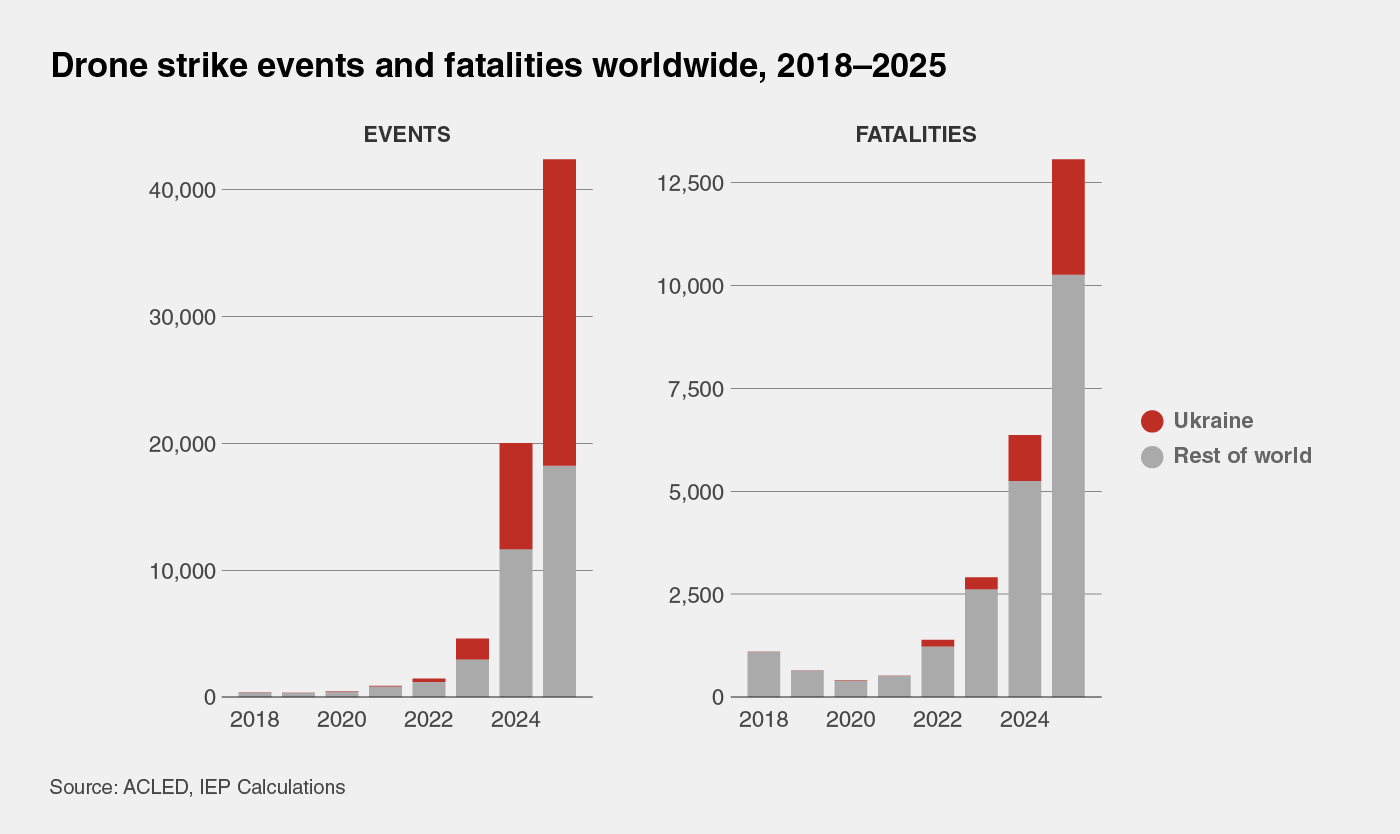
The war in Ukraine showed how quickly drones could reshape a battlefield. Cheap, short-range drones became a routine part of frontline combat, and their effect on civilians has grown each year. In 2025, short-range drones killed 577 civilians in Ukraine and injured 3,288, according to the UN Human Rights Monitoring Mission in Ukraine.
That was more than double the 2024 figures of 226 killed and 1,528 injured. The GPI 2026 also notes that autonomous systems in Ukraine are now being used to engage targets without an operator in the loop.
The conflict in Gaza added another layer: the use of artificial intelligence (AI) to select targets. The GPI 2026 reports that algorithmic targeting systems in Gaza have reportedly cut human review to about 20 seconds per strike. More broadly, military targeting cycles that took about a day in the 1990s can now take as little as five seconds.
Institute for Economics & Peace (IEP) Founder and Executive Chairman Steve Killelea said that “AI and autonomous drone technology are making life and death decisions with human oversight reduced to seconds.”
Sudan is an example of what can happen when this technology spreads to a civil war with weak oversight and many outside suppliers. An investigation by the Centre for Information Resilience identified 21 drone models used in Sudan since the war began, 10 deployed by the RSF and five by the SAF. The systems originate mainly from Belarus, China, Iran, Russia, Sudan and Türkiye. No binding international framework governs their use.
The war began in April 2023 as a contest for control of Khartoum and other major cities. Drones have since extended the reach of both sides far beyond the front lines. Both the SAF and the RSF have moved towards long-range strikes on supply routes, fuel and ammunition depots and command centres.
The effect is that no part of the country is beyond reach. Most drone-related civilian deaths in early 2026 occurred in Kordofan, but drone use has spread to Darfur, Blue Nile, White Nile and Khartoum.
A strike on Khartoum International Airport on 4 May 2026 disrupted all flights. Strikes on power stations, fuel stores and water sources have caused blackouts and cut supplies to populations that already face famine.
Drones also change the cost of fighting. A force that cannot hold territory can still strike its opponent’s logistics, markets and towns. This lowers the price of continuing the war, and it shifts more of the burden onto civilians. In the first four months of 2026, markets were the most frequently struck target in attacks that caused civilian casualties.
Sudan’s civil war is now in its fourth year, with no settlement in sight. Sudan ranks as the second least peaceful country on the GPI 2026, behind Russia and ahead of the Democratic Republic of the Congo, Ukraine and Israel.
The GPI estimates hundreds of thousands of people have been killed, more than 12 million displaced and famine confirmed in multiple regions. Within 18 months of the war starting, Sudan had displaced more people than any other conflict in the world.
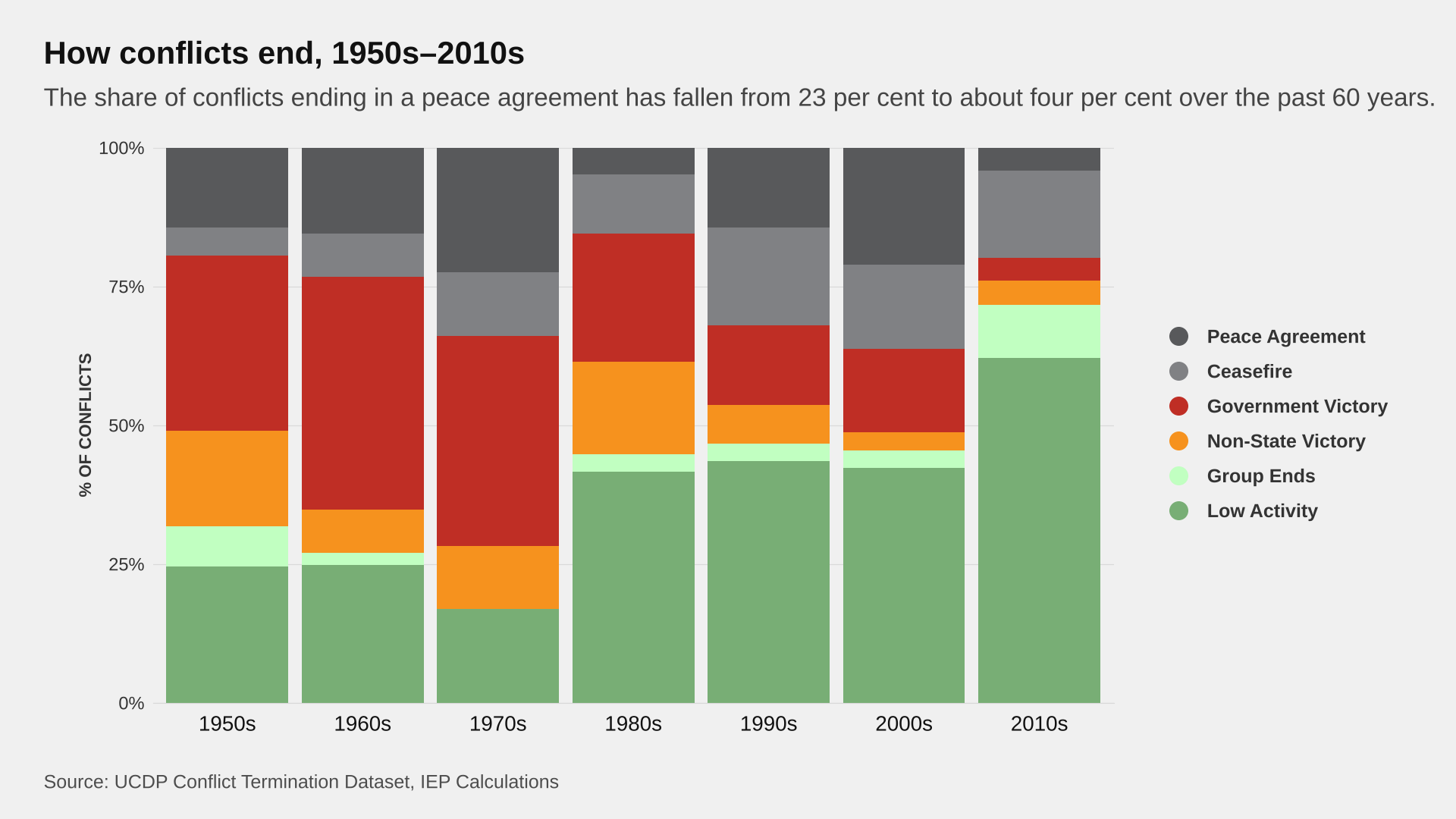
Sudan fits a wider pattern in the GPI data: wars are lasting longer and ending less often. The share of conflicts ending in a decisive military victory fell from 49% in the 1970s to fewer than 9% in the 2010s. Conflicts resolved through a formal peace agreement fell from 23% to 4% over the same period. The GPI 2026 concludes that wars are no longer won or lost; they are inconclusive and often normalised.
There were 61 active state-based conflicts in 2024, the highest number since the end of the Second World War. Much of this growth comes from internationalised internal conflicts, in which foreign states support or fight alongside parties inside another country. These conflicts have increased by more than 175% since 2010. The number of countries involved in external conflicts rose from 59 in 2008 to 103 in 2026.
Sudan’s war is part of a larger regional system. The GPI 2026 identifies the conflicts in Sudan, Ethiopia, Eritrea, South Sudan and Somalia as interlocked, with all nine factors associated with conflict spread present in the Horn of Africa. The war also finances itself. The RSF produced an estimated 10 tonnes of gold in 2024, worth around US$860 million.
These conditions make the war harder to end. External supply of weapons, including drones, allows both sides to keep fighting without decisive gains. Revenue from gold and other resources sustains armed groups. Drones then let each side strike deep into territory held by the other, which raises civilian deaths without changing the military balance.
The Global Terrorism Index 2026 identifies the rising use of drone technology by terrorist groups as a growing risk. In Colombia, Revolutionary Armed Forces of Colombia (FARC) dissident groups and the National Liberation Army have adopted drone warfare, drawing direct inspiration from the battlefield innovations seen in Ukraine, with 77 drone attacks recorded in 2024 and 2025. In Burkina Faso, attackers used a drone to monitor a military barracks in Soudougui before an attack claimed by Jama’at Nusrat al-Islam wal-Muslimin (JNIM). In Pakistan, Tehrik-e-Taliban Pakistan has used drones to carry out targeted bombings.
These cases show the same diffusion seen in Sudan. Techniques developed by state militaries in Ukraine and Gaza are being adopted by non-state armed groups within a few years. The spread of drones is happening faster than the rules that govern them. The GPI 2026 finds that no binding international framework governs targeted drone attacks, and 118 of 193 UN member states are absent from global initiatives on the governance of artificial intelligence.
The economic cost of violence continues to rise.
The global economic impact of violence reached US$21.81 trillion in 2025, equal to 10.5% of global gross domestic product (GDP). Global military expenditure reached a record US$2.9 trillion. By comparison, spending on peacebuilding and peacekeeping was US$49.2 billion, around 0.5% of military spending.

Identifying and measuring the factors that drive peace