In this excerpt from our IEP Peace Academy, learn why understanding the different definitions of peace is crucial for peacebuilders.

Learn why understanding the concept of peace from both a negative peace and positive peace perspective is crucial for peacebuilders.
There are two common conceptions of peace — Negative Peace, or actual peace, and Positive Peace.
IEP’s definition of Negative Peace is understood as ‘the absence of violence or fear of violence — an intuitive definition that many agree with, and one which enables us to measure peace more easily.
Measures of Negative Peace are the foundation of the IEP’s flagship product, the Global Peace Index.
However, while the Global Peace Index tells us how peaceful a country is, it doesn’t tell us what or where we should be investing in to strengthen or maintain levels of peace.
This leads us to Positive Peace, derived from the data contained within the Global Peace Index. Positive Peace provides a framework to understand and address the many complex challenges the world faces.
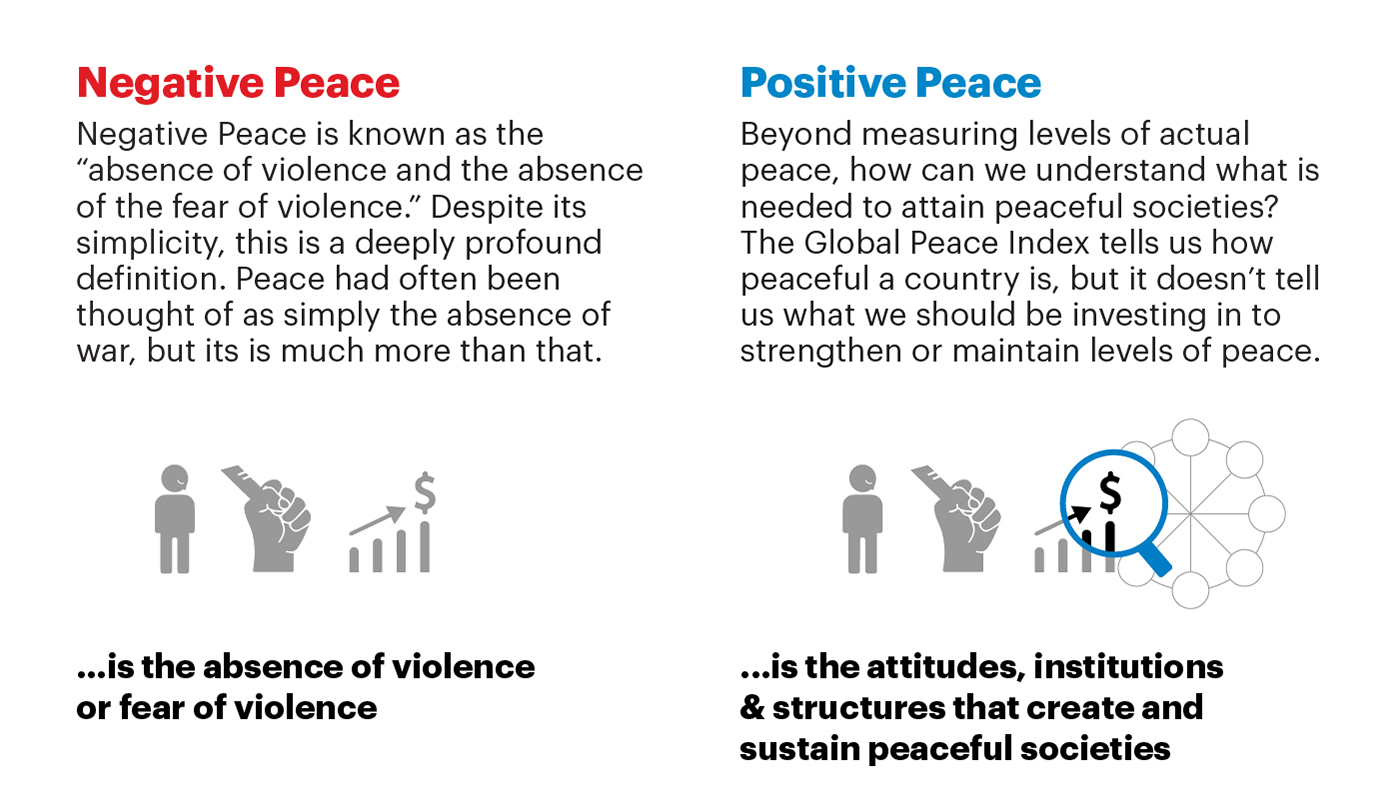
Positive Peace is defined as the attitudes, institutions and structures that create and sustain peaceful societies.
It provides a framework to understand and then address the multiple and complex challenges the world faces. Positive Peace is transformational in that it is a cross-cutting factor for progress, making it easier for businesses to sell, entrepreneurs and scientists to innovate, individuals to produce, and governments to effectively regulate.
In addition to the absence of violence, Positive Peace is also associated with many other social characteristics that are considered desirable, including better economic outcomes, measures of well-being, levels of inclusiveness and environmental performance.
A parallel can be drawn with medical science; the study of pathology has led to numerous breakthroughs in our understanding of how to treat and cure disease.
However, it was only when medical science turned its focus to the study of healthy human beings that we understood what we needed to do to stay healthy. This could only be learned by studying what was working.
Unfortunately, there exist many obstacles to global peace, and thus, it is important to understand peace. One which has had a huge impact in the 21st century is terrorism. 9/11 and its aftermath has transformed into one of the most influential driving forces of global security policy in living memory. From the ongoing conflicts and the deployment of new technologies – such as drones. Political and military leaders have been preoccupied with the costs, solutions and impacts associated with terrorism.
Another example of how important it is to understand peace in today’s world is COVID-19. The global pandemic represents the single most significant systems shock of the past 50 years. By mid-2020 the impacts of COVID-19 had been felt internationally, and the frail nexus of global trade and travel collapsed beneath the weight of border closures and lockdowns. IEP’s intensive research reveals that today’s world has begun to recover from the shocks of the COVID-19 pandemic. However, many of the ramifications of the lockdown linger in the form of disruptions to supply chains, product shortages and increasing energy and food prices. The rise in costs for fuel and food has further intensified food insecurity and political instability all around the world, but particularly in low-resilience regions such as Sub-Saharan Africa, South Asia and MENA.
IEP research reveals that improving levels of Positive Peace is a solution to many of the common social and economic maladies afflicting countries worldwide. Countries that score poorly across all 8 pillars of peace are invariably plagued by violence, war and civil conflict. Therefore, an awareness of the attitudes, structures and institutions that are conducive to peace is essential for community leaders and key stakeholders living in these countries to engage effectively with the peacebuilding process.
Are you interested in learning more about peace? Sign up for the free, online Positive Peace Academy
Understanding ecological threats, resilience and peace.