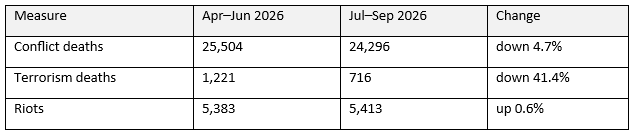
IEP has launched a new Quarterly Peace Briefing to track conflict, terrorism and civil unrest. The first edition, covering July to September 2026, finds fewer deaths from conflict and terrorism, but a rising trend in riots.
The Global Peace Index (GPI) is IEP’s flagship measure of global peacefulness. Released each June, it combines 23 indicators that measure the absence of violence or the fear of violence. But a great deal can change in the 12 months between editions. The GPI – Quarterly Peace Briefing is designed to fill that gap, giving an update on the state of peace in the world every quarter.
Each briefing draws on three datasets: conflict events and deaths from the Uppsala Conflict Data Program (UCDP), terrorist attacks and deaths from Dragonfly’s Terrorism Tracker, and riots, including violent demonstrations and mob violence, from the Armed Conflict Location and Event Data project (ACLED). For each, the briefing provides a map of the quarter, a summary of key events and monthly trends dating back to October 2021.
Source: GPI – Quarterly Peace Briefing, July–September 2026
The headline figures improved, but the quarter was marked by escalation in several regions. The ceasefire between the United States and Iran collapsed on 8 July after Iran attacked commercial vessels in the Strait of Hormuz. The two sides traded strikes until 23 July, before hostilities resumed in early September.
The war widened to Yemen. On 20 July the Houthis announced a blockade of Saudi ports and shipping in the Bab al-Mandab strait, and in September seized coastal areas of south-western Yemen next to the strait, prompting Saudi airstrikes in four governorates.
Elsewhere, fighting between the Sudanese army and the Rapid Support Forces intensified in North Kordofan and Blue Nile State in mid-August. On 24 September Pakistan struck 10 locations inside Afghanistan after an attack on a police compound in Kohat killed at least 16 police officers.
Conflict deaths fell 4.7 per cent from the previous quarter, to 24,296, and were 52.2 per cent lower than in the same quarter of 2025. The quarter ranks 19th of the 20 recorded since late 2021.
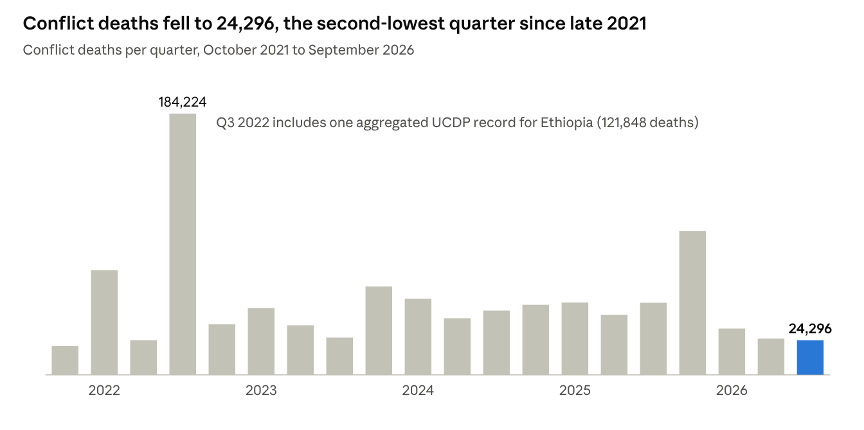
Source: UCDP, IEP calculations, via GPI – Quarterly Peace Briefing. Data to September 2026.
Ukraine remained the deadliest conflict, accounting for 16,643 deaths, or 68.5 per cent of the global total, across 832 events. The UN Human Rights Monitoring Mission in Ukraine reported that July was the deadliest month for civilians since early 2022, with civilian casualties 30 per cent above June. Russia launched at least 429 missiles at Ukraine in July, more than twice the number in June.
Yemen recorded the second-highest toll, with 1,710 deaths, up from 110 in the previous quarter. Fighting in Lahij governorate on 15 September killed 165 people, the deadliest single event of the quarter. Conflict deaths in Pakistan more than doubled, from 669 to 1,517, making it the third-deadliest country.
Terrorism deaths fell 41.4 per cent from the previous quarter, to 716, and attacks fell 36.5 per cent, to 275. Both were the lowest of any quarter since late 2021.
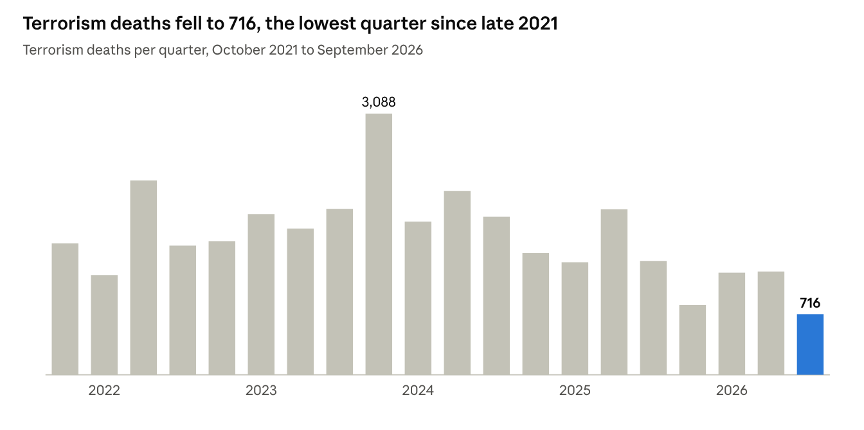
Source: Dragonfly Terrorism Tracker, IEP calculations, via GPI – Quarterly Peace Briefing. Data to September 2026.
Pakistan recorded the most terrorism deaths of any country, with 246 across 97 attacks, or 34.4 per cent of the global total. Tehrik-e-Taliban Pakistan (TTP) and the Balochistan Liberation Army (BLA) stepped up attacks on security forces in Khyber Pakhtunkhwa and Balochistan.
The Sahel remained a centre of terrorist activity. Niger, Nigeria and Mali ranked second to fourth, with 125, 89 and 85 deaths. The deadliest attack of the quarter killed 50 people on 18 July, when a Malian army convoy was ambushed near Tabankort in the Gao region. Syria recorded 64 deaths, more than three times its total in the previous quarter.
The ideological mix also shifted. Deaths attributed to nationalist groups rose 61.6 per cent, to 181, while deaths attributed to religious groups fell 60.1 per cent, to 313.
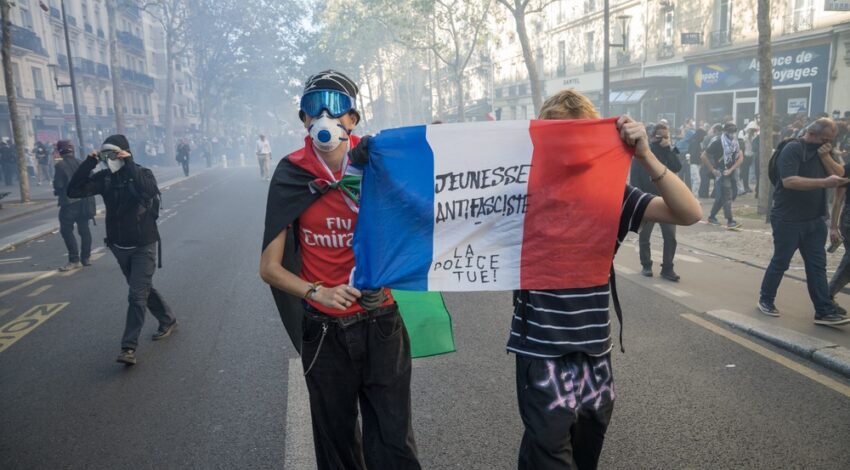
Riots were the one measure to deteriorate. Riots are categorized as either instances of mob violence, or violent demonstrations. There were 5,413 riots in the quarter, the highest quarterly total since late 2021 and 11.7 per cent more than in the same quarter of 2025. Compared with the previous quarter, riots were almost unchanged, rising 0.6 per cent, while riot fatalities fell 24.5 per cent, to 735.
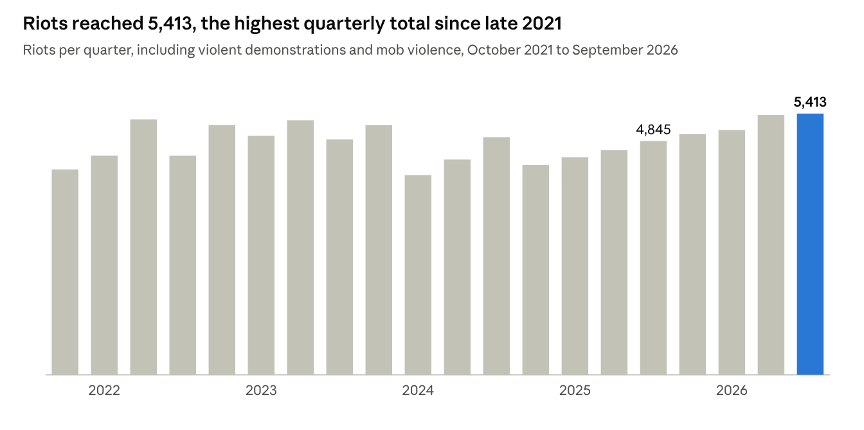
Source: ACLED, IEP calculations, via GPI – Quarterly Peace Briefing. Data to September 2026.
Palestine accounted for 1,707 riots, or 31.5 per cent of the global total, and 181 more than in the previous quarter. In late July, the UN Human Rights Office warned that settler attacks in the occupied West Bank had reached an all-time high.
Riots in France more than tripled, from 55 to 178. Pakistan recorded the most riot fatalities, with 95, followed by Kenya with 79 and India with 46. In Indonesia, a march on parliament in Jakarta on 27 August, calling for a law to seize assets tied to corruption, ended in clashes with police and overnight rioting.
The full briefing, including interactive maps and monthly data by region, is available at peacebrief.economicsandpeace.org.

Terror groups had been using artificial intelligence mainly as a propaganda tool, useful for generating slick recruitment videos or...

While advancing a “maximum lethality” doctrine in its war with Iran, the US is simultaneously testing a large-scale AI-driven military...
Identifying and measuring the factors that drive peace