A record number of people are being referred to the UK’s counter-terrorism program led by concerns over extreme right-wing views, ahead of Islamist extremism.

Over 10,000 people were referred to the UK’s Prevent counter-terrorism program in the year to 30 September 2025, up 39 per cent on the previous year and the highest figure since records began in April 2015.
Concerns about ‘extreme right-wing’ views accounted for around one in five referrals, up 42 per cent on the year before and the single largest category, ahead of Islamist extremism, which made up 8 per cent. A 2025 review by the UK’s former Independent Prevent Commissioner linked an earlier surge in referrals to publicity around a mass stabbing attack carried out by a teenager who had himself been referred to Prevent three times beforehand.
The UK data reflect a wider pattern documented in the Global Terrorism Index (GTI) 2026, published by the Institute for Economics & Peace. Deaths from terrorism fell 28 per cent globally in 2025, to 5,582, the lowest figure since 2007. In the West, however, terrorism deaths rose 280 per cent, to 57, driven largely by antisemitism, Islamophobia and political motivations. Seven of the 19 countries that deteriorated on the Index in 2026 were Western nations.
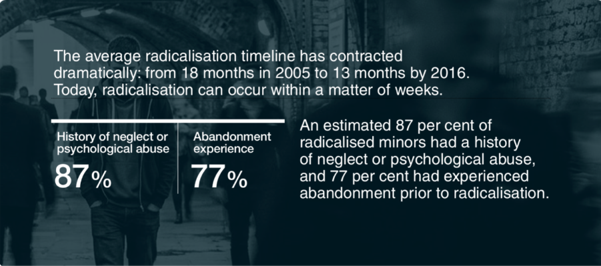
Children and adolescents accounted for 42 per cent of all terror-related investigations in Europe and North America in 2025, a threefold increase since 2021. The average time it takes a person to become radicalised has also fallen sharply, from 16 months in 2002 to a matter of weeks today, which the GTI attributes to algorithmic amplification and the exploitation of developmental vulnerabilities in young people. Among radicalised minors, 87 per cent had a history of neglect or psychological abuse, and 77 per cent had experienced abandonment.
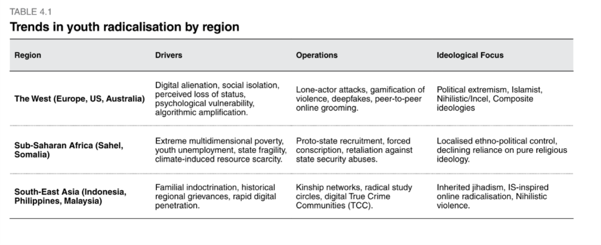
The drivers of youth radicalisation vary by region. In the West, alienation and social isolation are the dominant factors, whereas in sub-Saharan Africa, 71 per cent of recruits cite human rights abuses by state security forces as the catalyst for joining an extremist group, and a quarter cite a lack of job opportunities. The rise of youth involvement in the West is also tied to the decentralisation of terrorism itself: lone actors carried out 93 per cent of fatal terrorist attacks in the West over the past five years and are three times more likely to succeed than groups of two or more, making individual cases harder to detect before they escalate.
The GTI 2026 describes a ‘funnel strategy’ used by extremist networks. Recruiters use algorithm-driven platforms such as TikTok, Instagram and YouTube Shorts to draw young users towards increasingly extreme content, then move the conversation to encrypted messaging apps for operational planning. Gaming and chat platforms, including Roblox, Fortnite and Discord, are used to build social bonds with isolated young people.
Europol’s 2025 EU Terrorism Situation and Trend Report reached similar conclusions. It found that a growing variety of online communities recruit minors and young adults, then coerce them into violent acts against themselves or others, often targeting children between eight and 17 years old who show signs of mental health issues, social isolation or digital dependency. Some minors investigated in 2024 had administered terrorist propaganda channels or used gaming platforms to train themselves in weapons handling.
Researchers at the Institute for Strategic Dialogue, who have studied extremist activity on Discord, Steam, DLive and Twitch, note that gaming spaces are used more often to bring already radicalised people together than to recruit new members from scratch. The distinction matters for policy design, though it does not reduce the risk to individual children: once inside these spaces, young people are exposed to content and peer pressure that can harden existing extremist beliefs.
A related but distinct network, known as 764, shows how far this exploitation can go. US authorities, who have opened more than 250 investigations into the group, describe a decentralised network that grooms children as young as nine into self-harm, violence and the production of abuse material in exchange for status within the group. Canada has designated it a terrorist entity. The network sits closer to nihilistic violent extremism than organised far-right ideology; even so, its grooming tactics mirror methods documented across the broader youth-targeted extremist ecosystem.
The Global Peace Index (GPI) 2026 found that global peace deteriorated for the 12th consecutive year, and the conditions that precede conflict are the worst recorded since the Second World War. In the US, the political instability indicator deteriorated by 38.5 per cent, accompanied by a rise in violent demonstrations. The GPI links political polarisation and rising antisemitic violence to the conditions in which extremist narratives gain traction, consistent with the GTI’s findings on the drivers of Western terrorism.
In the UK, referrals judged to carry a risk are passed to Channel, a voluntary safeguarding program offering mentoring, education and careers support. The Home Office has acknowledged that the rise in referrals is straining the program, and it is working to make case management more efficient.
The GTI 2026 notes that youth-led plots are, on current evidence, easier to stop than adult ones. Between 2022 and 2025, 97 per cent of plots involving a minor were intercepted, compared with 68 per cent of adult-only plots. But the growing scale of youth radicalisation is offsetting that lower success rate, so the overall level of threat has not eased. Radicalisation pathways once measured in years are now measured in weeks, running through platforms built for entertainment rather than security, and the data from the UK, the GTI and Europol point in the same direction: recruitment is starting younger, moving faster, and increasingly happening in plain sight.
The average time to become radicalised has fallen from 16 months in 2002 to a matter of weeks, according to the Global Terrorism Index 2026. The report attributes the faster pace to algorithmic amplification on social media and the exploitation of developmental vulnerabilities in young people.
Recruiters use algorithm-driven platforms such as TikTok, Instagram and YouTube Shorts to draw young users towards increasingly extreme content, then move conversations to encrypted messaging apps for operational planning. Gaming and chat platforms, including Roblox, Fortnite and Discord, are used to build social bonds with isolated young people, according to the Global Terrorism Index 2026 and Europol.
Among radicalised minors studied for the Global Terrorism Index 2026, 87 per cent had a history of neglect or psychological abuse and 77 per cent had experienced abandonment. In the West, alienation and social isolation are the dominant drivers, in contrast to sub-Saharan Africa, where 71 per cent of recruits cite human rights abuses by state security forces as their reason for joining an extremist group.
Yes. The Global Terrorism Index 2026 reports global terrorism deaths fell 28 per cent in 2025 to their lowest level since 2007, but deaths in Western countries rose 280 per cent, and children and adolescents accounted for 42 per cent of terror-related investigations in Europe and North America, a threefold increase since 2021.
Referrals citing extreme right-wing concerns rose 42 per cent in the year to September 2025, to 2,103 cases, the largest single category among Prevent referrals that year. The rise mirrors a wider pattern in Western countries, where the Global Terrorism Index 2026 recorded a 280 per cent increase in terrorism deaths, driven in part by youth radicalisation.


Youth radicalisation has become a defining feature of the contemporary terrorism landscape, emerging alongside a broader shift in the nature and...

The recruitment and indoctrination of youth by extremist groups are evolving rapidly, and traditional counter-extremism have struggled to keep pace,...
Identifying and measuring the factors that drive peace