
New research Dr Michael Mascolo demonstrates that the Institute for Economics & Peace’s eight pillars of Positive Peace can transform how businesses operate, creating organisations that generate profit whilst genuinely supporting employee wellbeing.
Dr Michael Mascolo’s ground-breaking paper extends the HALO model beyond national governance into the commercial sphere, challenging the conventional wisdom that profit must compete with people. His work reveals that the same systemic conditions that create peaceful societies can foster what he terms “collaborative flourishing” in businesses.
The traditional view holds that a business exists primarily to generate shareholder returns, with employee needs serving as secondary concerns or necessary costs. This framework creates an inherent conflict between profit and people. However, Mascolo’s research demonstrates that organisations embodying Positive Peace principles achieve superior outcomes across both financial performance and job satisfaction metrics.
The adapted model identifies nine interconnected pillars for businesses: proactive and inclusive leadership; economic success; equitable resource distribution; concern for dignity and rights; good external relations; transparent communication; investment in people; low corruption; and critically, capacity for socio-emotional engagement.
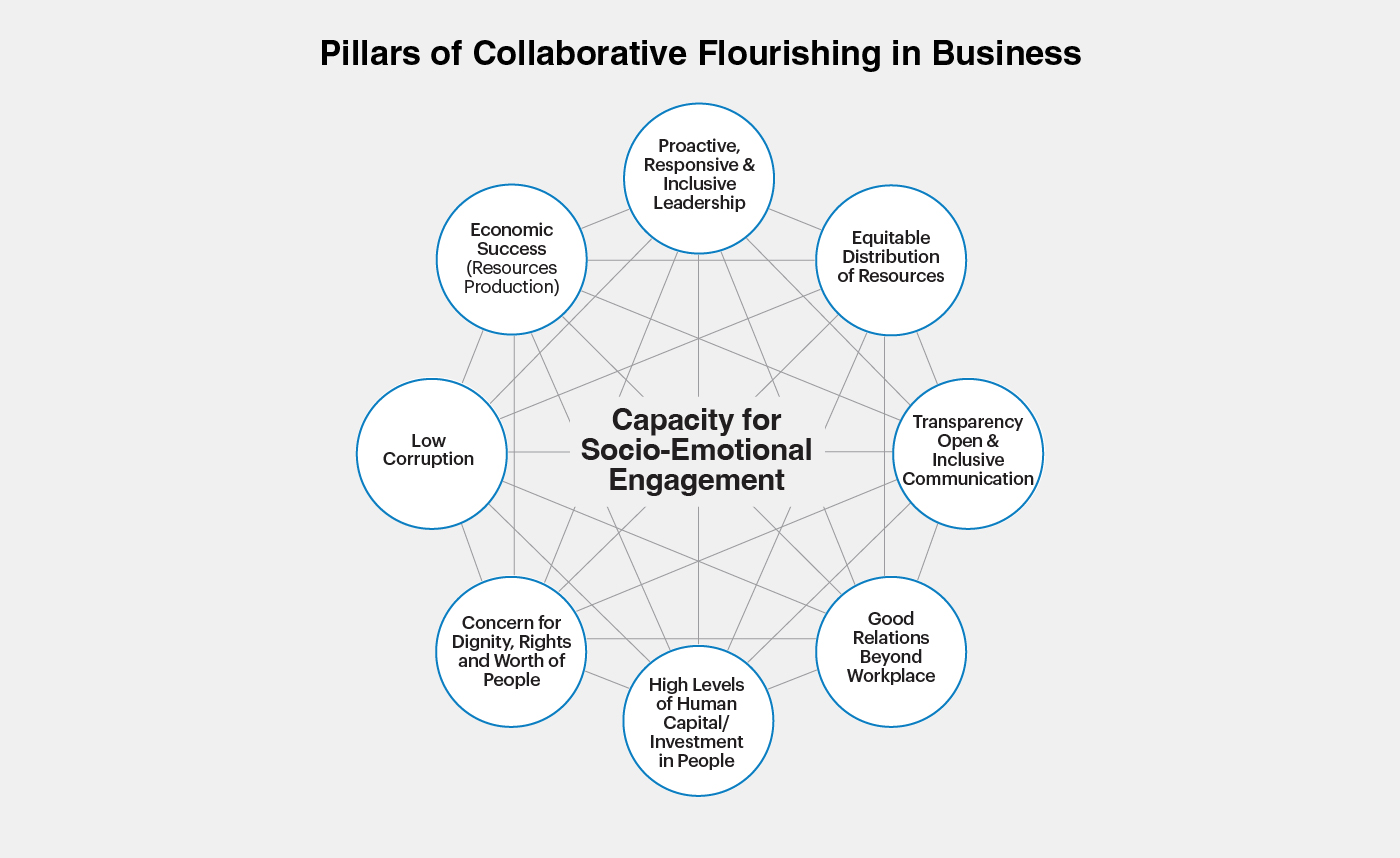
Drawing on systems thinking, the research shows these pillars don’t operate independently. Rather, they create virtuous cycles where improvements in one area reinforce others. For instance, inclusive leadership increases employee trust and belongingness, which enhances emotional safety necessary for collaboration and productivity. This increased productivity generates financial success, which strengthens company reputation, attracting higher quality talent, which further increases productivity.
The research reveals that socio-emotional intelligence serves as the glue binding these pillars together. Organisations where leaders and employees demonstrate emotional intelligence consistently show higher job satisfaction, lower conflict levels, reduced stress, and greater productivity. This capacity to manage emotions and relationships enables the peaceful resolution of inevitable workplace conflicts.
Mascolo reframes peace itself as not the absence of conflict, but the capacity to manage conflict without resorting to hostility. In business contexts, this means creating infrastructures that allow stakeholders to meet their needs through collaboration rather than force. The nine pillars provide this infrastructure by addressing fundamental human needs: autonomy, economic security, dignity, belonging, and purpose.
The research synthesises extensive literature demonstrating that companies operating according to these principles achieve measurably superior outcomes. Workers in collaborative environments report higher satisfaction, commitment, and productivity. They experience lower stress, burnout, and turnover. Importantly, these human benefits translate directly into financial success.
This challenges business leaders to ask: what are profits for? When organisations pursue both profit and human wellbeing as simultaneous ends rather than competing goals, they create sustainable systems that serve all stakeholders.
The implications are profound: the same principles that build peaceful nations can build thriving businesses. Collaborative flourishing isn’t merely ethical, it’s strategically sound.
Explore the full research paper: Collaborative Flourishing: Positive Peace in Business and Organisations


The two concepts that are at the core of all of IEP’s work: Positive Peace and Systems Thinking.

The relationship between the economic performance of a country and levels of peace can provide peacebuilding and investment insights.
Advancing a systems-based approach to understanding and building peace.
Analysing the factors that sustain peace.