The Positive Peace Report 2026 finds freedom of the press fell faster than any other indicator over the past decade, accelerating sharply after COVID-19. This decline occurred alongside broader deteriorations in the institutions essential to sustaining peace.

Of the 24 indicators that make up the Positive Peace Index (PPI), none fell further over the past decade than freedom of the press. According to the Positive Peace Report 2026, by the Institute for Economics & Peace (IEP), the indicator deteriorated by 22.1% globally between 2015 and 2024, with declines recorded in 141 of the 163 countries in the Index. It is the steepest decline of any single indicator IEP measures, ahead of every other data point that feeds into the eight Pillars of Positive Peace.
The finding is notable not just for its size but for its timing. In the five years before the COVID-19 pandemic, freedom of the press deteriorated by 3.4%, a gradual decline broadly in line with other Positive Peace indicators. Between 2020 and 2024, it fell by 18.5%, more than five times faster.
Many of the emergency press restrictions introduced during the pandemic were never fully reversed, while the rapid spread of disinformation has placed further pressure on independent journalism worldwide. The decline cuts across income levels and political systems alike, affecting long-standing democracies as much as states in conflict or political transition.
Freedom of the press sits inside the Free Flow of Information Pillar, one of five Pillars that recorded an improvement over the decade. That improvement, however, was driven entirely by one indicator: the telecom infrastructure index, which captures the diffusion of digital communication technologies across societies. It improved by 36.8% as connectivity expanded worldwide. Freedom of the press and quality of information, the Pillar’s other two indicators, both deteriorated notably.
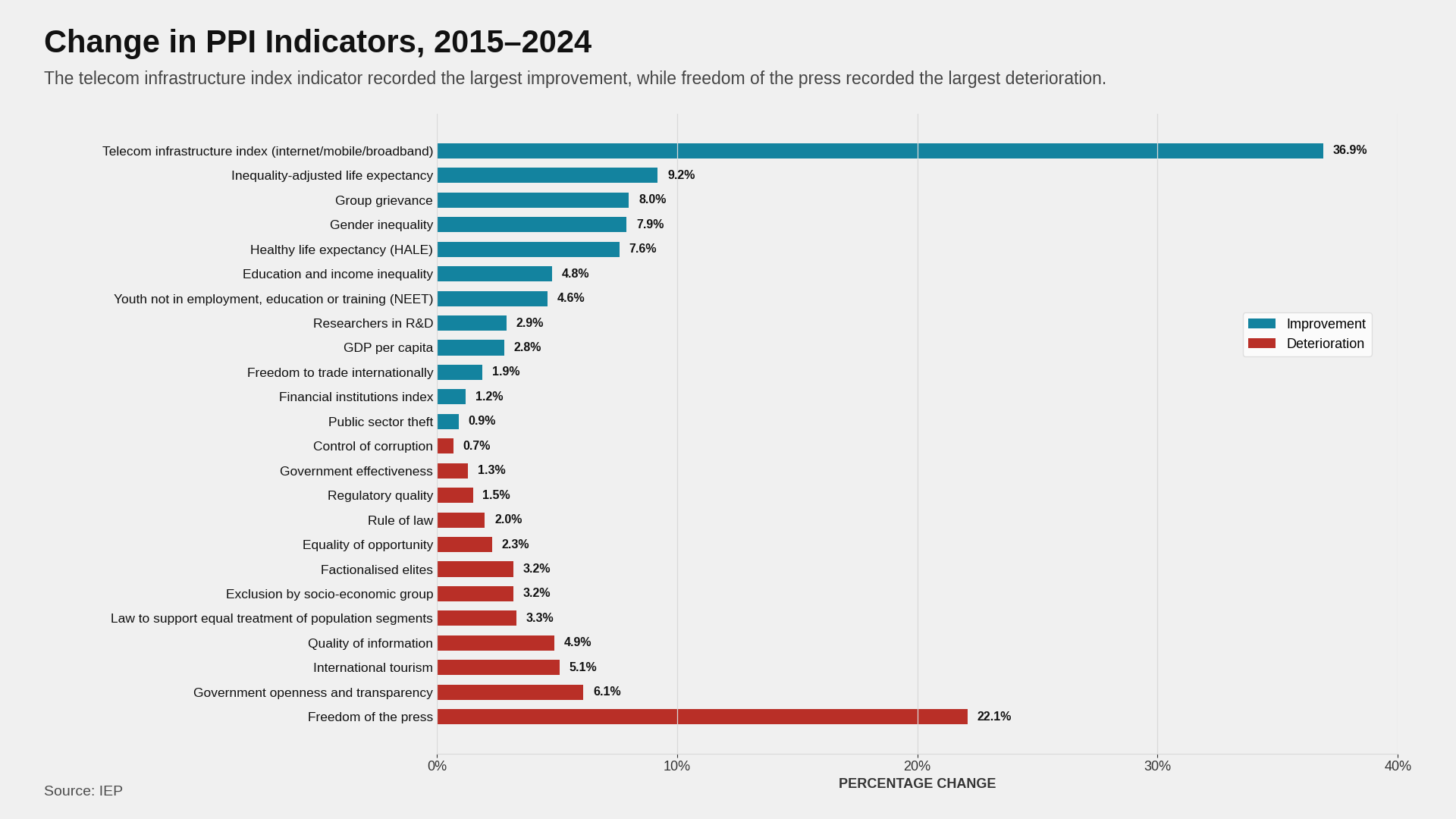
This divergence presents one of the most striking findings of the report: even as access to information has never been wider and easier, the quality, reliability and freedom of the information itself are in decline.
The same basic pattern holds at the level of the overall Index. Global Positive Peace improved by 1.7% over the decade to 2024, but excluding the telecom infrastructure index, the PPI would have deteriorated by 0.1%, with 84 of 163 countries recording declines against 79 that improved.
The clearest sign of institutional strain is the Well-Functioning Government Pillar, which recorded the largest deterioration of any Pillar over the decade, down 3%. Government openness and transparency fell 6.2%, rule of law fell 2%, and government effectiveness fell 1.5%. Read together, the picture is consistent: the structures that hold power accountable, including a free press, transparent government and the rule of law, weakened over the same decade in which connectivity, health and human capital measurably improved.
India’s score on the indicator fell by 45.4%, the sharpest decline among all its indicators, even as its overall Positive Peace score improved by around 6%.
IEP’s research treats Positive Peace as a system, in which no single Pillar operates in isolation from the others. Positive Peace overall is a strong empirical predictor of societal resilience: countries that improved in Positive Peace over the decade saw real GDP grow at twice the rate of countries that deteriorated, while foreign direct investment grew at 8.5% a year in improving countries against 3.5% in deteriorating ones. Positive Peace also correlates closely with environmental performance, health outcomes and subjective wellbeing.
A free press functions as part of the feedback mechanism that keeps these other systems working. It surfaces problems, holds institutions accountable and sustains the public trust that other structural gains depend on. When that feedback mechanism weakens, the report suggests, the benefits of progress elsewhere in the system become harder to sustain.
The report also finds that Positive Peace has predictive power. All 16 countries with the largest Positive Peace deficits in 2009, meaning countries whose structural foundations lagged well behind their levels of ‘negative’ or actual peacefulness, went on to deteriorate in peacefulness by 2024. Declining press freedom, alongside government transparency and the rule of law, is among the clearest early signals that a country’s structural foundations are eroding, even while other measures continue to improve.
Overall, the US recorded the second-largest Positive Peace deterioration in the Index over the decade, down 8.8%, driven by a 54.6% decline in the factionalised elites indicator, itself the largest deterioration recorded on that indicator by any country in the Index. Russia deteriorated by 5.2%, with most of the decline occurring after its 2022 invasion of Ukraine.
The pattern extends beyond the leading powers. The Netherlands sits in the global top 10 for Positive Peace, yet its score deteriorated by 8.1% over the decade, the fifth-largest decline of any country in the Index, alongside comparable declines in the United Kingdom and Austria. A high starting position offered no protection against the same institutional pressures affecting less peaceful countries elsewhere.
The past decade is best understood as two trends running in parallel. Structural gains, in connectivity, health and human capital, continued to strengthen, while there was a weakening in institutional and informational conditions, including press freedoms, government transparency and the cohesion of political elites.
On a global level, Positive Peace rose only because the first trend outweighed the second, and only just. The decline in freedom of the press, which was faster than for any other measure IEP tracks, is a worrying sign for the prospects for peace in a world already beset by multiplying societal-level and international threats to stability and security.
The Positive Peace Index (PPI) is IEP's measure of the attitudes, institutions and structures that create and sustain peaceful societies. It covers 163 countries and 99.7% of the world's population, built from statistical analysis of more than 20,000 data points across 24 indicators grouped into eight Pillars of Positive Peace.
Freedom of the press fell 22.1% globally between 2015 and 2024, the steepest decline of any PPI indicator. Most of that decline happened after 2020: many emergency press restrictions introduced during the COVID-19 pandemic were never fully reversed, and the rapid spread of disinformation has placed further pressure on independent journalism.
The global PPI improved by 1.7% over the decade, but that gain was driven almost entirely by the telecom infrastructure index, which improved by 36.8% as connectivity expanded worldwide. Excluding that one indicator, the Index would have deteriorated by 0.1%, with more countries declining than improving.
Yes. The US recorded the second-largest Positive Peace deterioration in the Index over the decade, down 8.8%, driven largely by a 54.6% decline in the factionalised elites indicator. Russia deteriorated by 5.2%, mostly after its 2022 invasion of Ukraine. Even the Netherlands, a global top 10 country for Positive Peace, recorded the fifth-largest overall decline of any country in the Index, down 8.1%, alongside comparable declines in the United Kingdom and Austria. India's freedom of the press specifically fell 45.4%, even as its overall Positive Peace score improved.
Positive Peace is a strong predictor of resilience: countries that improved in Positive Peace over the decade saw GDP grow at twice the rate and foreign direct investment grow at more than double the pace of deteriorating countries. A free press is part of the feedback mechanism, surfacing problems and holding institutions accountable, that keeps those other structural gains sustainable. Its decline is also one of the clearest early signals in IEP's Positive Peace deficit model, which has correctly identified countries at risk of deteriorating in peacefulness.

IEP has identified eight key factors, or Pillars, that comprise Positive Peace.
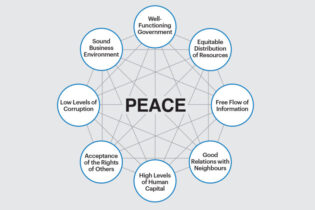
Harnessing the essence of Positive Peace is more than just envisioning a world without conflict; it’s about actively shaping our future through...
Identifying and measuring the factors that drive peace
Identifying and measuring the factors that drive peace