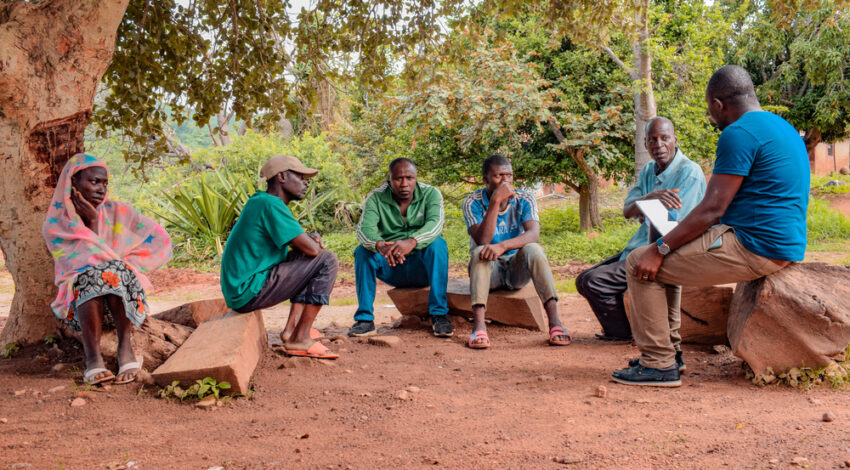
Development donors face an uncomfortable truth: measuring project outputs is not the same as measuring community impact.
Most organisations track what they deliver – wells dug, workshops conducted, loans disbursed – in ways that satisfy reporting requirements and demonstrate activity but reveal little about whether communities are actually stronger, more cohesive, or better equipped to sustain progress after funding ends.
Understanding real community-level impact is critical for sustainable development.
Consider a typical livelihoods programme where success metrics might include number of participants trained, businesses launched, or income increases recorded. These are valuable indicators, yet they tell us nothing about whether the programme improved trust between community members, strengthened local governance capacity, or built the social fabric that determines whether gains persist.
Research consistently shows that communities with stronger social cohesion, better governance, and more equitable resource distribution achieve better development outcomes and sustain them, while interventions that ignore these foundational factors often see gains evaporate once external support withdraws.
Donors increasingly recognise this challenge, and the question is not whether community-level impact matters, but how to measure it systematically across diverse contexts.
Traditional assessment approaches struggle to capture these outcomes because:
The result is a persistent gap: organisations invest heavily in programs designed to strengthen communities, yet lack reliable evidence of of whether those efforts succeed.
Effective community impact measurement requires a framework grounded in empirical research – one that identifies which factors actually determine community resilience and social cohesion.
The Institute for Economics & Peace has spent over a decade analysing what makes societies peaceful and resilient, drawing on more than 50,000 data points across 163 countries to identify eight interconnected pillars that underpin sustainable peace and development, ranging from well-functioning governance and equitable resource distribution to levels of human capital and acceptance of others’ rights.
Translating this framework to community level creates a standardised yet locally relevant approach to measuring what programmes often aim to achieve but struggle to demonstrate.
For donors, this shift offers practical benefits:
Together, this provides evidence that supports both accountability and strategic learning.
IEPs Community Strength Barometer (CSB) applies this methodology through a rapid assessment tool that captures community perceptions across all eight foundational factors. The CSB provides:
For organisations serious about impact rather than activity, the question is no longer whether to measure community strength, but how quickly they can start. Tools like the CSB offer a data-driven and cost-effective approach to connect programmes to measurable community-level impact.
Explore how the Community Strength Barometer can strengthen your impact measurement at CSB: See how it works.


IEP has identified eight key factors, or Pillars, that comprise Positive Peace.

“To meet our global environmental challenges, we must have major structural changes.” Writes Steve Killelea in this excerpt from his debut book,...
Analysing the factors that sustain peace.
Engage with the transformational Positive Peace program through research, workshops, education &...