Dr Andrew Thomson and Professor Dominic Bryan of Queen's University Belfast set out the case for using the Positive Peace framework to measure and monitor peacefulness in Northern Ireland, and to serve as a model for systems thinking-informed peacebuilding.
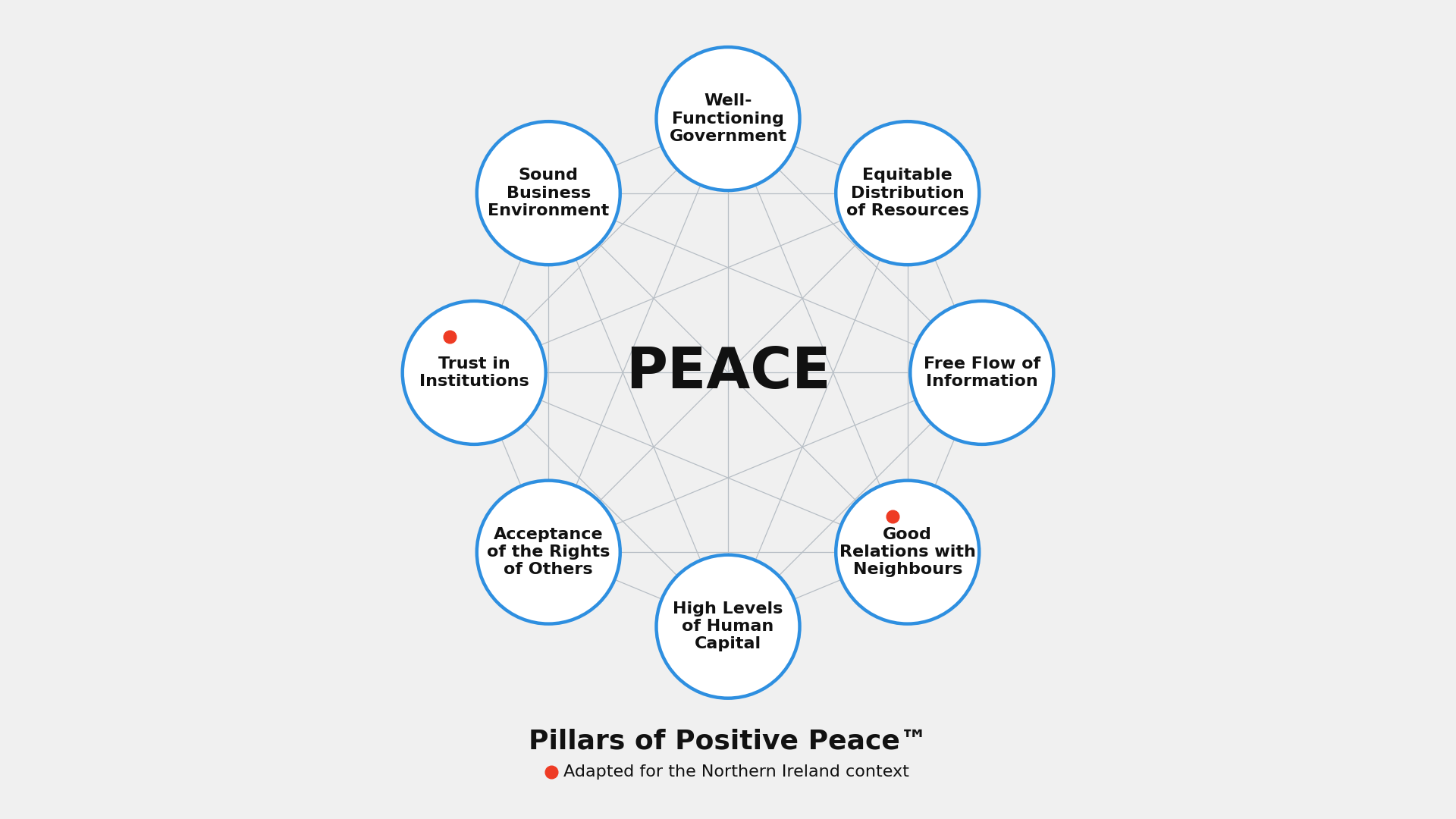
Positive Peace is defined by the Institute for Economics and Peace (IEP) as “the attitudes, institutions and structures that create and sustain peaceful societies over the long term”, and further described as “the conditions in which people thrive”. The IEP’s Positive Peace framework is derived from statistical analysis of almost 50,000 economic and social indicators in 163 countries, to identify the factors most strongly associated with peaceful and resilient societies.
The new Northern Ireland Peace Index (NIPI) applies these frameworks and methodology to Northern Ireland to provide measurement of both negative peace and Positive Peace over time and at the Local Government District levels. Thomson and Bryan also argue that this evidence-based, forward-focused and systems-oriented model suggests ways in which all government departments can play a role in peacebuilding, offers non-governmental organisations and agencies alternative ways to frame their contributions to systemic change, and provides a basis on which practitioners can enhance and move beyond the focus on ‘good relations’ and contact theory. They write that they hope the report helps guide Northern Ireland to a more sustainable peace.
The Good Friday Agreement, also known as the Belfast Agreement, was reached on 10 April 1998, ending three decades of violent conflict that caused 3,720 deaths and approximately 47,540 injuries. Since then, levels of political violence, what the report describes as negative peace, the absence of violence and the fear of violence, have decreased.
However, significant divisions remain. The shared Executive established under the 1998 Agreement has faltered, with six periods in which there was no working government, amounting to around 10 years in total.
The institutional architecture originally conceived under the 1998 Agreement has grown over time to deal with ongoing issues such as dealing with the past, policing, and contestation over cultural identity, including flags, parades and the use of the Irish language. By contrast, issues such as poverty and economic inequality, restructuring of the health service, house building, economic development outside Belfast, and shared education have been tackled slowly and only intermittently, a pattern Thomson and Bryan attribute to a political system that makes developing a progressive and ambitious programme for government difficult.
Since 1998, further political solutions have been found at the St Andrews Agreement (2006), the Hillsborough Castle Agreement (2010), the Stormont House Agreement (2014), the Fresh Start Agreement (2015), and New Decade, New Approach (2020). There have been four Programmes for Government, covering 2008 to 2011, 2011 to 2015, 2016 to 2021, and 2024 to 2027. Alongside these, there have been three major policy initiatives specifically aimed at peacebuilding: A Shared Future (2005), the Programme for Cohesion, Sharing and Integration (2010) and Together: Building a United Community (2013), together with numerous local council policies and five rounds of significant funding from the European Union.
Thomson and Bryan turn a critical eye on the most recent Programme for Government titled Our Plan: Doing What Matters Most, published on 25 February 2025. In that document, the word ‘peace’ appears 12 times and is presented as an overarching concept spanning the policy areas of People, Planet and Prosperity. The programme states: ‘Our cross-cutting commitment to Peace will make sure that everyone feels the benefit of a growing economy, improved environment and a safer and fairer society.’
Despite this language, the authors note that nowhere in the Programme for Government is ‘peace’ defined, and nowhere is the ‘cross-cutting commitment’ explained. The document does contain policies that revolve around peacebuilding, including a commitment to develop a trauma-informed public sector and ongoing support for the PEACE PLUS programme and Safer Communities, along with a promise to refresh the Good Relations Programme, Communities in Transition, Together: Building a United Community, Urban Villages and Tackling Paramilitarism, Criminality and Organised Crime, as well as introducing a strategic approach to racial equality. The programme’s key measurement tool is its ‘Wellbeing Framework’, a dashboard of statistics intended to show the quality of life in Northern Ireland and how different Section 75 groups and people in different parts of the region are faring.
But Thomson and Bryan’s conclusion is direct: coherent, concentrated peace development in Northern Ireland has been weak, relying on a set of institutions produced by a series of agreements, without any major review, alongside a series of ‘good relations’ policies applied to a society that is becoming more diverse. In the most recent Programme for Government, they argue, the word ‘peace’ is used as a placeholder, without meaningful strategic objective attached to it.
The IEP identifies three broad strategic models used internationally to structure peacebuilding at the government level. Some countries establish a dedicated Ministry of Peace, others form a Commission or Council specifically tasked with developing a peace process whilst many others instead mainstream peace throughout government, embedding it across departments rather than concentrating it in a single body. Northern Ireland has followed none of these options.
Thomson and Bryan present the Northern Ireland Peace Index and its accompanying Positive Peace framework as a tool that can help identify a strategic, mainstreamed way forward for peacebuilding across Northern Ireland’s government departments, offering the region a way to move from treating peace as a word used in policy documents to treating it as a measurable, systemic objective pursued deliberately across government.
Explore findings: Northern Ireland Peace Index (Interactive site)
The NIPI applies the Institute for Economics and Peace's Positive Peace framework and methodology to Northern Ireland, measuring both negative peace and Positive Peace over time and at Local Government District level.
Dr Andrew Thomson and Professor Dominic Bryan of Queen's University Belfast argue for using the Positive Peace framework to empirically measure and monitor peacefulness in Northern Ireland, and as a model for systems thinking-informed peacebuilding across government.
The three decades of violent conflict that preceded the 1998 Agreement caused 3,720 deaths and approximately 47,540 injuries.
The word ‘peace’ appears 12 times in Our Plan: Doing What Matters Most (25 February 2025). Thomson and Bryan note that despite this, ‘peace’ is never defined in the document and the promised ‘cross-cutting commitment’ to it is never explained.
The IEP has identified three broad models used internationally: establishing a dedicated Ministry of Peace, forming a Commission or Council to develop a peace process, or mainstreaming peace throughout government departments.

Northern Ireland has recorded its lowest levels of violence and fear of violence since 2019, improving 10.7% from the 2019 baseline. However, the...

IEP has identified eight key factors, or Pillars, that comprise Positive Peace.
Identifying and measuring the factors that drive peace
Analysing the factors that sustain peace.