Sudan is once again on the edge of atrocity, and once again, the world's attention is largely elsewhere.
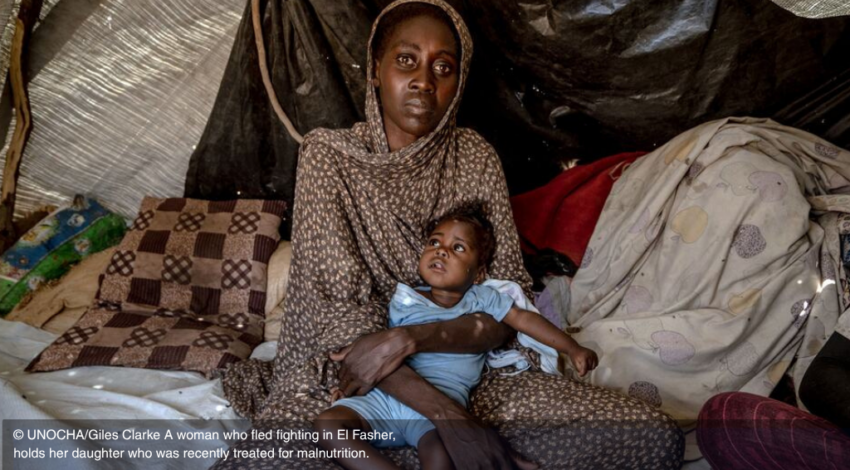
In El Obeid, the capital of North Kordofan state, hundreds of thousands of people are trapped in a city under siege.
Drone strikes by the paramilitary Rapid Support Forces (RSF) have hit power grids, transformers, water treatment plants, schools, universities and hospitals, and residents describe daily bombardment of the roads, fuel supplies and vehicles they would need to escape.
Civilians have been used as human shields, and rights organisations have warned for months that El Obeid risks becoming the next site of mass atrocities. In late July, the Sudanese Armed Forces (SAF) pushed RSF fighters off the highway connecting El Obeid to Khartoum, briefly easing the siege, but the drone attacks and the risk to the city’s roughly half a million residents have not stopped.
These latest warnings follow the RSF’s capture of El-Fasher in Darfur in October 2025, after an 18-month siege that left more than 70,000 civilians dead in weeks. A UN Fact-Finding Mission later concluded bore the “hallmarks of genocide,” citing mass killings, systematic sexual violence and the deliberate targeting of non-Arab communities. Amnesty International went further, describing the violence as ethnic cleansing. In January 2025, the US State Department had already made its own formal determination that the RSF was committing genocide in Sudan.
When the UN Human Rights Council convened an urgent debate on El Obeid in July 2026, it was explicit that the same warning signs, encirclement, attacks on infrastructure, and mounting humanitarian isolation, were reappearing.
Sudan’s war has produced the world’s largest displacement crisis, with more than 13 million people forced from their homes. Yet coverage and diplomatic engagement lag far behind the response to Ukraine, Gaza and, more recently, Iran.
The number of active major conflicts globally has risen sharply over the past decade.
Since the Hamas attack on Israel in October 2023, and the Israeli military response, the attention of Western governments and media organisations has been overwhelmingly directed toward Gaza, layered on top of an international response to Ukraine that was already well established. Sudan’s war began just months before the war in Gaza began dominating headlines and has struggled ever since to break through.
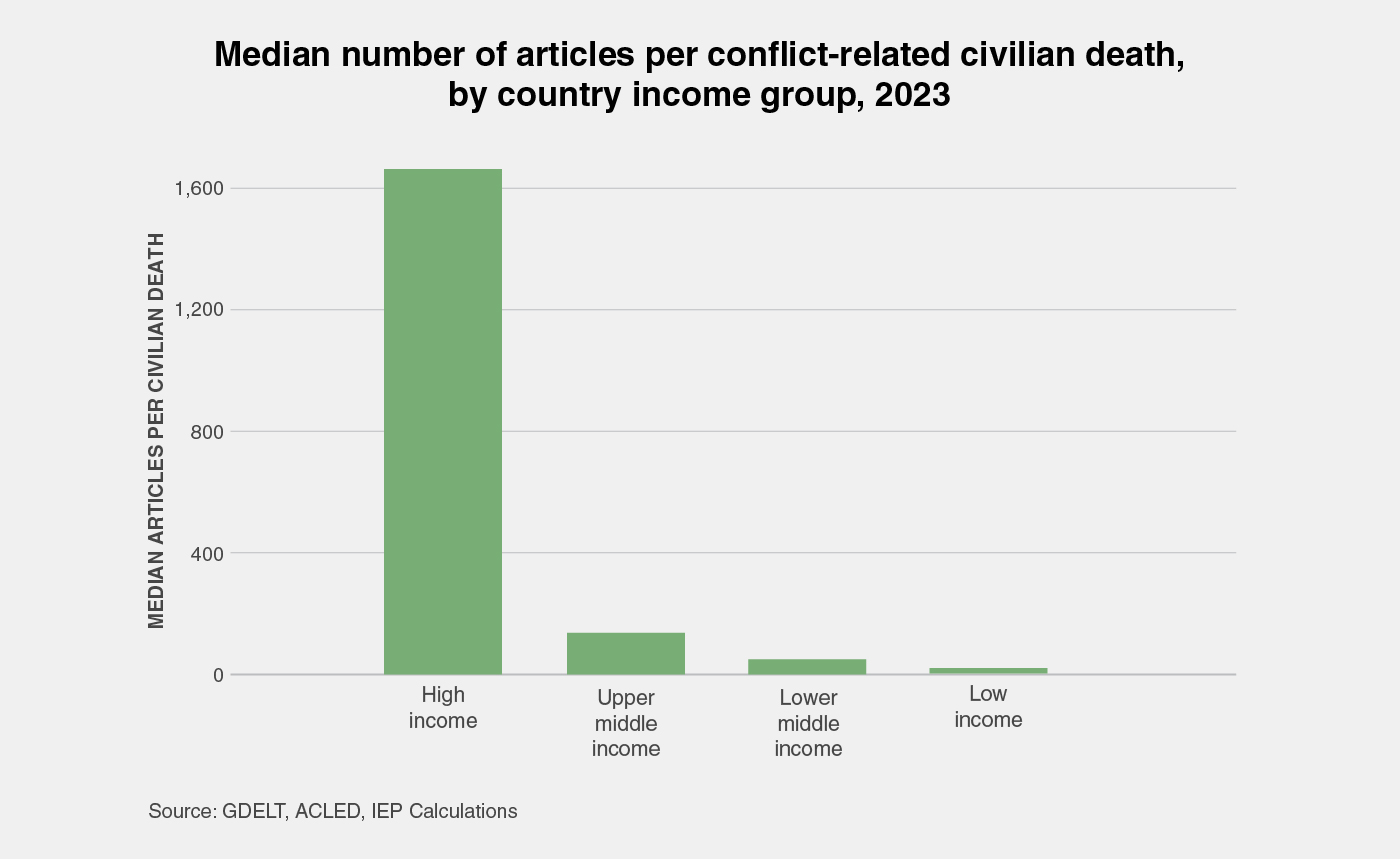
The median number of articles per death in high-income countries was 1,663, nearly 100 times more than the 17.4 articles per death in low-income countries. – Global Peace Index 2025
There are substantial disparities in news coverage across countries, and a high number of deaths does not necessarily translate to a high volume of coverage. The disparity in media coverage is most pronounced between major powers and less geopolitically influential countries. For example, of the five countries with the highest ratio of articles to civilian conflict deaths in 2023, all but one were highly economically developed or upper-middle income countries. Conversely, conflicts in less economically developed countries like Ethiopia and Burkina Faso received very little coverage, even though both had over 20,000 recorded civilian deaths. Ethiopia is an example of the impact of restricted media access, as in recent years there have been far-reaching efforts to restrict information flows and reporting on violence in the country.
In Sudan, communications blackouts, the danger faced by local journalists, and the difficulty of independently verifying events in active conflict zones have made the country’s conflict harder to report on than others where international media have a more established presence. And part of it, as the UK-UAE allegations suggest, is that sustained attention depends on someone being willing to draw it, and some of the governments best placed to do so have had their own reasons for staying quiet.
One source that has been tracking the situation in Sudan is Nathaniel Raymond, Director of the Humanitarian Research Lab at the Yale School of Public Health. For the past two years, this project has been “satellite tracking” and alerting the world to the unfolding mass atrocities.
In the siege of El Obeid, the city’s highway to Khartoum was only recaptured by the Sudanese Armed Forces (SAF) on July 27, 2026 and within hours the RSF had launched retaliatory drone strikes on the city. The UN estimates that drone strikes by both the RSF and the SAF have killed more than 1,000 people in the Kordofan region alone since the start of 2026, and that in the first four months of the year, armed drones were responsible for more than 80 per cent of civilian deaths nationwide, killing at least 880 people. Strikes have expanded well beyond Darfur and Kordofan into Blue Nile, White Nile and Khartoum itself, including a strike on Khartoum International Airport in May that grounded all flights.
Both sides are flying drones. The Sudanese army has used Turkish-made Bayraktar Akinci aircraft, while the RSF has relied on Chinese-made Sunflower-200s, and both have struck hospitals, markets, water infrastructure and displaced civilians as well as military targets.
The 2026 Global Peace Index found that drone attacks increased by roughly 11,500 per cent globally between 2018 and 2025, and that 565 separate armed groups, from state militaries to cartels and rebel factions, used drones in that period. AI-enabled targeting systems have compressed decision-making that once took hours into a matter of seconds. The Index also named Sudan as the world’s most severe humanitarian crisis, with an estimated 150,000 people killed and more than 12 million displaced, famine confirmed in multiple regions, and a war that is now partly self-financing through gold production.
Sudan’s civil war, now in its fourth year, is not only a domestic conflict between the Sudanese army (SAF) and the rebel RSF. It is sustained, in significant part, by external military and diplomatic support, which could be impacting why warnings of genocide have not translated into a stronger international response.
A parliamentary select committee is due to hear testimony that the UK’s Foreign, Commonwealth and Development Office had intelligence as early as 2024 suggesting Ethiopia was supporting the RSF but did not make this public because of significant private pressure from the United Arab Emirates. Ethiopia’s alleged role did not become public knowledge until early 2026, and it continues to deny involvement.
Research on the external dynamics of genocide has found that patron states, the powerful allies that client states rely on for military, economic or diplomatic support, play a decisive role in whether genocide is enabled or restrained. Where a patron’s own strategic interests are best served by looking away, atrocities are more likely to proceed unchecked. Where a patron has more to lose from association with mass violence, it is more likely to restrain its client. That dynamic, observed in past conflicts from Rwanda to Nagorno-Karabakh, is now playing out in Sudan, where the RSF’s access to external backing, and the reluctance of some governments to jeopardise their own relationships with its backers, has shaped both the trajectory of the war and the international community’s willingness to confront it.
IEP’s research has highlighted how the concentration of global attention on Ukraine and Gaza has left other crises, including Sudan, more vulnerable and less resourced. Warnings of genocide, backed by UN investigators, human rights organisations and now parliamentary testimony, have not yet produced the level of diplomatic pressure that has accompanied other crises of comparable severity.
Positive Peace is built on the idea that durable peace depends on the structures, attitudes and institutions that prevent conflict and support recovery, not only on international attention when a crisis reaches its worst point. But sustained international engagement remains a critical part of atrocity prevention, and Sudan’s renewed warnings are a reminder of how much that engagement still depends on which conflicts the world chooses to see.
Amid mounting economic and environmental pressures, the Bimbia-Bonadikombo Community Forest in Cameroon faces significant challenges. Elsie Fonyi...
While nations focus on spending on defence, a network of quiet changemakers is growing, people at the grassroots who refuse to accept conflict as...
Identifying and measuring the factors that drive peace
Engage with the transformational Positive Peace program through research, workshops, education &...