A new report from IEP reveals middle power influence - led by the UAE, Türkiye and Indonesia – is rising, as superpower reach has plateaued.
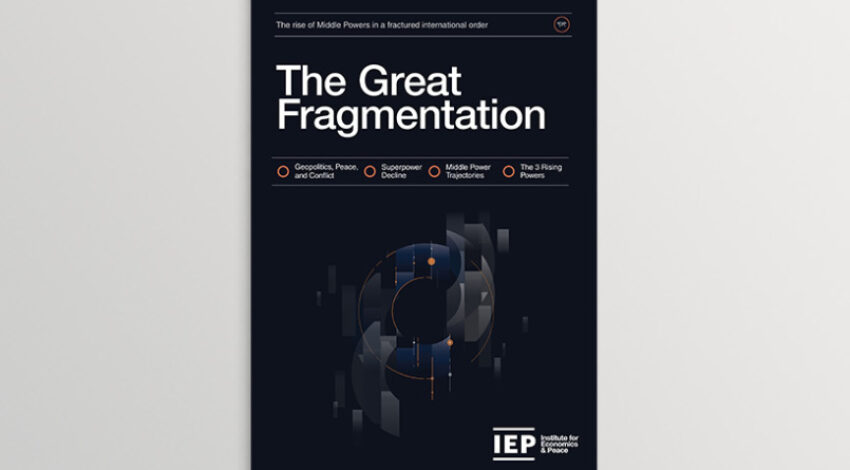
The report, The Great Fragmentation: The Rise of Middle Powers in a Fractured International Order, also finds that while the United States, China, Japan and major European economies have seen their relative global influence plateau or weaken, India is the only great power whose overall influence continues to expand.
The findings position India not as a rising middle power, but as a future-defining great power, whose strategic choices will play a decisive role in shaping global stability, trade and diplomacy in the decades ahead.
Geopolitical fragmentation now exceeds Cold War levels, superpower influence has plateaued since 2015, and the number of middle power nations has nearly doubled from nine in 1991 to 16 today.
Other than India, all great powers are experiencing a decline in their share of global economic output, the report notes, underscoring India’s unique trajectory in a rapidly changing global order.
The combined material capacity of middle powers now exceeds that of great powers. This is a structural shift, not a temporary fluctuation, and it will define global politics for the next two decades. – Steve Killelea, IEP Founder and Executive Chairman
Rising middle powers have rapidly expanded their diplomatic connectivity, narrowing the gap with great powers. As middle and emerging economies command a growing share of global GDP, superpowers are finding it increasingly difficult to shape their behaviour.
The report’s findings align with the need for middle powers to pursue strategic diversification. Canada’s announcement of 12 new trade and security agreements across four continents in six months reflects the hedging strategies IEP identifies among rising powers globally.
The era of choosing sides is over for middle powers. Our research shows that nations like the UAE, Türkiye and Indonesia are building influence by maintaining relationships with both Washington and Beijing while creating independent capacity for action. – Steve Killelea, IEP Founder & Executive Chairman
The report warns that fragmentation carries significant risks. Internationalised intrastate conflicts have nearly tripled since 2010, with middle powers increasingly involved as suppliers, mediators, or proxy supporters.
However, the report notes that the strategic positioning of middle powers also creates opportunities – their ability to maintain dialogue with multiple parties makes them essential for conflict resolution, as demonstrated by Türkiye‘s role in brokering the Black Sea grain deal.
Further reading:
Canadian PM Mark Carney's Davos Speech Aligns with New IEP Report on Middle Power Emergence.

France is the latest Western country to cut migration as mainstream political parties face threats from anti-migration, nationalist blocs that are...
The rise of Middle Powers in a fractured international order
Identifying and measuring the factors that drive peace