Development practitioners have long understood that programmes struggle to deliver lasting results in fragile or conflict-affected settings, yet the inverse receives far less attention; that strengthening the conditions for peace may be the most effective way to accelerate development outcomes across all sectors. This relationship is not incidental but foundational, and organisations that recognise it gain significant advantages in both programme design and impact measurement.
Research from the Institute for Economics & Peace demonstrates that countries with higher levels of peace consistently achieve better outcomes across health, education, economic growth, and environmental sustainability, with the relationship holding even when controlling for income levels and geographic factors.
The explanation lies in what IEP terms Positive Peace – the attitudes, institutions, and structures that create and sustain peaceful societies. These same factors – well-functioning governance, equitable resource distribution, high levels of human capital, free flow of information, good relations between groups, acceptance of others’ rights, low corruption, and a sound business environment – also happen to be the enabling conditions for effective development.
This convergence has profound implications for how development organisations approach their work. Rather than treating peace as a separate sector or niche concern, the Positive Peace framework reveals it as the connective tissue that determines whether investments in any sector will succeed and endure.
A health programme, for example, operating where governance is weak and corruption endemic faces fundamentally different challenges than one where these foundational conditions are strong, and addressing those underlying factors may prove more effective than increasing programme budgets.
The eight pillars of Positive Peace provide a comprehensive yet practical framework for understanding these dynamics, with each pillar empirically validated through analysis of more than 50,000 data points across 163 countries and refined over more than a decade of research. Critically, these pillars are interconnected – improvements in one area tend to generate positive spillovers across others, creating multiplier effects that amplify development investments.
Development practitioners need actionable insights into the conditions within communities that determine whether programme outcomes will endure.
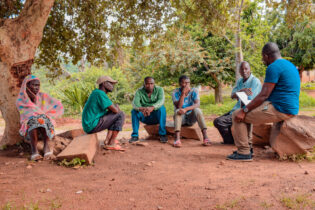
The Eight Pillars of Positive Peace can be translated into community-level indicators, capturing local governance quality, social cohesion, access to resources, human capital, and other factors that influence long-term resilience. Measuring these pillars allows organisations to understand whether project efforts are truly strengthening community impact:
Turning community-level insights into action involves more than measurement. Evidence-based approaches ensure that programme design, resource allocation, and reporting are all informed by reliable data.
Community assessments grounded in Positive Peace principles allow organisations to:
The challenge for practitioners has been translating this macro-level framework into actionable community-level measurement, and this is precisely what the Community Strength Barometer delivers. The Community Strength Barometer (CSB) exemplifies this approach, providing a rapid, standardised method for capturing community perceptions across all eight pillars. The CSB enables organisations to establish baselines, identify priority intervention areas, track progress over time, and demonstrate impact on the foundational conditions that determine whether development gains persist.
For organisations serious about delivering sustainable, meaningful outcomes:
For organisations seeking to integrate peace into their development approach, the pathway is now clear: measure the conditions that matter, target interventions where they will have greatest systemic effect, and demonstrate results in terms that reflect genuine community transformation rather than activity metrics alone.
Discover how the Community Strength Barometer can strengthen your peace-integrated development approach at CSB: See how it works.
Further Reading:

Analysing the factors that sustain peace.
Engage with the transformational Positive Peace program through research, workshops, education &...