The Global Terrorism Index (GTI) ranks countries by terrorism impact, using incidents, fatalities, injuries, and hostages weighted over five years to capture both the immediate and longer-term effects of attacks. This article explains how scores are calculated and scaled to compare countries...

The Global Terrorism Index (GTI) ranks 163 countries based on four indicators weighted over five years. A country’s annual GTI score is based on a unique scoring system to account for the relative impact of incidents in the year. The four factors counted in each country’s yearly score are:
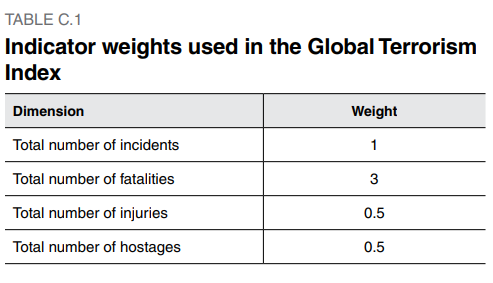
Each of the factors is weighted between zero and three, and a five-year weighted average is applied in a bid to reflect the latent psychological effect of terrorist acts over time. The weightings shown in Table C.1 were determined by consultation with the GPI Expert Panel.
The greatest weighting is attributed to a fatality.
To assign a score to a country, each incident is rated according to the four measures. The measures are then multiplied by their weighting factor and aggregated. This is done for all incidents and then all incidents for each country are aggregated to give the country score. To illustrate, Table
C.2 depicts a hypothetical country’s record for a given year
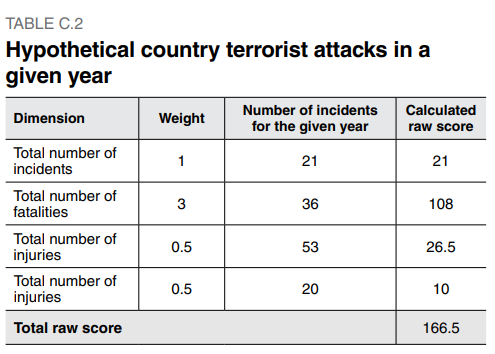
Given these indicator values, this hypothetical country for that year would be assessed as having an impact of terrorism of (1×21) + (3×36) + (0.5×53) + (0.5×20) = 166.5.
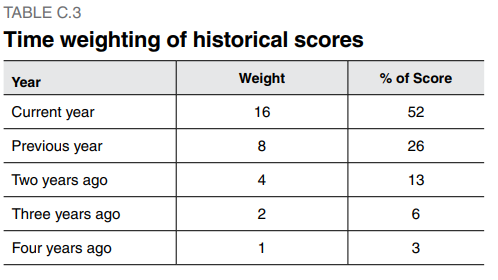
To account for the aftereffects of trauma that terrorist attacks have on a society, the GTI takes into consideration the events of previous years as having a bearing on a country’s current score. For instance, the scale of the 2011 terrorist attacks in Norway continued to have a psychological impact on the population for many years after the event. To account for the lingering effects of terrorism, the prior four years are also included in the scoring with a decreasing weight each year. Table C.3 highlights the weights used for each year.
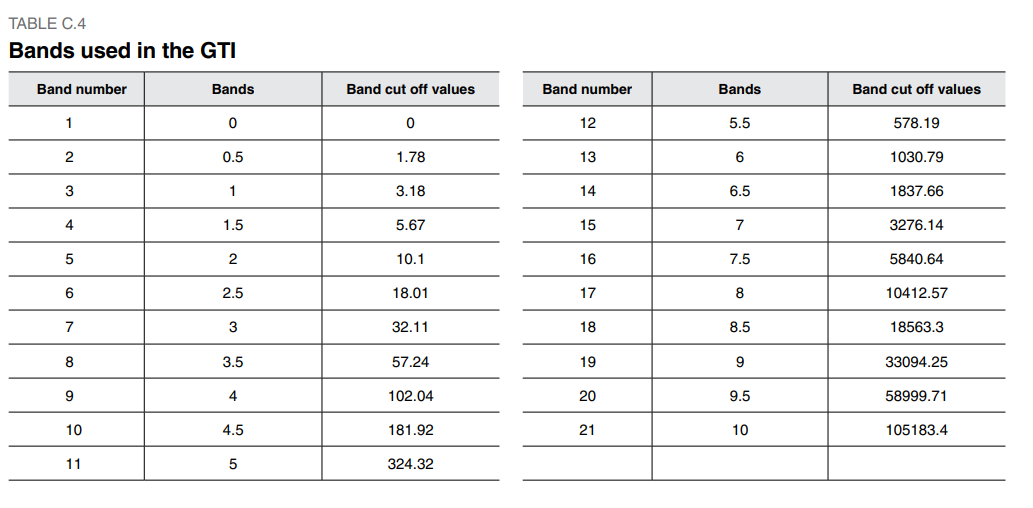
The impact of terrorism is not evenly distributed throughout the world. There are a handful of countries with very high levels of terrorism compared to most countries which experience only very small amounts of terrorism, if any. Hence, the GTI uses a base 10 logarithmic banding system between 0 and 10 at 0.5 intervals.
As shown in Table C.4,C.4 this mapping method yields a total number of 21 bands. This maps all values to a band of size 0.5 within the scale of 0-10. To band these scores, the following method is used:
This method produces the set of bands used in the GTI listed in Table C.4.

The number of countries recording a terrorist attack increased from 58 to 66, according to the 12th annual Global Terrorism Index (GTI). This...

The Sahel remains the global epicentre of terrorism, accounting for over half of all terrorism-related deaths in 2024 with the number of countries...

Measuring the impact of terrorism

Discover the current trends and patterns in terrorism around the world, the underlying geopolitical drivers and the impact of global conflicts.
Register Now