The four deadliest terrorist organisations, Islamic State, Jamaat Nusrat Al Islam wal Muslimeen, Tehrik e Taliban Pakistan, and al Shabaab, were responsible for a substantial share of deaths in 2025.
Each operates within a distinct regional context, yet they share common characteristics, including the ability to exploit instability, adapt to shifting conditions, and sustain operations over extended periods.
The Global Terrorism Index 2026 (GTI) shows that while deaths from terrorism declined by 28 per cent in 2025, a limited set of organisations remain responsible for the majority of fatalities. This concentration highlights the continued influence of entrenched militant actors, even as the overall global trend points downward.
IS remains one of the most globally recognised and operationally influential groups. Although its territorial control has diminished significantly since its peak, it continues to operate through a network of affiliates and provinces across multiple regions. Its activity is no longer concentrated in a single theatre, but dispersed across areas including the Middle East, sub Saharan Africa, and parts of Asia. This decentralised model has allowed the organisation to remain resilient despite sustained counterterrorism pressure.
The group’s ability to inspire and coordinate activity beyond its core areas of operation reflects a broader shift in how terrorist organisations function. Rather than relying solely on centralised command structures, Islamic State has fostered a loose network of affiliated groups and ideological supporters. This model allows for greater flexibility and reduces the vulnerability associated with hierarchical organisations.
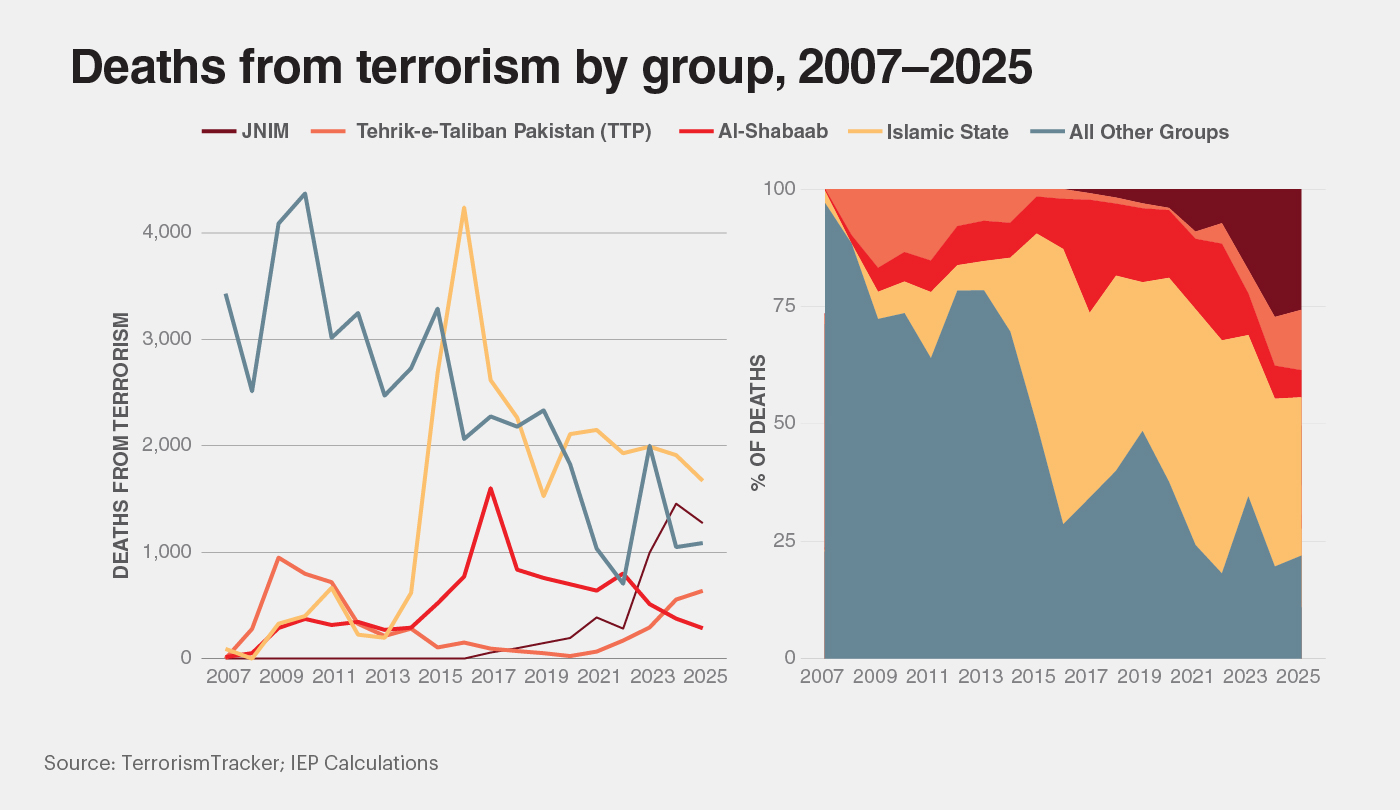
JNIM has emerged as a dominant force in the Sahel, where it operates across Mali, Burkina Faso, and neighbouring countries. Its growth reflects the broader expansion of militant activity in sub Saharan Africa, which has become the epicentre of global terrorism. The group has been able to embed itself within local contexts, leveraging grievances related to governance, security, and economic marginalisation.
The operational environment in the Sahel provides favourable conditions for groups such as JNIM. Porous borders, limited state presence, and complex local dynamics allow militant organisations to move across territories and sustain their activities. This has contributed to a steady increase in violence in the region over the past decade.
TTP has also experienced a resurgence, contributing to Pakistan becoming the country most impacted by terrorism in 2025. The group’s activity is closely linked to developments in neighbouring Afghanistan, where the return of the Taliban has altered the regional security landscape. Cross border dynamics have enabled the group to intensify its operations, highlighting the importance of regional factors in shaping the trajectory of individual organisations.
Al Shabaab continues to operate primarily in Somalia and the wider Horn of Africa, maintaining its position as one of the most lethal groups globally. Despite ongoing military pressure, the organisation has demonstrated a capacity to adapt and persist. Its operations extend beyond Somalia’s borders, and it continues to generate revenue through taxation, extortion, and other forms of economic activity.
The persistence of these groups reflects the broader relationship between terrorism and conflict. The majority of deaths attributed to these organisations occur in countries experiencing high levels of violence. This reinforces the finding that terrorism is most prevalent in environments characterised by instability, weak governance, and ongoing conflict. In such contexts, militant groups can operate with relative freedom and draw on local grievances to sustain recruitment.
At the same time, the structure and strategies of terrorist organisations are evolving. The decline of large scale, centrally controlled entities has been accompanied by the rise of more decentralised and networked forms of organisation. This shift is evident not only in the operations of Islamic State, but also in the broader ecosystem of extremist activity.
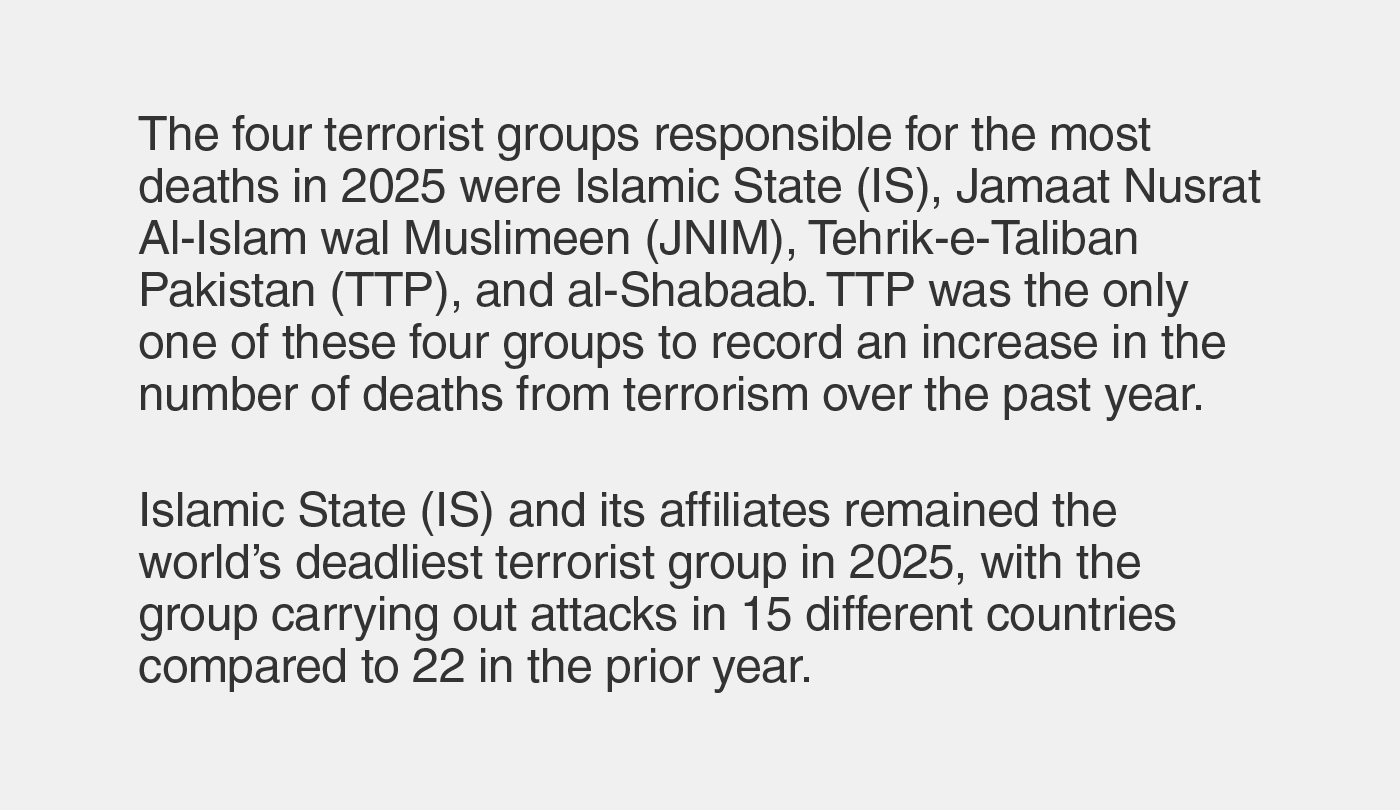
Affiliates and loosely connected groups play an increasingly important role in sustaining the overall level of violence. These actors may operate independently, but remain connected through shared ideologies, branding, and tactical approaches. This creates a more diffuse threat environment, in which the boundaries between organisations are less clearly defined.
The interaction between established groups and emerging actors further complicates the landscape. While the deadliest organisations continue to account for a large share of fatalities, smaller groups and individual actors contribute to a growing number of incidents. This is particularly evident in Western countries, where lone actors have become the dominant form of terrorism.
Over the past five years, lone actors have been responsible for the vast majority of fatal attacks in the West. Although these attacks often result in fewer casualties than those carried out by organised groups, their frequency and unpredictability present significant challenges for security services. The decentralisation of terrorism means that the influence of major organisations is now expressed not only through direct operations, but also through inspiration and ideological dissemination.
Technology has played a key role in this evolution. Digital platforms enable terrorist organisations to extend their reach beyond their immediate areas of operation, disseminating propaganda and engaging with potential recruits across borders. This has allowed groups to maintain relevance and influence even as their physical capabilities have been constrained.
The adaptability of the deadliest terrorist groups is a defining feature of the current landscape. These organisations have demonstrated an ability to adjust their strategies in response to changing conditions, whether through shifting geographic focus, adopting new tactics, or leveraging technological developments. This flexibility has contributed to their longevity and continued impact.
The concentration of terrorism among a small number of groups has important implications for counterterrorism efforts. Targeting these organisations can have a significant impact on overall levels of violence. However, the decentralised nature of contemporary terrorism means that disrupting one group does not necessarily eliminate the broader threat. New actors can emerge, and existing networks can reconfigure in response to pressure.
The GTI 2026 highlights that while global terrorism has declined, the underlying dynamics remain complex. The deadliest terrorist groups continue to shape the distribution of violence, operating within environments that enable their persistence and growth. Their influence extends beyond the areas in which they are directly active, contributing to a broader ecosystem of extremism that is increasingly interconnected.
Understanding the role of these groups is essential for assessing the future trajectory of terrorism. Their activities reflect both local conditions and global trends, illustrating how the concentration of violence among a small number of actors interacts with a wider process of fragmentation and change.
— Download the Global Terrorism Index 2026 Press Release
— Request a Media Interview
— View the Global Terrorism Index 2026 interactive map
Border regions have become central to the geography of modern terrorism, reflecting a shift in how and where violent activity is concentrated.
In the wake of the widening Iran conflict, the Global Terrorism Index 2026 warns that future trends in terrorism will be shaped by emerging...
Assessment of the current state of the Iran conflict through the lens of terrorism and the...