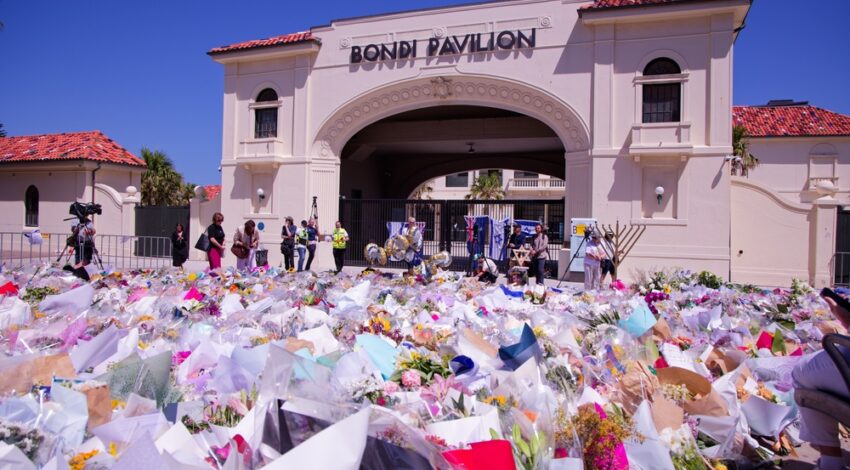
The recent terror attack at Bondi Beach in Sydney, my home city, has shaken Australia to its core. Fifteen people lost their lives at a Jewish community celebration, many more were injured, and the country has been forced to confront a sobering truth: even societies considered among the world’s most peaceful are not immune to sudden, devastating violence.
Australia remains one of the safest countries globally. Our homicide rate is low, our gun ownership levels are modest, and our terrorism impact, measured by the Global Terrorism Index (GTI), is far lower than in most nations. Yet two individuals, a father and son with legal access to multiple firearms and reportedly exposed to extremist Islamic State radicalisation, were able to carry out a coordinated attack that inflicted mass casualties within minutes.
The Bondi attack should not be dismissed as an isolated incident. Rather, it reflects a broader global trend: the rise of small-cell terrorism, in which two or a handful of individuals radicalise together, often within close social circles. These groups draw their inspiration not from formal extremist organisations, but from online ecosystems that merge personal grievance, ideological narratives and global conflict imagery.
This year’s Global Terrorism Index 2025 shows that more than 97 per cent of terrorism deaths occur in active conflict zones, especially in the Sahel, the Middle East and South Asia. But violence in Western countries is taking on a different form. Organised, hierarchical networks are less common; instead, terrorism in the West increasingly emerges from small groups or single individuals who self-radicalise, construct their own extremist frameworks and operationalise attacks using readily available weapons. However, extremists are not always radical Islamists; they can also be both far left or far right individuals with perceived grievances against society.
This raises a critical question:
What does it take to maintain peace in an era when violence can be both global in inspiration and hyper-local in execution?
The world is entering its most fragile period for international consensus since the end of the Second World War. According to the Global Peace Index 2025 (GPI), global peacefulness has declined in 13 of the past 15 years. There are now more active conflicts than at any time since the Cold War. International aid is shrinking, geopolitical competition is rising, and global goodwill is fragmenting.
We call this period the Great Fragmentation: a world where trust – between countries, communities and institutions – is breaking down. Our mechanisms for cooperation are weakening at the very moment when collective challenges such as climate change, economic inequality, mass displacement and rapid technological disruption require unprecedented collaboration.
When these pressures converge, violence becomes more likely, whether in conflicts abroad or in violent incidents at home.
One of the GPI’s 23 indicators is the ease of access to small arms and light weapons. The proliferation is staggering: more than one billion firearms are in circulation globally, of which around 85 per cent are held by civilians. Access to weapons does not automatically lead to violence, but it heightens the potential for it. Where Positive Peace – the attitudes, structures and institutions that sustain peaceful societies – is strong, the risks are mitigated. Where it is weak, weapons become a flashpoint.
Highly peaceful countries such as Iceland, Portugal, Singapore and New Zealand feature low homicide rates, low terrorism impact and relatively tight access to firearms. But the relationship is not universal. Switzerland and Finland, for example, combine high levels of civilian firearm ownership with high peacefulness, because they also maintain strong governance, low corruption, rigorous training and robust licensing systems. Their foundations for peace counterbalance the risks that guns introduce.
This nuance is crucial.
Weapons amplify the environment in which they exist. In cohesive societies with strong institutions, risk is contained simply by the social cohesion of society. In fragmented societies, the same weapons can turn local tensions into mass-casualty events.
Across Ukraine, the Middle East, and parts of Africa, Asia and Latin America, peace agreements are becoming harder to achieve. Conflicts are increasingly complex, fragmented and shaped by transnational networks, including arms trafficking, cyber operations and the spread of extremist ideologies online. Traditional diplomacy is struggling to manage conflicts that no longer have clear fronts, clear actors or predictable trajectories.
IEP’s research consistently shows that countries with strong Positive Peace are far more resilient.
They recover faster from conflict, experience fewer violent shocks and are more likely to sustain long-term stability. These societies also have better economic performance, higher measures of environmental sustainability and better development outcomes. Yet global investment in these foundational structures lags far behind the pace at which risks are rising.
Despite global deterioration, there is reason for optimism. Demand for evidence-based insights into peace has never been greater. Governments are increasingly adopting Positive Peace as measurement frameworks to guide strategy. Communities from Cambodia and the Philippines to Uganda, South Sudan and Australia are using the Positive Peace framework to strengthen resilience, rebuild trust and reduce the risk of violence before it emerges.
These steps matter.
Peace is not merely the absence of violence – it is the presence of systems that foster social cohesion, opportunity, effective governance and an environment where grievances can be resolved without bloodshed.
The coordinated attack at Bondi Beach is a tragic reminder of the fragility of peace, even in nations that feel distant from global conflict. It reflects the interconnected nature of modern violence: whether it be global extremist narratives circulating online, small-group radicalisation, or the role of accessible firearms.
Preventing similar attacks requires more than policing alone. It demands investment in social cohesion, community-based prevention, youth engagement, and the broader ingredients of Positive Peace. It requires rebuilding trust – between citizens, institutions and across the global community.
Peace does not arise organically. It must be nurtured, protected and continually renewed.
The Bondi attack shows what is at stake. But it also highlights the urgency of strengthening the structures that hold peaceful societies together.

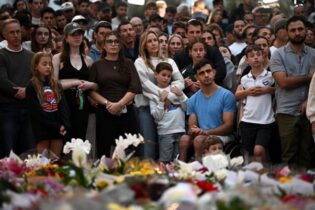
The terror attack on a Jewish celebration at Bondi Beach, inspired by ISIS and carried out by a father and son using legally-owned firearms, has...
Rising conflict deaths, accelerating geopolitical tensions, and middle power assertiveness are driving ‘The Great Fragmentation’ – a...
Identifying and measuring the factors that drive peace
Analysing the factors that sustain peace.