Around a quarter of the 1,248 players at the 2026 World Cup were born outside the country they are representing, the highest proportion ever recorded at a men's World Cup.
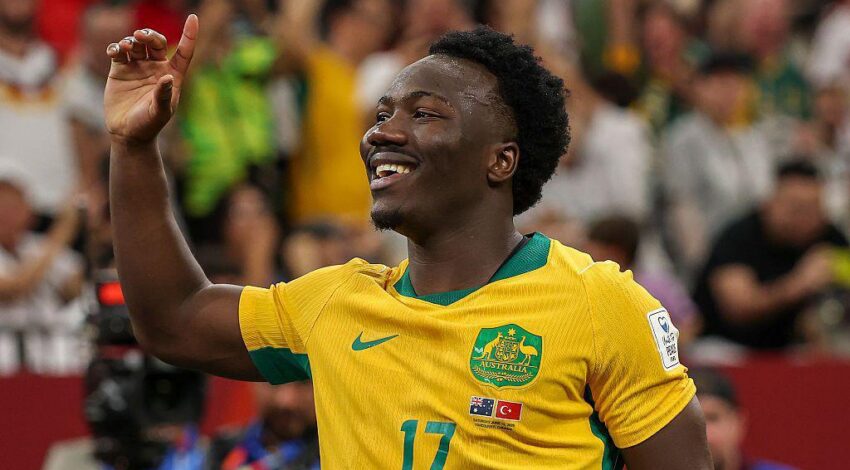
In the 27th minute of Australia’s opening match at the 2026 FIFA World Cup, Nestory Irankunda received a long pass, burst through the Turkish defence and finished calmly into the bottom corner.
At 20 years old, he has just become the youngest Australian player ever to score at a World Cup. He was also born in a refugee camp in Kigoma, Tanzania, to parents who had fled conflict in Burundi.
According to the 2026 Global Peace Index (GPI), Burundi ranks among the least peaceful countries in Africa, a country that has experienced cycles of ethnic conflict, political violence and mass displacement for decades. Tanzania, where Irankunda was born, hosted hundreds of thousands of Burundian refugees across multiple waves of displacement. His family journeyed from a camp in Kigoma to Adelaide in South Australia.
As a talented teenage footballer, he was recruited by one of the world’s most famous clubs, Bayern Munich in Germany, before moving to Watford in England in order to gain more match time to give himself a chance of being selected for his adopted country at the World Cup.
Irankunda’s teammate Mohamed Toure, who he met playing school sport, carries a parallel story. Toure was born in a refugee camp in Conakry, the capital of Guinea, after his Liberian parents fled civil war in 1990. They spent 14 years in that camp before a chance encounter with a Red Cross aid worker helped set their course for Australia. Toure arrived in Adelaide when he was seven months old. He is now 22, Norwich City’s leading striker in England, and best friends with Irankunda.
“It’s crazy to have us all here together from African background,” Irankunda said.
Australia’s 26-man squad for this tournament draws from at least 15 different cultural and ethnic backgrounds. In a country where nearly one in three people are born overseas, the squad reflects the nation that selected it. But while record numbers of Australians watched the broadcast of their national team’s famous first-up victory over Türkiye, on the same day that the nation began celebration of Refugee Week, ahead of World Refugee Day on June 20, it also comes against a backdrop of the rise of the populist radical right and anti-immigration One Nation party.
For nearly three decades, One Nation sat on the fringes of politics in Australia, a country that has long prided itself on multi-culturalism. But amid rising cost-of-living pressures and a global surge in anti-immigration parties, its popularity has climbed sharply, making it the major challenger to the ruling Australian Labor Party, a rise accelerated further by the Islamic State-inspired Bondi Beach terror attack in December 2025.
Against this backdrop, the Australian players wanted to take a stand and on the eve of the World Cup created a video to display their support and pride for the team, and the country’s, multi-cultural diversity. The current squad is represented by players with Italian, Burundian, Liberian, Turkish-Cypriot, Dutch, Zimbabwean, Scottish, South Sudanese, Serbian, and Sri Lankan backgrounds, among others.
“The Socceroos aren’t just a team. We are a reflection of modern Australia,” current Australian team vice-captain Jackson Irvine says in the video.
A message from the Socceroos ahead of their 2026 FIFA World Cup campaign. 🌏🏆Watch here
IEP’s World Cup and Peace tracks the peace profiles of every nation competing at the 2026 tournament, including a dedicated section on players born outside the country they now represent. The scale of this metric at this tournament is striking. Roughly a quarter of the 1,248 players at the 2026 World Cup were born outside the country they are representing, the highest proportion ever recorded at a men’s World Cup.
Morocco fielded the first ever starting line-up composed entirely of foreign-born players in their group stage opener against Brazil. Bosnia’s foreign-born contingent traces the refugee diaspora produced by the 1990s Balkan conflicts, with 17 players born elsewhere, including Germany, Austria and Sweden.
These patterns are, in large part, the physical residue of conflict. The 2026 GPI, published by IEP, found that global peacefulness has deteriorated for the 12th consecutive year. The number of active state-based conflicts has reached 61, a record high since the Index was first published in 2008. The deaths from internal conflict indicator recorded its largest single-year deterioration in the GPI’s history. Against that backdrop, the number of people forcibly displaced worldwide has also reached record levels.
The Christmas Truce of 1914, when soldiers from opposing sides of the First World War laid down their weapons for spontaneous games of football in No Man’s Land, has become football’s most enduring peace story. The 2026 tournament, playing out more than a century later before an estimated global television audience of five billion people, offers a different kind of peace story. That process is visible in the data on IEP’s fixture tracker, which maps every group stage match-up by GPI score across the three domains of Ongoing Conflict, Societal Safety and Security, and Militarisation.
From his parents fleeing civil war in Liberia to a safe home in Australia, Toure said simply making it to a World Cup for his family’s adopted country was more than he could have hoped for.
“If my dad can go to work and say, ‘Yeah, my son played at the World Cup’, for me that makes me happier than me playing in a World Cup,” he said.
Explore the peace profiles of every competing nation, including their GPI rankings across all three domains and the stories behind their foreign-born players, at Peace and the World Cup .
Let's Go
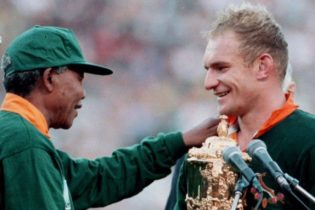
The 1995 World Cup final pitted South Africa against New Zealand in a stadium packed to capacity. Five minutes before the kick-off Mandela appeared...

"Sport, with its emphasis on fair play, teamwork, and respect, encapsulates these conditions, serving as a microcosm of a peaceful society," writes...
Identifying and measuring the factors that drive peace
Identifying and measuring the factors that drive peace