The killing of Nemesio ‘El Mencho’ Oseguera Cervantes, leader of the Jalisco New Generation Cartel (CJNG), marks the end of an era in Mexico’s criminal landscape. It may also mark the beginning of another.
As head of the CJNG – a heavily militarised criminal organisation that rose to prominence in the past decade through a violent national expansion campaign – El Mencho presided over one of the most aggressive periods of cartel conflict in modern Mexican history. The group became synonymous with territorial conquest, open warfare against rivals, and the rapid expansion of fentanyl and methamphetamine trafficking into the United States.
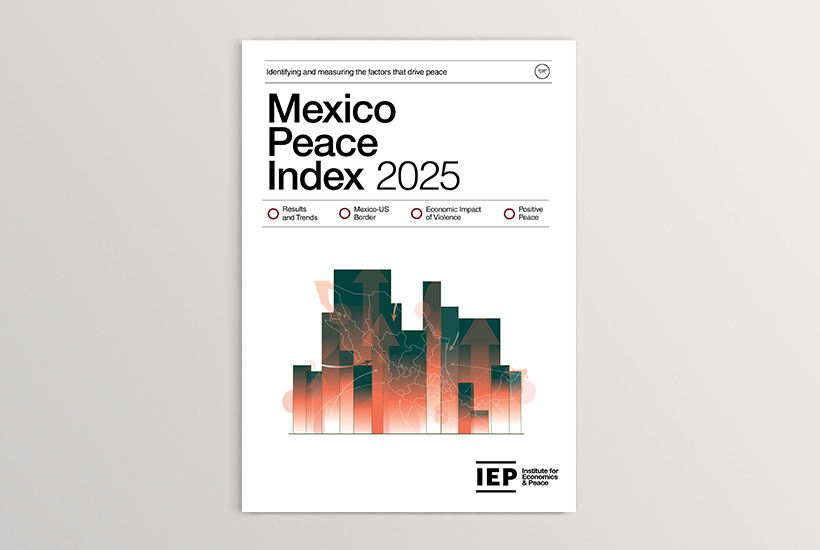
As documented in the Mexico Peace Index 2025, which tracks peace and violence in Mexico over more than a decade, this rise coincided with –and significantly contributed to – a dramatic deterioration in peacefulness across the country. More than 300,000 people have been murdered in Mexico in the past decade. Between 2015 and 2019, the national homicide rate climbed from 15.1 to 28.2 deaths per 100,000 people. This period overlapped directly with the CJNG’s expansion across Mexico.
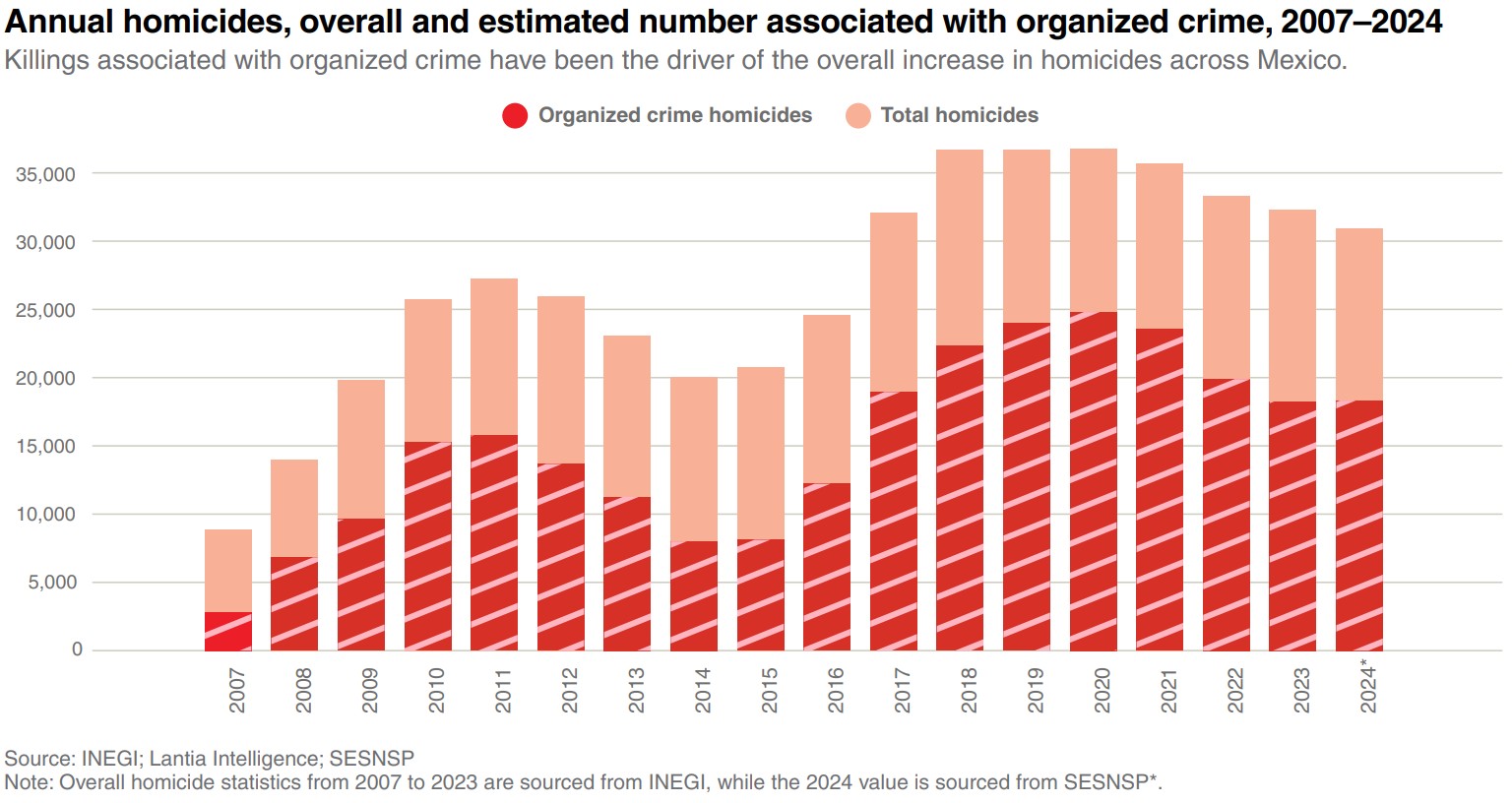
As shown in the above figure, organised crime has been the engine of Mexico’s violence crisis. The annual number of murders estimated to be linked to organised crime rose more than sixfold over the past two decades, from about 3,000 to about 18,000. In contrast, all other homicides doubled.
Violence trends in Mexico are not immutable; they respond to shifts in cartel power, alliances, recruitment capacity, and state strategy. And few groups have shaped those shifts more than the CJNG.
According to data from the Uppsala Conflict Data Program (UCDP), the CJNG has been associated with three out of four homicides from cartel clashes since 2016. The breakdown of an alliance between the CJNG and the Sinaloa Cartel in 2017 marked the beginning of a steep rise in cartel conflict deaths nationwide.
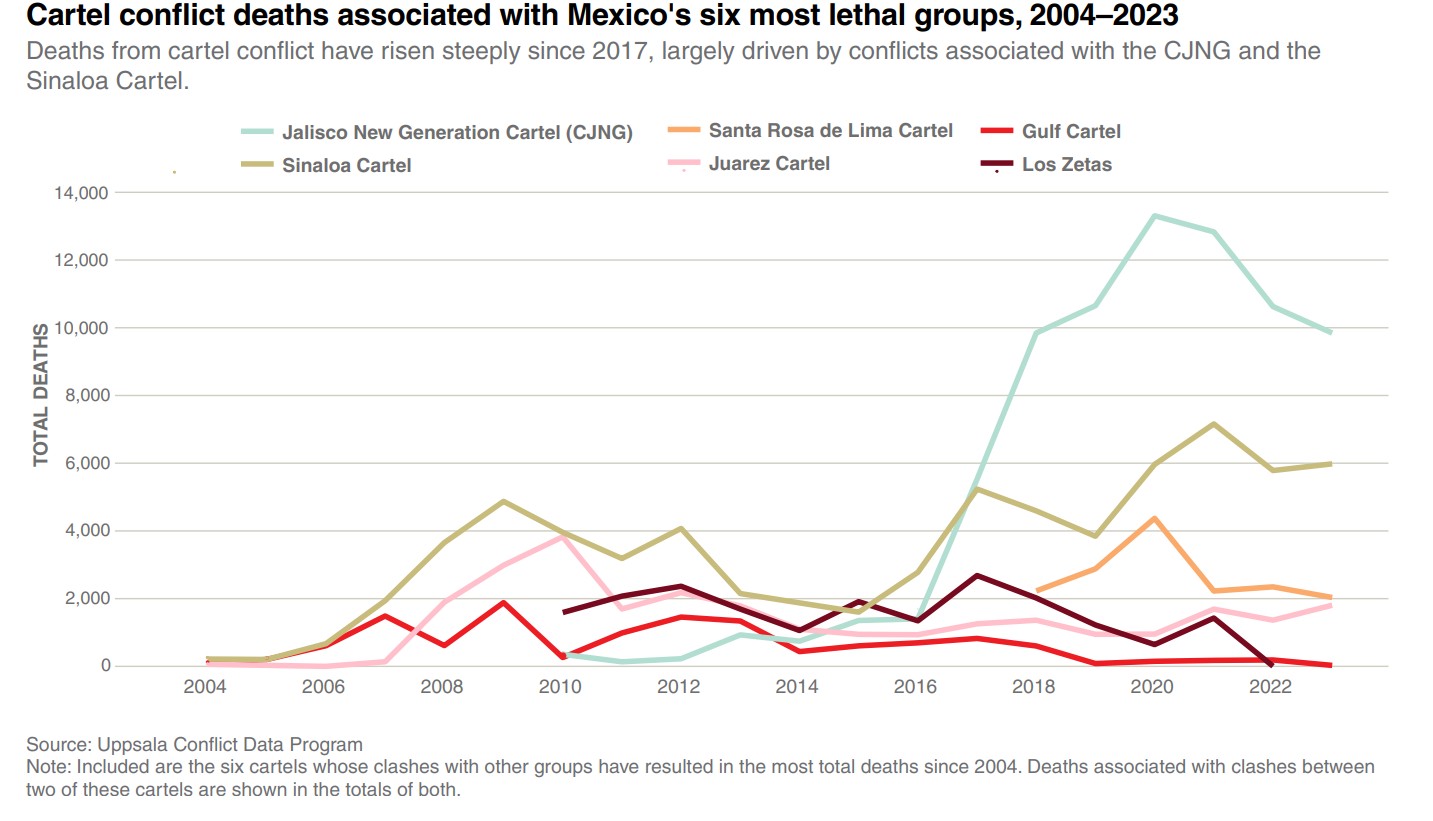
By the early 2020s, however, Mexico’s criminal landscape appeared to be entering a period of partial reconstitution. The CJNG and the Sinaloa Cartel had emerged as the two most powerful cartels in the country. As of 2022, these two groups were estimated to control 30 to 35 per cent of Mexico’s territory.
In some regions, cartel dominance has coincided with a degree of relative stability. Where criminal hegemony is firmly established, open confrontation may decline, even if criminal governance deepens. Jalisco and Sinaloa –strongholds of the CJNG and the Sinaloa Cartel – have at times seen comparatively infrequent incidents of political violence, suggesting that entrenched control can reduce overt conflict.
Nevertheless, turf wars and cartel violence, including cartel infighting, were far from over. For example, over the past decade, the Sinaloa Cartel has undergone internal fracturing. The 2016 arrest of Joaquín ‘El Chapo’ Guzmán triggered fissures within the organisation, producing two main rival factions – the Mayiza and the Chapitos. After years of tension, the July 2024 arrest of Mayiza leader Ismael ‘El Mayo’ Zambada, reportedly following a betrayal by the Chapitos faction, resulted in a dramatic escalation of rivalry. In September 2024, major armed clashes between the factions erupted in Sinaloa state. The fracturing raised serious questions about whether the cartel would continue to function as a unified entity.
As Sinaloa splintered, the CJNG appeared poised to consolidate a dominant national position. It expanded opportunistically into contested territories, from Zacatecas to Tabasco, where fragmentation among local groups fuelled record levels of homicidal violence. In Colima, a strategic entry point for precursor chemicals used to synthesise fentanyl, battles involving the CJNG helped drive homicide rates above 100 deaths per 100,000 people for three consecutive years.
Yet even amid this turbulence, the past five years have brought modest but noteworthy improvements in peacefulness at the national level. The homicide rate fell from its 2019 peak to 23.3 deaths per 100,000 people in 2023, remaining at that level in 2024, and declining much further in 2025 and the beginning of 2026.
The killing of El Mencho risks disrupting some of those gains.
Mexico has experienced the pitfalls of ‘kingpin’ strategies before and the parallels are hard to ignore. When the government launched its war on drugs in 2006, authorities prioritised decapitating criminal organisations by targeting their leadership. The result was not the disappearance of cartels but their fragmentation. Organisations splintered into smaller, often more violent groups. According to UCDP data, the number of criminal organisations involved in at least one death rose from just two in 2005 to 23 in 2023. Recorded incidents of cartel clashes surged from 173 in 2013 to 3,732 in 2021.
El Mencho’s grip over the CJNG was somewhat uniquely centralised and personalistic. Unlike other cartels featuring multiple power centres, the CJNG revolved more tightly around its leader. There is no clear successor with comparable authority. That uncertainty creates fertile ground for internal competition, splinter factions, and violent contests over lucrative trafficking routes, from Pacific ports handling fentanyl precursors to border corridors moving synthetic drugs north, along with an array of other criminal rackets.
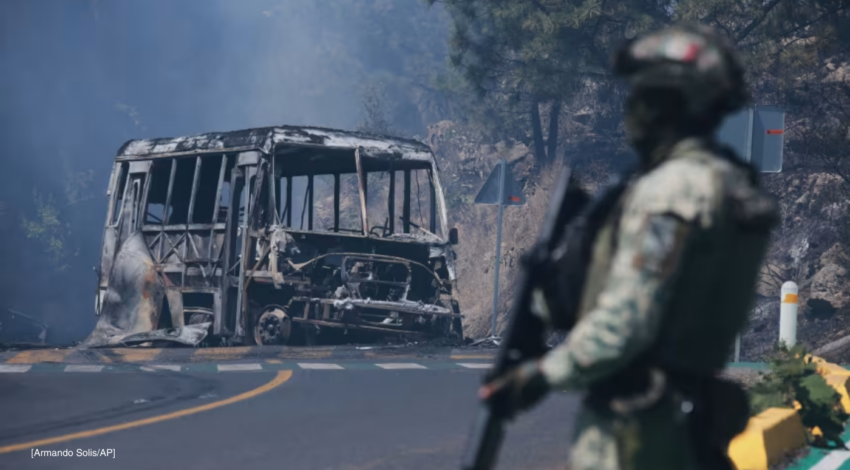
The immediate aftermath has already been volatile. The roadblocks, arson, and armed clashes across multiple states following the military operation that killed El Mencho are tragically familiar scenes. The deeper question is whether this moment will ultimately reduce violence or unleash another cycle of fragmentation and bloodshed.
The death of El Mencho represents more than the elimination of a fugitive. It is a structural shock to the criminal order that has shaped Mexico’s violence over the past decade.
If the CJNG fractures, Mexico could see a resurgence of the very turf wars that drove the dramatic deterioration in peacefulness in the late 2010s. If, however, a new balance of power emerges without widespread fragmentation, and Mexican security forces are able to capitalise on this major blow to one of the country’s most lethal organisations, recent peace gains could hold.
Mexico’s fragile progress toward greater peacefulness now faces its most consequential stress test in years.
Mexico has long struggled with organised crime, a complex issue that undermines the stability of its regions and communities. Despite efforts to curb...

Violent criminal organisations in Mexico are largely fuelled and financed by drug trafficking, with most of the supply destined for the United States...
Identifying and measuring the factors that drive peace
Identifying and measuring the factors that drive peace.