INTERVIEW: Two women leaders in the DRC, Aline Ngombo Eambela in Lotumbe and Irène Kabwang Nachikomb in Lualaba Province, explain how training in leadership, economic independence and Positive Peace is helping women build resilient communities from the ground up.
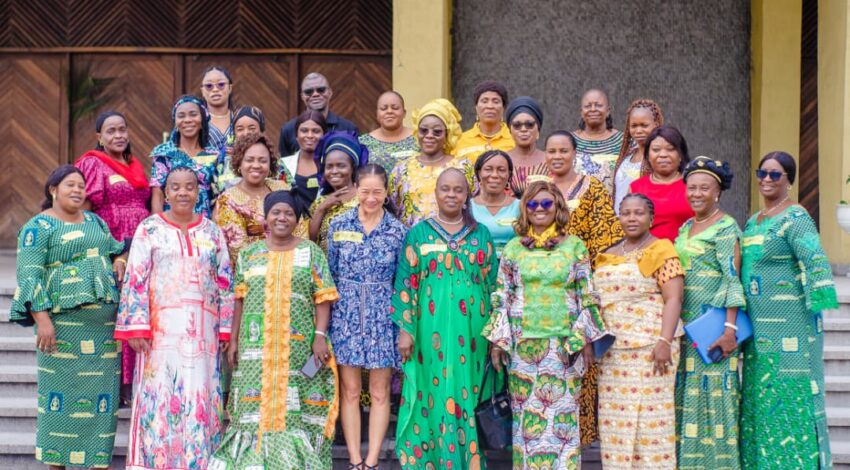
In Lotumbe, women now outnumber men in village savings and loan associations, ecological farming and other activities that earn an income. In Lualaba Province, in the country’s south, women’s cooperatives and community committees are giving women a seat at the same table as men and helping neighbourhoods resolve conflict without violence.
Behind this work are women like Aline Ngombo Eambela, who co-leads Debout (Rise Up) Lotumbe with Mandela Ekonyo, and Irène Kabwang Nachikomb, an epidemiologist who heads the Department of Women, Family and Children of the Church of Christ in Congo (ECC) in Lualaba.
The women church leaders from the ECC meet regularly with their respective community members through weekly Sunday church services where they have the opportunity to connect, to share and exchange ideas, address specific issues affecting women and their families, and to bring community members together to cooperate and collaborate on projects and initiatives that build peace and resilience in their communities.
Both took part in a Positive Peace training program in Kinshasa in April 2026, and both are now sharing what they learned with women in their communities.
In this interview, they talk about the challenges their communities face, from limited resources to gender-based violence, how Positive Peace has been received, and what they would tell decision-makers and communities elsewhere who want to build lasting peace.
Q. For people who don’t know the Women Church leaders training story, tell us about your backgrounds and how your organisations started?
Aline Ngombo Eambela: My journey began in 2022 when the Debout (Rise Up) Lotumbe committee selected me as a candidate for leadership and entrepreneurship training. Following this training, everything changed; Congo Leadership Initiative (www.congoleaders.org) entrusted us with the mission to train other young people, a task we continue to carry out to this day. Later, upon the arrival of a delegation from the General Secretariat of the Disciples of Christ Community in Congo, the former coordinator and his deputy resigned. The members of the Debout Lotumbe committee then chose us [co-leader Mandela Ekonyo and me] to take their place and lead the organisation. Thanks to the skills I acquired, I also had the opportunity to represent the Lotumbe community at a training programme focused on Positive Peace, held in April 2026 in the DRC capital, Kinshasa.
Irène Kabwang Nachikomb: I hold a master’s degree in public health, specialising in epidemiology. I am married, and I am a Protestant Christian in the United Methodist Church. I have been responsible for mentoring pastors’ wives and young women, and I have taken part in various trainings, including on HIV/AIDS care and family planning. I am currently head of the Department of Women, Family and Children of the ECC in Lualaba Province.
Last April in Kinshasa, we took part in the training on Positive Peace with (IEP Partnership Manager) Patricia Garcia. It was wonderful, and we are continuing to raise awareness of it among women.
The ECC’s Women and Family Department (DFF) was created in 1987 to promote the spiritual, social and economic well-being of women, and to protect and strengthen the family through Christian education, literacy, empowerment, support for vulnerable families and community development activities.
Q. What challenges do you and the community members you are training face?
Aline Ngombo Eambela: We face several challenges within the community. Foremost among them is the prevailing mindset; we have worked hard to convince others not to underestimate themselves, a goal we are now successfully achieving. A second challenge is the lack of financial and material resources needed to organise training sessions on a regular basis.
Irène Kabwang Nachikomb: The challenges we face include gender-based violence and domestic violence; social inequality, discrimination and the social gap; Illiteracy and poverty; failure to respect laws and rules; and a lack of resources to better support women and young girls.
Q. You’ve incorporated Positive Peace training. How has that worked out?
Aline Ngombo Eambela: We always aim to go further; our objective is to establish our vision throughout the entire Lotumbe ecclesiastical district and to ensure that all women are informed about the Pillars of Positive Peace, with the ultimate goal of fostering a complete transformation among women in the future.
Irène Kabwang Nachikomb: Integrating Positive Peace training is a good thing for our communities. It was well received, and the women asked for it to continue, because it puts women at the centre of the discussion and allows them to sit at the same table as men. Through these women, we are reaching, and will continue to reach, all levels of society by spreading the message.
Q. Your training empowers women leaders across the DRC to address inequality and build community resilience. Can you give some examples of how you try to achieve this?
Aline Ngombo Eambela: Yes, our training programmes empower women leaders to combat inequality and strengthen the resilience of our community. For example, in Lotumbe today, women outnumber men in activities such as VSLAs (Village Savings and Loan Associations), ecological agriculture and other income-generating activities. These are made possible through knowledge gained during various training sessions.
Irène Kabwang Nachikomb: We train women in economic independence and decision-making by helping them to create women’s cooperatives, manage small income-generating activities, save collectively, and participate in community decisions. As a result, women become financially stronger and take part in meetings and decision-making. This means they can contribute more to the stability of their households and to development.
In a neighbourhood facing family conflict, inequality between men and women or financial difficulties, a committee of women, men, young people and local leaders can be set up to organise community dialogues to raise awareness of equal rights, train women in mediation and conflict resolution, and involve women in decisions and set up a mutual support network. The results are less discrimination and gender-based violence, and greater participation. The community becomes fair and united, and able to solve its problems without violence.
Q. Your program connects women from across the vast and diverse DRC. How important has this network become?
Aline Ngombo Eambela: Our network is the Église du Christ au Congo’s Women and Families Department. We truly value this network. It is a great asset that opens doors for exchanging experiences and sharing with others.
Irène Kabwang Nachikomb: This network matters because it means all women will be able to build peace with confidence wherever they are. It is through women that we can reach most of the population – in the family, at the market, in the churches, and through children talking with their friends. As the saying goes, educate a woman and you educate the whole nation. Training a woman strengthens a family, empowering women strengthens the community, and strengthening the community builds lasting Positive Peace.
Q. If you could send a message to government or decision-makers about supporting communities like yours, what would it be?
Aline Ngombo Eambela: Our ongoing message is to strengthen safety by addressing violence against women.
Irène Kabwang Nachikomb: Involve all levels of a community or country in decision-making, without forgetting women and young people.
Q. What advice would you give to other communities around the world about building peace from the ground up?
Aline Ngombo Eambela: We encourage others not to give up, despite the difficulties they may encounter. Every woman should strive to support her community and her family through her actions. As the saying goes: I may not be able to change everyone, but if I change myself, everything around me can change.
Irène Kabwang Nachikomb: My advice would be to encourage dialogue, promote tolerance, involve young people and women in Positive Peace initiatives, strengthen solidarity, raise awareness of the values of respect, justice and non-violence, prioritise reconciliation, forgiveness and reparation after conflict, and act together.
Lasting peace begins when every member of the community becomes an actor.
Discover more through this short video:

"In Cambodia the Women Peace Makers are testing an alternative approach using IEP’s Positive Peace framework to move to a more holistic approach to...

Growing up in Ciudad Juárez, Mexico, I always knew I wanted to work on girl empowerment and the rights of women. I wanted to be an activist for...
Identifying and measuring the factors that drive peace
Identifying and measuring the factors that drive peace