The clean energy shift has made critical minerals strategic assets. Bridget Cameron, IEP Communications Intern, examines how this rising demand is colliding with weak governance and foreign competition, deepening existing conflict in the DRC.
The age of fossil fuels is slowly declining, and renewables are taking their place. This is the aspiration of the 2015 Paris Agreement, which presented a renewable future into a legally binding international framework, with the target of net-zero emissions by 2050. For this to occur, the energy market has had to dramatically change. This has been termed the ‘energy transition’ and is a shift that is already apparent. According to the ‘Statistical Review of World Energy’, renewable energy supplied 30% of the increase in the world’s total energy supply between 2016-2025, a marked change from the 5% it accounted for just two decades prior. However, there is a key difference between the new demand for critical minerals used for renewable energy versus other uses. This is that these minerals have been securitised due to the existential underpinning of the energy transition and, as such, are strategic beyond their pure export value.
The energy transition has resulted in a race to control the critical minerals required for renewable sources of energy, like lithium, cobalt and rare earth minerals. There is a geopolitical element to this transition, as these minerals can only be extracted from particular regions thereby making these regions more strategically important. An unintended consequence of this is that regions that already have institutional and political instability lack the capacity to effectively manage this demand to enhance developmental capacity. Instead, pre-existing problems are exacerbated through the increased value of critical minerals due to their association with conflict and dependence on foreign extraction. This is the case for the Democratic Republic of the Congo (DRC).
Conflict has been synonymous with the DRC for the last three decades. This was born from the legacy of the Rwandan genocide and has manifested in persistent conflict between the government’s Armed Forces of the Democratic Republic of the Congo (FARDC) and Rwandan-backed M23 rebels. The DRC globally ranked third last on the Institute for Economics & Peace‘s (IEP) Global Peace Index 2026 and last in the sub-Saharan region, as its ongoing conflict remains among the worst in the world and has contributed to a significant displacement crisis. As of September 2026, the UN indicated that the situation in the DRC continues to deteriorate, harming the security of its civilians. As a result, a barrier to peace in the DRC has been poor governance, one of the Eight Pillars of IEP’s Positive Peace framework. According to the World Bank’s Worldwide Governance Indicators the DRC scored lowest in the categories of government effectiveness and control of corruption, at 18.4 and 17.2 respectively out of 100. This indicates weak institutional capacity and makes the DRC particularly vulnerable to the ‘resource curse’, where countries fail to develop economically despite significant resource-wealth as they become dependent on attracting foreign investment.
Mineral wealth in the DRC has been historically tied to conflict. The concept of ‘conflict minerals’ is entangled with the DRC’s illegal mineral trade at the beginning of the century centred around the ‘3TGs’ (tantalum, tin, tungsten and gold), particularly used in electronics and automobiles. This was tied mainly to the Great Lakes region in central Africa where minerals were linked to fuelling conflict and human rights abuses, resulting in mineral tracking and monitoring of trade to avoid the involvement of armed groups in these practices. With the energy transition and increased demand for different types of minerals, notably cobalt and copper for the DRC, the country risks further mineral exploitation. According to the Resource Governance Index, the DRC ranks among the worst and is failing in the categories of revenue management and enabling environment.
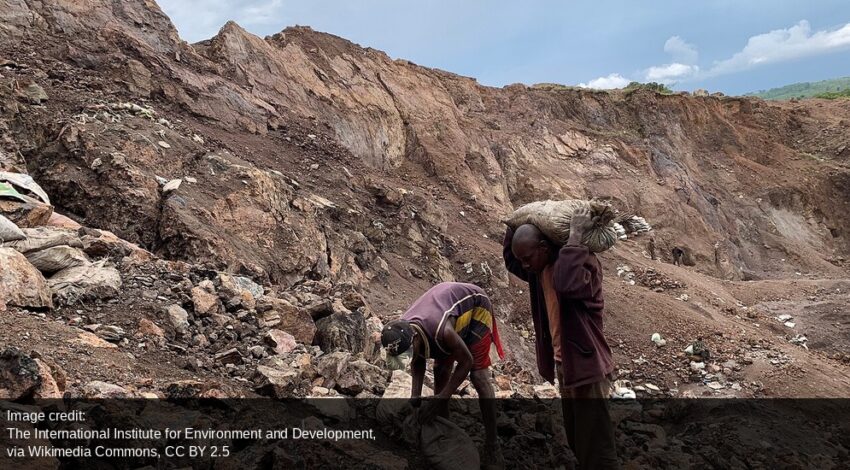
Mining is a significant part of the DRC’s economy, and this is a sector that is only growing. In 2024, the mining industry grew 12.8%, driven largely by copper and cobalt exports. Over 75% of the world’s cobalt is mined in the DRC, 51% of tantalum, roughly 13% of copper and 9% of refined copper. In 2024, the mining sector contributed 40% to its GDP and made up 71.1% of overall GDP growth. Mining is thus embedded in the DRC’s economy and, subsequently, its conflict is associated with control over resources. This is structurally important as it reconfigures power relations. research shows that mining expansion in the eastern region of North and South Kivu has deepened social vulnerability by further weakening governance in already fragile conflict-affected settings. According to the UN, North and South Kivu, as some of the most resource-rich regions in the world, are still the main site of clashes between FARDC and M23 forces as has historically been the case.
As the global demand for critical minerals increases, there is greater potential for this conflict historically associated with the 3TGs to spread further south into the copper and cobalt rich region in southern DRC. Simultaneously, the problems of weak governance and institutional capacity found in countries like the DRC will intensify and make it more difficult to build the conditions for peace. This is further exacerbated through the use of procedural, not structural methods to enforce transparency and accountability in global supply chains, making it difficult to regulate operations beyond company initiatives like Corporate Social Responsibility (CSR) and Social Licence to Operate (SLO).
Unlike refining, mining can continue regardless of the state of infrastructure, conflict and the economy. This is evident in the prevalence of artisanal and small-scale mining (ASM) operations in the DRC. Although likely underreported, it is currently estimated that 2 million people are involved in ASM practices in the DRC, accounting for about 20% of the country’s mineral output. Without strong regulation and governance, this source of mining and the informal market it creates is vulnerable to corruption, human rights abuses and illegal trade.
The fight for critical minerals is central to the internal conflict in the DRC, and it is an increasingly global concern given the energy transition towards renewables. As much as 80% of mines in the DRC are operated or owned by Chinese firms, with China also the destination country where 76.4% of it is refined. There is a clear asymmetry in wealth generation here, as the DRC lacks the capacity, due to poor institutions, to refine its own materials. The International Energy Agency (IEA) predicts that by 2030, 84% of cobalt will be singularly mined in the DRC, which it notes as a geopolitical risk. Cobalt is a key component found in batteries used for electric vehicles, a market that China dominates in manufacturing 75% of electric cars produced in 2025. The IEA also tracks this as an expanding market, with electric car sales growing in more than 90 countries in the first half of 2026, compared to the same time the year prior. This means that the energy transition positions the mineral wealth of the DRC as having global significance. Therefore, the current concentration of cobalt mining operations poses a threat to the country’s resilience against conflict as foreign powers seek to influence and control this mineral wealth as a strategic commodity.
This is just one facet of the challenges facing the DRC and similar countries with vast mineral wealth. If the energy transition were to cease in growth, conflict would likely still persist in the case of the DRC. It does, however, highlight the unintended consequences of the energy transition and the complicated nature of extractive economies, particularly that ‘clean energy’ is not divorced from some of the existing challenges in global supply chains. This is an important consideration in the era of ‘The Great Fragmentation’, where peace continues to deteriorate globally and conflicts become more frequent, which currently stand at their highest number since World War II. As these minerals become even more integral, control of resources is likely to influence existing conflicts and exacerbate their conditions.
The energy transition refers to the shift away from fossil fuels toward renewables, the aspiration behind the 2015 Paris Agreement's net-zero target by 2050. Renewable energy supplied 30% of the increase in the world's total energy supply between 2016 and 2025, up from just 5% two decades prior, driving sharply rising demand for the critical minerals, like lithium, cobalt, and rare earth minerals, needed to build renewable infrastructure.
Critical minerals can only be extracted from particular regions, making those regions more strategically important. Because of the energy transition's existential stakes, these minerals have been “securitised,” meaning they are treated as strategic assets beyond their pure export value, giving the countries and regions that hold them outsized geopolitical significance.
Mining is deeply embedded in the DRC's economy: in 2024, the sector grew 12.8%, contributed 40% to GDP, and made up 71.1% of overall GDP growth. Because mining is so central economically, conflict in the DRC has become tied to control over resources, reconfiguring power relations. Research shows mining expansion in North and South Kivu has deepened social vulnerability by further weakening governance in already fragile, conflict-affected settings, and these regions remain the main site of clashes between government forces and M23 rebels.
This pattern, sometimes called the “resource curse,” describes how countries fail to develop economically despite significant resource wealth, as they become dependent on attracting foreign investment rather than building institutional capacity. The DRC scored lowest among comparable countries in the World Bank's government effectiveness and control of corruption indicators, 18.4 and 17.2 out of 100 respectively, reflecting the poor governance that IEP identifies as a barrier to peace, one of the Eight Pillars of its Positive Peace framework. The DRC ranks third last globally on IEP's Global Peace Index 2026, underscoring how weak institutional capacity leaves its mineral wealth unable to translate into development or stability.
Yes. Regulations introduced by the EU in 2023 and 2024, the Battery Regulation and the Critical Raw Materials Act, increasingly require verifiable proof of environmental and governance standards before buyers will purchase minerals. Research on the DRC's mining sector warns that without institutional reform, it risks remaining indispensable as a raw mineral supplier while losing access to the most regulated, higher-value markets that now demand auditable compliance.

As the world transitions towards renewable energy, an unexpected consequence has emerged; intensified competition for natural resources. This shift...
The Institute for Economics & Peace (IEP) has launched its 19th annual Global Peace Index 2025 (GPI) in Nairobi, highlighting significant peace and...
Identifying and measuring the factors that drive peace
Identifying and measuring the factors that drive peace