A nursery school director in Cameroon is making the case that peacebuilding starts in the wrong place.
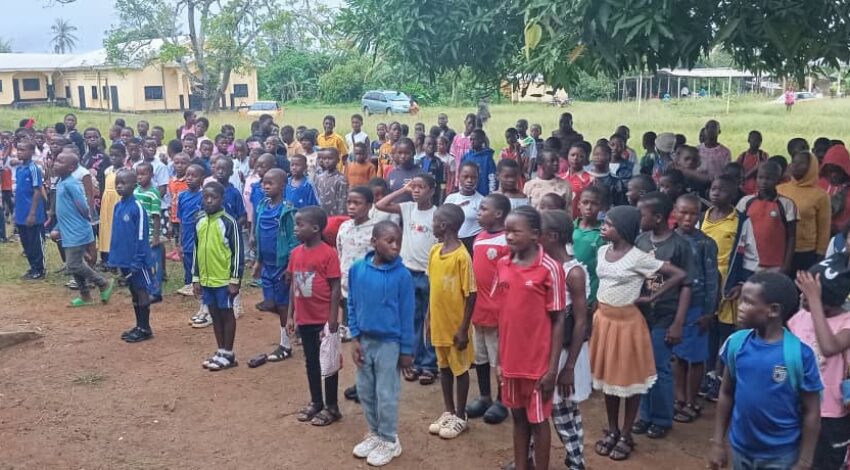
Akonjock Christina Arrah has spent 18 years teaching three to six-year-olds. After completing the IEP Ambassador Programme, she built a conflict resolution framework for nursery classrooms that is already changing how children in her community handle disagreement.
Peacebuilding tends to show up after things have gone wrong. Post-conflict programmes, adult mediation, state-level negotiations: the infrastructure of international peace work is largely built around fixing problems that already exist.
Akonjock Christina Arrah thinks that is too late.
A nursery school teacher and director with the Ministry of Basic Education in Cameroon, Akonjock has spent 18 years watching children between the ages of three and six learn, fight, share and grow. What she noticed, across nearly two decades in the classroom, is that the habits which drive conflict in adults are not adult problems. The inability to name emotions, the refusal to consider another person’s perspective, the instinct to take rather than negotiate: these are learned, or not unlearned, in early childhood.
“The nursery classroom is where the software of life is installed. If we want a more peaceful world, we have to start there.” – Akonjock Christina Arrah, IEP Ambassador; English Teacher – Ministry of Basic Education, Cameroon
After completing the Institute for Economics and Peace (IEP) Ambassador Programme, Akonjock spent time working out how to translate the Positive Peace framework, designed for use at the level of nations and institutions, into something usable in a room full of four-year-olds.
The result is the Nursery Mediation Engine, a three-tier classroom methodology she developed and has been refining ever since.
At age three, the focus is on emotional vocabulary. Before children develop the habit of hitting or grabbing when frustrated, teachers work with them to name what they are feeling. “I feel invisible.” “I feel crowded.” “I am frustrated.” The idea is straightforward: if a child can verbalise a feeling, they are less likely to act it out physically.
At ages four and five, the framework introduces the Three-Step Playground Dispute Loop. When two children fall out over a toy or a space, the teacher does not step in and decide who was right. Instead, each child has to say what they think the other child is feeling, suggest at least one compromise and then reach a mutual agreement. The teacher is there to keep the process moving, not to deliver a verdict.
By age six, Akonjock takes a different approach. She tracks which children repeatedly clash with each other and deliberately pairs them on collaborative tasks. The point is not to punish either child or force a friendship. It is to give them a shared experience of working together before an adversarial dynamic becomes fixed.
Akonjock has been tracking outcomes across her school community for years. The data is qualitative (this is classroom observation, not a controlled trial) but she notes that the patterns are consistent.
Children supported by the framework are observed to handle their own disputes independently by age six, without needing teacher intervention. Chronic bullying behaviours drop as teachers found that a great deal of routine playground friction was being resolved by the children themselves, also reducing classroom time spent on behavioural management interventions.
At the school level, Akonjock found that embedding peace metrics into how the school operated day to day also changed the dynamic between parents and staff. When an incident occurred, the conversation shifted away from blame and towards how the child was developing.
She has since taken the model further. Children’s Peace Clubs now operate across her school community, and she runs ongoing Parent-Teacher Association (PTA) Peace Talks to train parents and primary school teachers in non-violent mediation. These initiatives now sit under a formal structure: the Young Peacemakers Organisation (YPO), founded to nurture peacebuilding values, conflict resolution and civic responsibility in children from an early age. YPO is set to launch officially in Cameroon in July 2026, with a special address from its appointed Children’s Ambassador for Peace.
Akonjock is not just describing what works in her school. She is making a structural argument about where international peacebuilding resources should go.
If the behavioural patterns that drive conflict are set during early childhood, then strategies that only intervene at the adult stage are working against themselves. She is calling on international development organisations, national ministries of education and global security funds to treat early childhood infrastructure as a long-term security investment and to require Positive Peace frameworks within standard preschool curricula and nursery director certification.
The IEP framework, she says, gave her the language to connect what she was already seeing in the classroom to a global conversation. What she built with it is something any nursery teacher, anywhere, could pick up and use.
Are you interested in becoming an ambassador for peace? Sign up to express your interest in the IEP Ambassador Programme.

Amid mounting economic and environmental pressures, the Bimbia-Bonadikombo Community Forest in Cameroon faces significant challenges. Elsie Fonyi...
While nations focus on spending on defence, a network of quiet changemakers is growing, people at the grassroots who refuse to accept conflict as...
Identifying and measuring the factors that drive peace
Engage with the transformational Positive Peace program through research, workshops, education &...