Empowering 30 women leaders across the DRC, this Positive Peace training equips communities with tools to address inequality, build resilience, and drive sustainable peace.
The descent into Kinshasa is always striking.
From above, the vastness of the Congo River stretches like a lifeline, winding past a city alive with energy, movement, and resilience. But beneath that vibrancy lies a more complex story, one shaped by decades of conflict, inequality and the enduring strength of communities determined to build something better.
This was the setting for the Congolese women leaders training in Positive Peace.
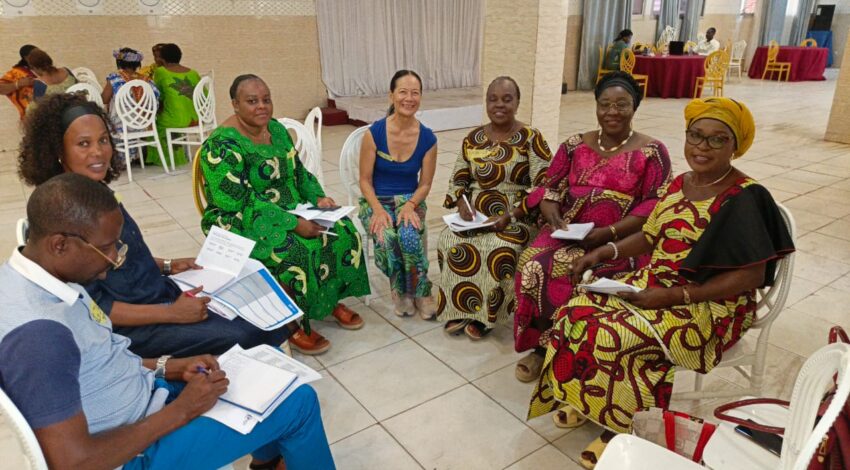
The training brought together 30 women leaders from 24 provinces across the Democratic Republic of the Congo. They arrived with stories of their communities, their struggles and their hopes. Most were church leaders, others community facilitators, youth leaders, or heads of women’s groups. All carried influence. All carried responsibility.
The workshop was hosted at the Centenaire Cathedral in Kinshasa, a symbolic space, both spiritual and communal, perfectly suited for conversations about peace, justice, and transformation. From the very beginning, the atmosphere was not one of passive learning, but of shared ownership. This was not about delivering knowledge, it was about unlocking it.
The first day began simply, with a question: “What is peace? ” The answers were anything but simple. Some spoke of the absence of violence. Others described dignity, justice, or the ability to provide for their families. As stories unfolded, it became clear that peace, in this room, was deeply personal and deeply political.
IEP’s concept of Positive Peace was introduced not just as the absence of conflict, but as the presence of systems and structures that create and sustain peaceful societies.
The eight pillars of Positive Peace became a framework through which participants began to reinterpret their daily realities. Suddenly, issues like corruption, inequality, and lack of opportunity were no longer isolated problems – they were interconnected pieces of a larger system.
A role-play exercise brought this to life. Participants acted out a fractured community attempting to rebuild trust. The lesson was clear: Peace is not built alone, it is built together.
If day one was about understanding, day two was about feeling.
The “Privilege Walk” activity was one of the most powerful moments of the training. Participants physically stepped forward or backward in response to statements about opportunity, access and life experience. By the end, the room was no longer a single group, it was a visible map of inequality. Silence followed. Then reflection. Then conversation.
This activity opened the door to deeper discussions about equity, justice, and the distribution of resources, core elements of Positive Peace. It also reinforced something essential, sustainable peace cannot exist where inequality is ignored. One of the two men who participated in the workshop, Jacques, said: “I really learnt a lot from the privilege walk”.
Later, in the “Yarn Game” activity, participants held strands of rope, creating a physical web that connected everyone. When one person moved, the entire structure shifted. The message was unmistakable: the eight pillars of Positive Peace are interconnected and every action affects the whole system.
By the third day, the energy in the room had shifted. The conversations were no longer theoretical they were practical, focused, and forward-looking. Participants began designing real community projects, rooted in the challenges they face daily:
Using tools like context analysis, stakeholder mapping, and planning frameworks, each participant developed a concrete proposal. These weren’t abstract ideas, they were actionable plans, grounded in the realities of their communities in their provinces. By the end of the day:
Perhaps the most significant outcome wasn’t just knowledge or skills, it was connection. Women from across the vast and diverse country of the DRC had formed a network. They shared phone numbers, ideas and commitments. They pledged to support each other, to collaborate, and to carry the work forward.
This is where the real impact begins. Because each of these 30 women is not working alone. Each represents a community, a church. a network, enabling a ripple effect. In contexts like the DRC, investing in women leaders is not just important, it is strategic. These women are:
When equipped with the right tools, they don’t just implement projects, they transform systems. This training was a reminder that leading on peace is not an abstract concept. It is lived, negotiated, and sustained at the community level, often by women whose leadership goes unrecognised, but whose impact is undeniable.
As the training concluded with a certificate ceremony, there was a sense of accomplishment but also urgency. The real work lies ahead:
It is built over time, through relationships, through action and through the quiet determination of women leading on peace.
On behalf of IEP, I gratefully acknowledge the generous support and partnership of Department de Femmes et Famille (DFF) of the Eglise du Christ au Congo (ECC), Emalyn Foundation, Rotary and HandUp Congo, whose funding and commitment made this training possible.
The training was conducted from 30 March to 4 April.
Identifying and measuring the factors that drive peace
Analysing the factors that sustain peace.