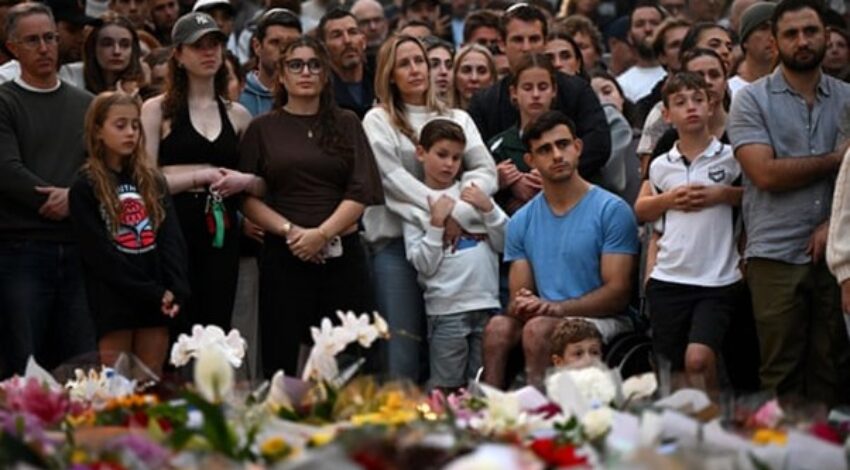
The terror attack on a Jewish celebration at Bondi Beach, inspired by ISIS and carried out by a father and son using legally-owned firearms, has shocked Australians and reopened questions on gun laws, and the wider relationship between gun ownership and peace.
Many Australians believed they had confronted their gun ownership concerns in the aftermath of the Port Arthur mass shooting in 1996, the country’s deadliest in modern history, which left 35 people dead.
Now, in the wake of Australia’s deadliest terror-related attack at its iconic Bondi Beach on December 14, 2025, which left 16 dead including one of the two gunmen, Australian governments are once again vowing to further tighten gun ownership laws.
While Australia’s overall terrorism impact and gun ownership remains low by global standards, two individuals with legal access to multiple firearms, and reported Islamic State training and radicalisation, were able to inflict mass casualties in minutes at a community celebration.
The most comprehensive global snapshot of firearms comes from the Small Arms Survey. It estimates that of more than one billion firearms in global circulation, around 857 million or about 85 per cent, are in civilian hands, with the remainder split between militaries and law-enforcement agencies. The distribution of these weapons is heavily skewed: civilians in the US are estimated to own around 393 million firearms, roughly 120.5 guns per 100 residents, almost half of the world’s civilian stock.
The same data suggests that Australia has about 14.5 firearms per 100 people, placing it in the middle of the global rankings and well below many European and Latin American states such as Canada (34.7), Finland (32.4) and Uruguay (34.7). At the other end of the scale, countries like Japan and the United Kingdom have fewer than five civilian firearms per 100 residents, reflecting a long-standing culture of tight regulation and limited civilian access.
Australia’s modern gun-control story begins with the Port Arthur massacre, which led to the National Firearms Agreement, banning most semi-automatic rifles and shotguns and funding a large-scale buy-back. Those reforms contributed to a dramatic fall in gun deaths and the absence of mass shootings for more than two decades. One analysis found that the gun homicide rate in the US is around 62 times higher than in Australia, underlining how restrictive firearm regimes can reduce lethal violence even in societies with similar levels of economic development.
Yet Australia today is far from gun-free, averaging four guns per licence holder, with the share of households owning a gun falling even as the number of guns per owner rises. It’s estimated the nation has over four million legally owned guns, roughly one for every seven Australians – about 25 per cent more than in 1996. And a relatively small group of licence-holders own very large arsenals, with the top 100 licence-holders in the state of New South Wales alone collectively owning more than 13,000 firearms.
Australian authorities confirmed one of the alleged Bondi gunmen held six firearms on a standard recreational licence, despite concerns about his son’s prior contact with intelligence agencies. This has raised questions about how effectively firearm licensing systems incorporate national-security risk assessments and whether current limits on the number and type of guns are fit for purpose. In response, the National Cabinet has signalled a new round of reforms, including caps on the number of firearms per person, restricting licences to citizens, accelerating a national firearms registry and tightening the reasons for owning high-powered rifles.
The Institute for Economics & Peace’s Global Peace Index (GPI) ranks 163 countries on their level of peacefulness using 23 indicators. One of those indicators is the ease of access to small arms and light weapons, which sits alongside measures of homicide, terrorism, violent crime and political instability.
In broad terms, GPI trends show that countries with high levels of peacefulness, such as Iceland, New Zealand, Portugal and Singapore, tend to combine low homicide rates, low terrorism impact and relatively restricted access to firearms. Countries experiencing protracted conflict, like Ukraine, Russia and the Democratic Republic of the Congo, have seen a deterioration in their peace scores driven in part by the proliferation of firearms from conflict zones, which fuels arms trafficking, gang violence and broader public insecurity.
However, the relationship is not mechanical. Some states combine high gun ownership with relatively high peacefulness. Switzerland and Finland are often cited examples, but they are underpinned by strong institutions, low corruption, mandatory training regimes and comparatively robust licensing systems. These countries have stronger Positive Peace – the attitudes, institutions and structures that sustain peaceful societies – which mediates the risks posed by civilian arsenals
The Global Terrorism Index 2025 (GTI), also produced by IEP, highlights that more than 90 per cent of terrorism deaths occur in active conflict zones, particularly in the Sahel, the Middle East and South Asia. For these regions, firearms are part of a broader ecosystem of violence that includes explosives, improvised devices and heavy weapons. An earlier GTI-based breakdown found that explosives accounted for about 60 per cent of attacks, with firearms used in roughly 30 per cent and other weapons making up the remainder.
In the West, by contrast, terrorism is much rarer but highly salient. The GTI 2025 notes that lone-actor and small-cell terrorism is on the rise in Western countries, with attacks increasing from 32 to 52 in 2024. Many of these attacks are carried out by young people radicalised online, constructing personalised extremist ideologies rather than joining formal organisations. Easily accessible firearms can be the decisive factor that turns a grievance or extremist fantasy into a high-casualty event, a combination that appears to have been part of the Bondi Beach attack.
Access to firearms is a risk amplifier: where institutions are weak, corruption is high and social grievances are acute, large civilian arsenals increase the likelihood that disputes escalate into lethal violence and that terrorist actors can acquire weapons.
Institutions and norms matter as much as the law on paper: high-peace, high-gun countries tend to have stringent licensing, strong enforcement, low general criminality and high trust in institutions – elements associated with stronger Positive Peace. Where these are absent, similar levels of gun availability produce very different outcomes.
Concentration of guns in a small number of hands carries its own risks: Australia’s experience shows that overall prevalence of guns can rise even while the number of licence-holders falls, creating pockets of high weapons concentration. That complicates policing, increases the stakes of theft or diversion, and can allow a single individual to mount attacks of far greater scale.
Terrorism risk is shaped by online ecosystems as much as by hardware: GTI 2025 highlights the growing role of online radicalisation and hybrid ideologies, particularly among youth in the West. Limiting access to firearms cannot address the root causes of radicalisation, but it can reduce the lethality of attacks when they occur.
Compared with many high-income peers, Australia remains a relatively safe country with low levels of firearm violence and terrorism. But it is a reminder that gun policy is not a one-off event; it is a continuous process of adapting regulation, enforcement and information-sharing to evolving threats.
From a peace-research perspective, the most effective response will combine intelligence integration through cross-agency cooperation and stronger national data systems with targeted tightening of weapons access, especially around high-risk individuals and high-capacity weaponry. It will also include investments in the broader pillars of Positive Peace such as acceptance of the rights of others, well-functioning government, good relations with neighbours, and low levels of corruption.

The number of countries recording a terrorist attack increased from 58 to 66, according to the 12th annual Global Terrorism Index (GTI). This...
Islamic State (IS) and its affiliates remained the deadliest terrorist organisation in 2024, responsible for 1,805 deaths across 22 countries.
Identifying and measuring the factors that drive peace